About the Journal
Biocenosis is a Centro de Educación Ambiental’s six-monthly publication (January-June/July-December) from Universidad Estatal a Distancia de Costa Rica (UNED), which has been edited since 1979. Currently, the magazine has the ISSN: 1659-4991 for its online version and the ISSN: 0250-6963 for its printed version, a format that is used only for the publication of extraordinary numbers.
- San José, Costa Rica. De la rotonda la Betania 500 m este, carretera a Sabanilla, Mercedes de Montes de Oca.
- Teléfono: +506 2527-2000
- Contacto: revistabiocenosis@uned.ac.cr
The scientific magazine´s purpose is to contribute with the process from awareness to taking action through environmental education. This one is addressed to educators, high school students and environmental managers. A relevant characteristic is to publish articles written on simple language without losing scientific accuracy which has positioned the magazine as a paper that contributes to disclose scientific information available for general public.
Announcements
Current Issue
Vol. 37 No. 1 (2026): Biocenosis. Revista Ambiental. Enero-junio. Centro de Educación Ambiental- UNED
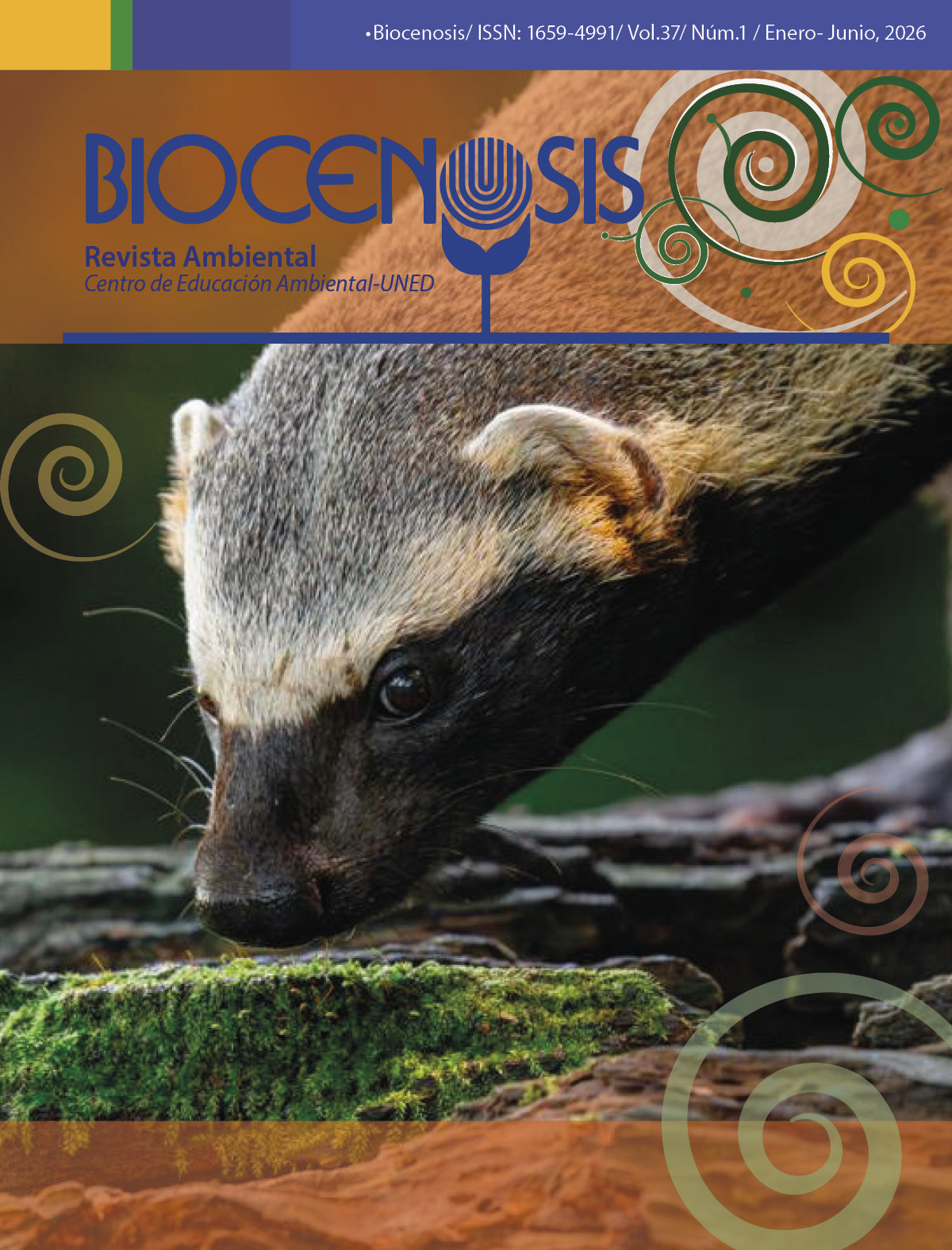
We invite you to read these valuable contributions, which we hope will strengthen and update your knowledge while promoting the visibility and dissemination of innovative experiences that continue to enrich environmental work in our country.
Cover photograph: Photograph by Leonardo Borges. Galictis vittata (greater grison). Las Pumas Rescue Center and Sanctuary, August 2024.
Published:
2026-06-30
Cover - Editorial
Articles
Ensayo científico
The journal accepts scientific articles, scientific essays, and systematization of experiences. In addition to bibliographic reviews, biographies of prominent scientists in the lines of publication, reproductions, and teaching guides that represent a resource that facilitates the process of awareness, understanding, and learning of a particular topic.
Contributions will be evaluated by members of the editorial committee or by external experts in a double-blind peer review, depending on the subject matter and format of the text submitted for evaluation.
All published works can be downloaded freely and can be used and reused, respecting the authorship and for non-commercial purposes, in accordance with the Creative Commons Attribution-NonCommercial 4.0 International license.

Biocenosis is currently included in the following information systems:
Indexes (with evaluation):

Latindex
Repositories:

UNED Journal Portal

Kímuk: National Repository of Costa Rica
Search engines:

Google Scholar
Directories:

Cultural Information System of Costa Rica (SICULTURA)
We invite you to visit our social media pages:
Brief historical overview of the journal
The journal Biocenosis has a rich history dating back to the 1970s and 1980s, when it was conceived as part of the Environmental Education Program led by Mario Boza at the State Distance University (UNED), now known as the Center for Environmental Education (CEA). During that period, the magazine took off strongly and contributed significantly to the recognition of UNED in the environmental field, thanks to its visionary contributions to this emerging topic.
When it was first launched in 1979, Biocenosis was a monthly newsletter aimed at educators, students, and the general public. Its pages reported on the environmental situation at the time and the growing concern for the conservation of natural resources in the country. However, it also addressed topics such as the use of medicinal plants, environmental education, and the preservation of biodiversity. In its early months, the magazine adopted a foldable format, but later it was decided to produce it in “offset” editions, which allowed for the inclusion of photographs, a new design, and greater typographical clarity. In 1979, the frequency changed from monthly to quarterly and, finally, to biannual in 1981.
The year 1982 marked an important milestone, as the newsletter was transformed into a magazine. This new format had a major impact and reach in various Latin American countries. Today, the magazine continues to promote the reading and analysis of a wide range of topics related to environmental education. It offers its readers new thematic lines that complement and enrich this field, which is characterized by its diversity and complexity.