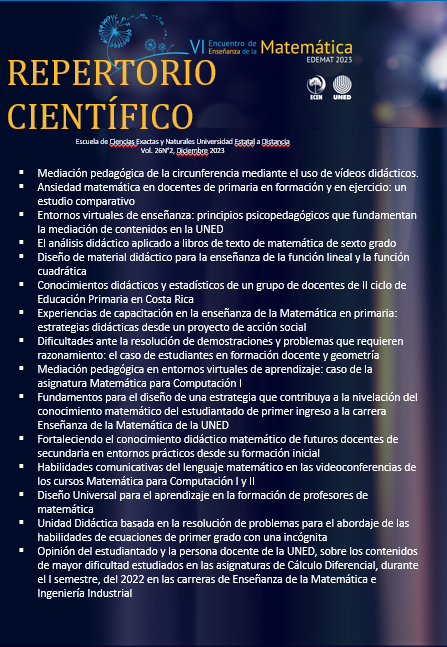
Dificultades ante la resolución de demostraciones y problemas que requieren razonamiento: el caso de estudiantes en formación docente y geometría
DOI:
https://doi.org/10.22458/rc.v26i2.5078Palavras-chave:
educación, enseñanza y formación, formación profesional, demostración matemática,, dificultad en el aprendizaje, enseñanza y formación en MatemáticaResumo
En este artículo se exponen los resultados de una investigación de tipo cualitativa y descriptiva que tuvo por objetivo determinar las dificultades que presenta el estudiantado, en formación para profesores de matemática, en la asignatura geometría euclídea I, al resolver demostraciones y problemas que requieran para su solución del razonamiento y la argumentación. Para el estudio se seleccionó cinco ítems de la primera prueba ordinaria del I cuatrimestre del 2019; los investigadores clasificaron los ejercicios seleccionados y realizaron una propuesta según su nivel de dificultad la cual se sometió a revisión y valoración por expertos, además, el análisis se realizó a partir de dos tablas que permitieran resumir la información: una para los ítems relacionados con demostraciones y la otra para los de razonamiento, inventiva y argumentación.
En cuanto a las demostraciones se logró determinar que si logran reconocer las hipótesis, definiciones, postulados y teoremas que le podrían permitir resolverlas, pero no logran establecer las inferencias lógicas entre ellas para lograr justificar de forma correcta lo solicitado. Respecto a los ejercicios que requieren razonamiento y argumentación, se logró evidenciar que los estudiantes presentan mayores dificultades, y que por lo general emplean elementos auxiliares que poco contribuyen con la solución. Se recomienda el diseño y elaboración de recursos que ayuden con la solución de las situaciones encontradas, específicamente, se recomienda la implementación de talleres pedagógicos con los estudiantes.
Downloads
Referências
Balacheff, N. (1987). Processus de preuve et situations de validation. [Processes of proof and situations of validation]. Educational Studies in Mathematics, 18(2), 147-176. https://www.researchgate.net/publication/320518071_Processus_de_preuve_et_situations_de_validation
Balacheff, N. (2008). The role of the researcher’s epistemology in mathematics education: an essay on the case of proof. ZDM International Journal on Mathematics Education, 40(3), 501-512. https://hal.archives-ouvertes.fr/hal-01675739/document
Bailera, A. & Oller, A. (2017). Formación del Profesorado y Demostración Matemática. Estudio Exploratorio e Implicaciones. Bolema, Rio Claro (SP), 31(57), 135-157. https://www.scielo.br/pdf/bolema/v31n57/0103-636X-bolema-31-57-0135.pdf
Cabassut, R., Conner, A., İşçimen, F. A., Furinghetti, F., Jahnke, H. N. & Morselli, F. (2011). Conceptions of proof–In research and teaching. En Proof and proving in mathematics education (pp. 169-190). Dordrecht: Springer. Doi: ht-
tps://doi.org/10.1007/978-94-007-2129-6_7
Fiallo, J., Camargo, A. & Gutiérrez, A. (2013). Acerca de la enseñanza y el aprendizaje de la demostración en matemáticas. Revista Integración Escuela de Matemáticas Universidad Industrial de Santander, 31(2), 181–205. http://www.scielo.org.co/pdf/rein/v31n2/v31n2a07.pdf
Fischbein, E. (1980). Intuition and Proof. 4th conference of the International Group for the Psychology of Mathematics Education at Berkeley. https://flm-journal.org/Articles/3C2FDFF14268CD1E813E785AD584E4.pdf
Godino, J. & Recio, A. (2001). Significados institucionales de la demostración. implicaciones para la educación matemática. Enseñanza de las ciencias, 19(3), 405-414. https://core.ac.uk/download/pdf/38990678.pdf
Hanna, G. & De Villier, M., (2012). Proof and proving in Mathematics Education. https://library.oapen.org/bitstream/handle/20.500.12657/48201/1/9789400721296.pdf#page=25
Ministerio de Educación Pública. (2012). Programas de Estudio de Matemáticas. I, II y III Ciclos de la Educación General Básica y Ciclo Diversificado. San José: Ministerio de Educación Pública. https://www.mep.go.cr/sites/default/files/programadeestudio/programas/matematica.pdf
Morales, S. & Samper, C. (2015). Dificultades en el aprendizaje de la demostración deductiva formal en geometría euclídea. AMAZONIA Investiga, 4(6). 55-68. https://www.google.com/url?sa=t&rct=j&q=&esrc=s&source=web&cd=&ved=2ahUKEwjG1rScssbsAhXBxVkKHSKtCcEQFjAAegQIAxAC&url=https%3A%2F%2Famazoniainvestiga.info%2Findex.php%2Famazonia%2Farticle%2Fdownload%2F685%2F645%2F&usg=AOvVaw0CQri6wLLsVccTcw-VmPz-
NCTM. (2003). Principios y estándares para la educación matemática, Sociedad Andaluza de Educación Matemática. Thales. Sevilla, España.
Ortiz, H. & Jiménez, F. (2006). La demostración elemento vivo en la didáctica de la Matemática. Scientia et Technica, 31, 237-240. https://dialnet.unirioja.es/descarga/articulo/4830598.pdf
Padilla, E. & Rojas, E. (2017). Geometría Euclídea y su didáctica en educación primaria. Editorial: EUNED. ISBN: 978-9968-48-336-0.
Radillo, M. (2011). Obstáculos y errores en el aprendizaje de la geometría euclideana, relacionados con la traducción entre códigos del lenguaje matemático, en el nivel licenciatura. http://funes.uniandes.edu.co/4835/1/RadilloObstaculosALME2011.pdf
Rico, L. (2013). El método del Análisis Didáctico. Revista Iberoamericana de Educación Matemática, 33, 11-27. http://www.fisem.org/www/union/revistas/2013/33/ARCHIVO6.pdf
Sanabria, G. (2006). Propuesta sobre la enseñanza de la demostración de implicaciones. Revista Digital Matemática Educación e Internet. 1-14. https://tecdigital.tec.ac.cr/revistamatematica/propuestas-didacticas-em/v7n1-jun2006/
Universidad Estatal a Distancia, UNED. (2019). Bachillerato y licenciatura en enseñanza de la Matemática. Manuscrito no publicado.
Downloads
Publicado
Versões
- 2023-12-13 (2)
- 2023-12-13 (1)