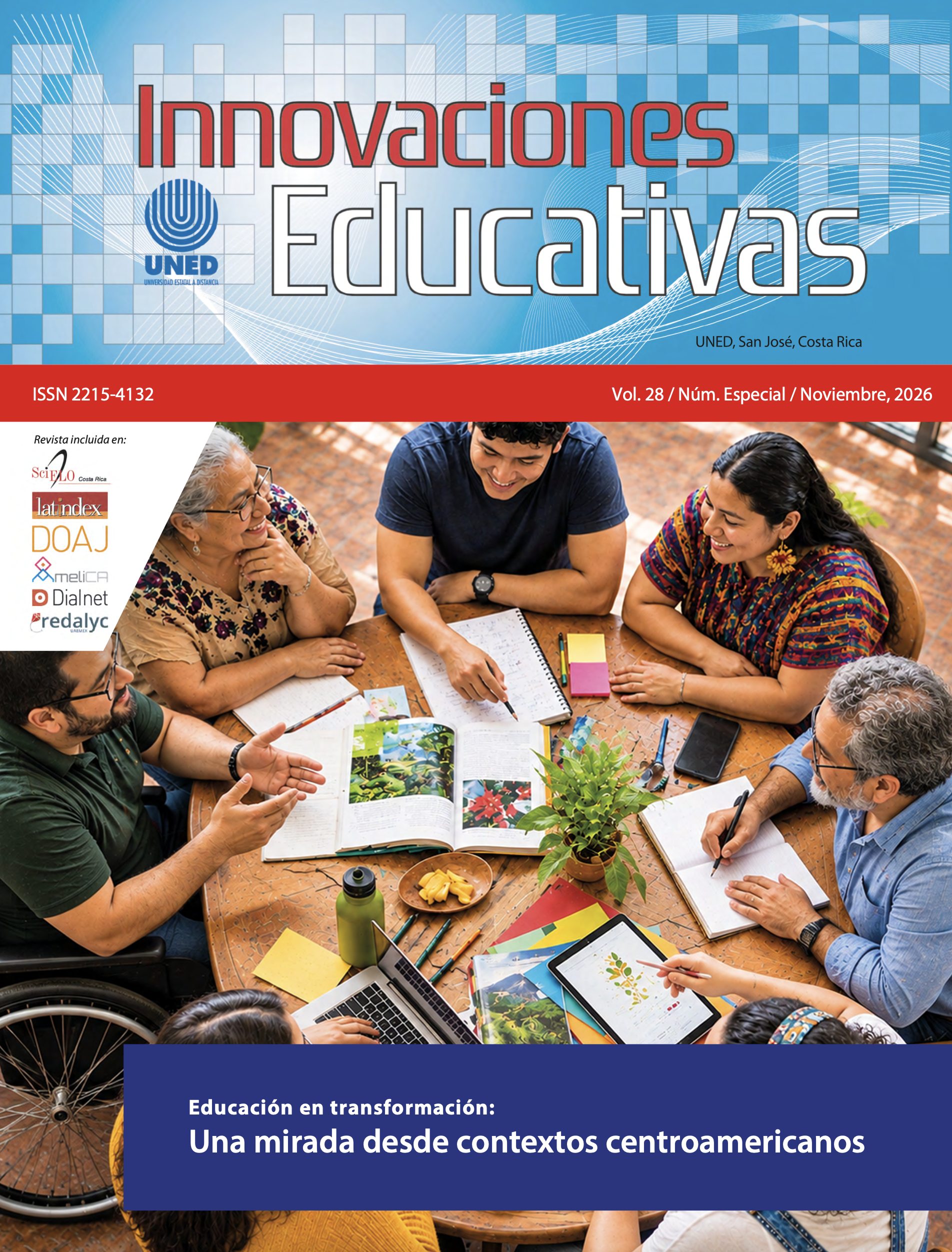
Pedagogical Innovation in Higher Education: Using Active Learning Methods to Stimulate Cognitive Skills in Older Adults
DOI:
https://doi.org/10.22458/ie.v28iespecial.6751Keywords:
educational innovations, university extension, adult education, lifelong learning, agingAbstract
This systematization of experience examines the implementation of the workshops “Mentes activas: mejorando nuestras habilidades cognitivas” (“Active Minds: Improving Our Cognitive Skills”), held in person at the Biblioteca Pública Faustino Montes de Oca in Costa Rica. Two groups participated: the first from September to November 2025 and the second from April to June 2026. The qualitative approach drew on document analysis (agendas, participation records, and feedback sessions), an evaluation questionnaire administered during the final workshop, and a review of the literature on the topic. Each group took part in 20 hours of workshops designed to stimulate cognitive skills in older adults in the canton of Montes de Oca. The analysis found that the workshop methodology was consistent with the approaches to active aging and human rights recognized in Costa Rica’s regulatory framework. The study concludes that the workshop experience could be adapted to other contexts, provided that the specific characteristics and conditions of each setting and participant group are taken into account.
References
Aguilera Arteaga, F. M., Rivera Ortíz, M. F., Murrieta Casillas, C. A., Morales Ávila, C. A., Zavala Pérez, A. J., Zepeda Guzmán, D. A., Lara Morales, A. y Cortés Álvarez, N. Y. (2024). Estimulación cognitiva: clave para el bienestar y la mejora cognitiva en adultos mayores. Jóvenes en la Ciencia, 28, 1–6. https://doi.org/10.15174/jc.2024.4506
Bergström, N. (2019). Konario [Juego de mesa]. Alga. https://doi.org/10.33936/psidial.v1iEspecial.6412
Consejo Nacional de la Persona Adulta Mayor. (2023, 14 de noviembre). Política Nacional de Envejecimiento y Vejez 2023-2033. https://conapam.go.cr/centro-de-informacion/politica-nacional-de-envejecimiento-y-vejez/
Convención Interamericana sobre la Protección de los Derechos Humanos de las Personas Mayores, Ley N.º 9394. (2016). Asamblea Legislativa de la República de Costa Rica. https://www.binasss.sa.cr/opac-ms/media/digitales/Convenci%c3%b3n%20Interamericana%20sobre%20la%20Protecci%c3%b3n%20de%20los%20Derechos%20Humanos%20de%20las%20Personas%20Mayores.pdf
Cruz-Peralta, M. d. J. y González-Celis, A. L. (2023). Intervenciones para mejorar la calidad de vida en adultos mayores: Revisión sistemática con preguntas PIO. Psicología y Salud, 33(2), 415–426. https://doi.org/10.25009/pys.v33i2.2824
Cuenca Sánchez, C. E. y Castillo Maldonado, T. A. (2024). Programa piloto de estimulación de la memoria en adultos mayores. Revista INFAD de Psicología. International Journal of Developmental and Educational Psychology, 2(1), 49–58. https://doi.org/10.17060/ijodaep.2024.n1.v2.2705
Fernández-Ballesteros, R., Robine, J.-M., Walker, A. y Kalache, A. (2013). Active aging: A global goal. Current Gerontology and Geriatrics Research, 2013, Artículo 298012. https://doi.org/10.1155/2013/298012
Flores-Villavicencio, M. E., Rodríguez-Díaz, M. y Robles Bañuelos, J. R. (2025). Principales funciones ejecutivas que cambian durante el envejecimiento normal. Anales en Gerontología, 16(1), 1–25. https://doi.org/10.15517/3h9fgt35
Gamito, P., Oliveira, J., Alves, C., Santos, N., Coelho, C. y Brito, R. (2020). Virtual Reality-Based Cognitive Stimulation to Improve Cognitive Functioning in Community Elderly: A Controlled Study. Cyberpsychology, Behavior and Social Networking, 23(3), 150–156. https://doi.org/10.1089/cyber.2019.0271
Hachem, H. y Manninen, J. (2020). Putting educational gerontology principles to the test: a quantitative confirmation of the empowering benefits of liberal arts courses. Educational Gerontology, 46(10), 653–665. https://doi.org/10.1080/03601277.2020.1805179
Instituto Nacional de Estadística y Censos de Costa Rica. (2024). Estimaciones y proyecciones nacionales de población 1950 - 2100. INEC. https://admin.inec.cr/sites/default/files/2024-09/mepoblaceppnac%201950%20-%202100.pdf
Intriago, V. y Rodas, J. A. (2024). Programas de entrenamiento cognitivo para la mejora de actividades de la vida diaria del adulto mayor. Revista PSIDIAL Psicología y Diálogo de Saberes, 3 (Edición Especial), 137–153. https://doi.org/10.33936/psidial.v1iEspecial.6412
Jara Holliday, O. (2018). La sistematización de experiencias: Práctica y teoría para otros mundos posibles. Centro Internacional de Educación y Desarrollo Humano (CINDE). https://repository.cinde.org.co/server/api/core/bitstreams/61c58b5b-ea28-49b9-b77c-501524b26ce1/content
Lemieux, A. (1997). Los programas universitarios para mayores: Enseñanza e investigación. IMSERSO.
Ley Integral para la Persona Adulta Mayor, Ley N.º 7935. (1999, 15 de noviembre). La Gaceta, N.º 221, Alcance N.º 88. https://dhr.go.cr/la_defensoria/leyes/ley_7935.pdf
Merriam, S. B. y Bierema, L. L. (2014). Adult learning: Linking theory and practice. Jossey-Bass.
Ministerio de Planificación Nacional y Política Económica. (2021). Índice de envejecimiento cantonal: 2015, 2020 y 2025. MIDEPLAN. https://documentos.mideplan.go.cr/share/s/QzTGHKFGQ_233SO6ZYgHtg
Padilla Sanchez, V. L. (2025). Fortalecimiento de habilidades cognoscitivas en adultos mayores. VIVE. Revista de Investigación en Salud, 8(24), 993–1000. https://doi.org/10.33996/revistavive.v8i24.428
Prince, M. (2004). Does active learning work? A review of the research. Journal of Engineering Education, 93(3), 223–231. https://doi.org/10.1002/j.2168-9830.2004.tb00809.x
Sánchez Gómez, C. y Fernández Rodríguez, E. J. (2021). The effectiveness of a training programme in everyday cognition in healthy older adults: A randomised controlled trial. BMC Geriatrics, 21(1), 79. https://doi.org/10.1186/s12877-020-01998-7
Sanjuán, M., Navarro, E. y Calero, M. D. (2020). Effectiveness of cognitive interventions in older adults: A review. European Journal of Investigation in Health, Psychology and Education, 10(3), 876–898. https://doi.org/10.3390/ejihpe10030063
Santamaría Gómez, L. M. (2024). Envejecer saludablemente con la práctica gerogógica [Tesis de Maestría, Fundación Universitaria Los Libertadores]. Repositorio Institucional de la Fundación Universitaria Los Libertadores. http://hdl.handle.net/11371/7181
Wang, S. y Chen, S. (2026). Digital Empowerment of Education for Older Adults: An Exploration in China. Springer. https://doi.org/10.1007/978-3-032-23859-7
Yuni, J. A. y Urbano, C. A. (2015). Educación de adultos mayores: Teoría, investigación e intervenciones. Editorial Brujas.
Zohar, A. y Shavit, Y. Z. (2025). Bridging geragogy and pedagogy: Towards a learning-sciences-based approach to older adults’ education. Educational Gerontology, 1–19. https://doi.org/10.1080/03601277.2025.2569386
Downloads
Published
Issue
Section
License
Copyright (c) 2026 Innovaciones Educativas

This work is licensed under a Creative Commons Attribution-NonCommercial-NoDerivatives 4.0 International License.