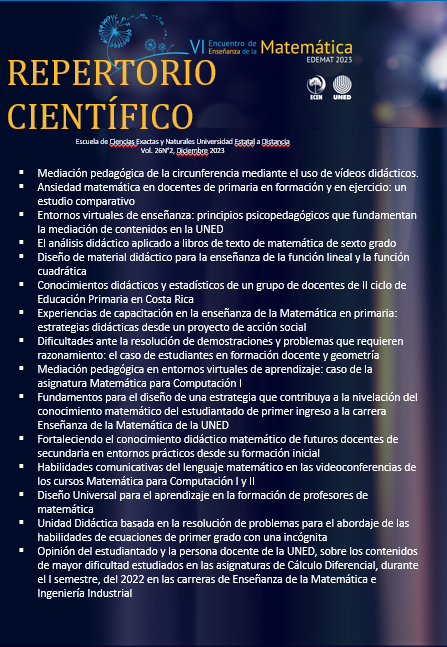
Ansiedad matemática en docentes de primaria en formación y en ejercicio: un estudio comparativo
DOI:
https://doi.org/10.22458/rc.v26i2.5063Keywords:
ansiedad matemática, subconstructos de ansiedad matemática, docentes de primaria en formación, docentes de primaria en ejercicio, sexo, edad, rendimiento académicoAbstract
In this research we set out to analyze the Mathematics Anxiety (MA) of a sample of primary teachers in training and primary teachers in practice, from anxiety to mathematics as a discipline (AD), to problem solving (AP ) and before the exams (AE). In addition, the relationship between AM in both groups and with the variables sex, age, grade level that they would least like to teach and academic performance was determined. To collect the data, the Fennema and Sherman (1976) subscale was applied. The results show that practicing primary school teachers have a significantly lower AM, AP and AE than trainee teachers; Furthermore, women have significantly higher AM, AD and AP than men; With respect to age, we found that the older the age, the AM, AD, AP and AE are significantly lower. It is recommended to carry out intervention strategies in this regard
Downloads
References
Aguero, E., Meza, L. G., Suárez, Z., & Schimidt, S. (2017). Estudio de la ansiedad matemática en la educación media costarricense. Revista Electrónica de Investigación Educativa, 19(1), 35–45. Retrieved from http://redie.uabc.mx/redie/article/view/849%0AResumen
Bursal, M., & Paznokas, L. (2006). Mathematics anxiety and preservice elementary teachers’ confidence to teach mathematics and science. School Science and Mathematics, 106(4), 173–179.
Delgado, I. (2016). Estudio comparativo sobre ansiedad matemática entre estudiantes de Costa Rica y España (Tesis de Maestría). Universidad de Granada, España.
Fennema, E. y Sherman, J. A. (1976). Fennema-Sherman mathematics attitudes scales: Instruments designed to measure attitudes toward the learning of mathematics by females and males. Journal for research in Mathematics Education, 7(5), 324-326. https:// doi.org/10.2307/748467.
Fernández, R., Hernández, C., Prada, R. y Ramírez, P. (2020). Creencias y ansiedad hacia las matemáticas: un estudio comparativo entre maestros de Colombia y España. Bolema, 34(68), 1174-1205. DOI: http://dx.doi.org/10.1590/1980-4415v34n68a16
Gómez-Chacón, I. M. (2009). Actitudes matemáticas: propuestas para la transición del bachillerato a la universidad. Educación Matemática, 21(3), 05-32.
Gil, N., Blanco, L. y Guerrero, E. (2006). El dominio afectivo en el aprendizaje de las Matemáticas. Una revisión de sus descriptores básicos. Revista Electrónica de Investigación Psicoeducativa, 8(4), 47-72.
Gil, F., Rico, L. y Castro, E. (2003). Concepciones y creencias del profesorado de secundaria andaluz sobre enseñanza-aprendizaje y evaluación de las matemáticas. Quadrante XII (1), 75-101.
Gresham, G. (2010). A study exploring excepcional education preservice teacher mathematics anxiety. Issues in the Undergraduate Mathematics Preparation of School Teachers: The Journal, 4, 1-14.
Koch, I. (2019). Choose Maths Gender Report: Mathematics and Gender: Are Attitudes and Anxieties Changing towards Mathematics? Australian Mathematical Sciences Institute.
Ministerio de Educación Pública de Costa Rica (2012). Programa de Estudio Matemática I, II y III ciclo de la Educación General Básica y Ciclo Diversificado. MEP, San José, Costa Rica.
McLeod, D. (1989). Beliefs, attitudes, and emotions: New views of affect in mathematics education. En Affect and mathematical problem solving (pp. 245-258). Springer New York, Estados Unidos.
Pérez Tyteca, P., & Castro, E. (2011). La ansiedad matemática y su red de influencia en la elección de carrera universitaria. Retrieved from http://funes.uniandes.edu.co/1831/1/402_Perez2011Laansiedad_SEIEM13. pdf%0APérez
Pérez-Tyteca, P. y Monje, J. (2017). Taller de resolución de problemas para prevenir la ansiedad matemática en los futuros maestros de educación infantil. Edma 0-6: Educación Matemática en la Infancia, 6(2), 14-27.
Pérez-Tyteca, P., Castro, E., Rico, L., y Castro, E. (2011). Ansiedad matemática, género y ramas de conocimiento en alumnos universitarios. Enseñanza de las Ciencias: Revista de Investigación y Experiencias Didácticas, 29(2), 237-250.
Piaget, J. (1977). Estudios sociológicos. España: Ariel.
Richardson, F. C., & Suinn, R. M. (1972). The mathematics anxiety rating scale: Psychometric data. Journal of Counselling Psychology, 19(6), 551–554.
Sánchez, H., y Reyes, C. (2002). Metodología y diseño de investigación científica. Lima: Editorial Universitaria.
Sánchez, J. (2013). Actitudes hacia la matemática de los futuros maestros de educación primaria. Universidad de Granada, Granada.
Sánchez, J., Segovia, I., & Miñán, A. (2011). Exploración de la ansiedad hacia las matemáticas en los Futuros maestros de educación. Profesorado Revista de Currículum Y Formación Del Profesorado, 15(3), 297–312. Retrieved from http://www.ugr.es/~recfpro/rev153COL6res.pdf
Sánchez, J., Segovia, I. y Miñán, A. (2020). Ansiedad y Autoconfianza hacia las matemáticas de los futuros maestros de Educación Primaria. Electronic Journal of Research in Educational Psychology, 18(2), 127-152.
Sánchez, J., Segovia, I. y Miñán, A. (2022). Ansiedad matemática, rendimiento y formación de acceso en futuros maestros. PNA 16(2), 115-140. DOI: http://dx.doi.org/10.30827/pna.v16i2.21703
Ureña, M. del P. (2015). Ansiedad a las matemáticas. Universidad de Jaen.