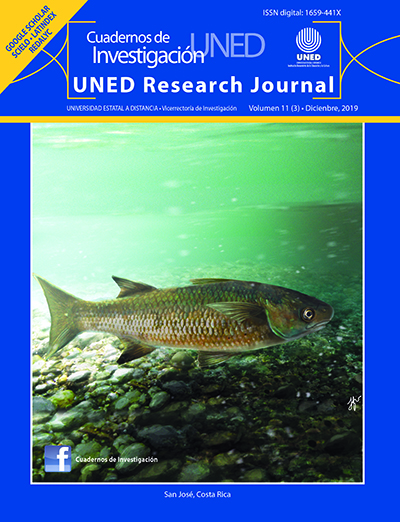
Diet and reproduction of the fish Joturus pichardi (Mugiliformes: Mugilidae) in the Pacuare River basin, Costa Rica
DOI:
https://doi.org/10.22458/urj.v11i3.2723Keywords:
freshwater fish, Central America, Diadromous fishes, migration, endoparasiteAbstract
Introduction: Joturus pichardi is an important migratory species that inhabits the rivers of the Atlantic zone of Costa Rica and has been little studied. Objective: To describe the diet and reproduction of J. pichardi and its relationship with environmental factors in the Pacuare River basin. Methods: Sixteen sampling sites were selected along the main channel or Pacuare River. The samplings were performed from October 2015 to October 2016. The gonads, stomach, and intestines of seven individuals of J. pichardi were analyzed. The relationship of J. pichardi between the physicochemical variables of the water and the structure of the habitat was analyzed. Results: Twenty individuals were collected at an elevation of 225-235masl. The occurrence of J. pichardi was related to sites with higher river velocity, high values of dissolved oxygen, rock substrate and forest land use. All the individuals analyzed had visceral fat and endoparasites in the stomach. Bryophytes, ferns, macroinvertebrates, and detritus were identified as part of the diet of J. pichardi. According to the analysis of gonads in adults, the individuals were identified in the gonadal state types I, II and V. Conclusions: Our results suggest J. pichardi is an omnivorous species associated with sites with rocks, rapids, well-oxygenated waters, and forest land use. Also, the analysis of gonads coincides with the known reproduction period of the species. Finally, individuals of Neoechinorhynchus spp. are recorded for the first time in stomachs of J. pichardi in Costa Rica.
Additional Files
Published
Issue
Section
License
Note: This abstract contains an incorrect copyright due to technical issues. Authors who publish with this journal agree to the following terms: Authors retain copyright and grant the journal right of first publication with the work simultaneously licensed under a Creative Commons Attribution License that allows others to share the work with an acknowledgement of the work's authorship and initial publication in this journal
All journal contents are freely available through a CC BY 4.0 license.
CC BY 4.0 is a Creative Commons: you can copy, modify, distribute, and perform, even for commercial reasons, without asking permission, if you give appropriate credit.
Contents can be reproduced if the source and copyright are acknowledged according to the Open Access license CC BY 4.0. Self-storage in preprint servers and repositories is allowed for all versions. We encourage authors to publish raw data and data logs in public repositories and to include the links with all drafts so that reviewers and readers can consult them at any time.
The journal is financed by public funds via Universidad Estatal a Distancia and editorial independence and ethical compliance are guaranteed by the Board of Editors, UNED. We do not publish paid ads or receive funds from companies.