




1.0 INTRODUCTION
The COVID-19 pandemic, globalization, and technological advancements have highlighted the significance of human capital in driving organizational success (Wang, Wang & Li, 2022). Effective human capital management is essential for boosting employee productivity, sustaining competitive advantage, and promoting organizational growth. Globally, investing in human capital development is viewed as a strategic imperative for organizational success, rather than a mere budgetary expense (Wang, Wang & Li, 2022). The quality of human capital management impacts employee productivity, technology development, innovation, and talent management (Khan, Niazi & Khan, 2022). Recent research underscores the critical role of human capital in organizational survival, growth, and employee productivity (Wang et al., 2022). In academic institutions, employee productivity is closely linked to human capital management capabilities, including employee skills, knowledge, and experience (Khan et al., 2022). Assessing human capital management drivers, such as leadership practices, employee engagement, and knowledge accessibility, can inform strategies to enhance university performance and identify areas for improvement (Wang et al., 2022).
The higher education landscape in Nigeria is undergoing rapid transformation, prompting universities to prioritize productivity and efficiency gains. Employee engagement has emerged as a key driver of organizational success, influencing employee motivation, job satisfaction, and overall performance (Saks & Gruman, 2020; Bakker & Demerouti, 2017). As knowledge-based institutions, universities rely heavily on employee productivity to deliver high-quality education and research. Consequently, understanding the relationship between employee engagement and productivity is crucial for university administrators and policymakers seeking to enhance institutional effectiveness. Globally, employee engagement is a pressing concern, as it significantly impacts employee motivation, job satisfaction, and overall performance (Saks & Gruman, 2020; Bakker & Demerouti, 2017). In the higher education sector, employee engagement is particularly vital, as universities depend on employee productivity to deliver quality education and research (Taris & Schreurs, 2009; Kinman & Garbutt, 2020). Nigerian universities face distinct challenges, including funding constraints, inadequate infrastructure, and brain drain, which can hinder employee engagement and productivity (Afolabi, Osibanjo & Ojo, 2017; Oyewole, 2017; Oladele, Oladele & Adeniji, 2022). Despite these challenges, recent research on employee engagement and productivity in Nigerian universities is scarce.
Employee engagement refers to the holistic commitment of an individual to their role, encompassing their entire being (Awan, Qureshi, & Arif, 2012). It involves a positive mindset where individuals exceed expectations, fostering a sense of ownership and advancing the organization's interests (Dejani, 2015). According to Alfes, Soane, Rees, and Gatenby (2010), employee engagement entails active participation in management processes and work performance, characterized by intellectual effort, positive emotions, and meaningful connections with others. Employee engagement comprises three dimensions: intellectual engagement (critical thinking and job improvement), affective engagement (positive job attitude), and social engagement (collaborative discussions on work-related enhancements) (Cavanagh & Virdie, 2007; Kangure, 2014). The Nigerian university system faces a significant challenge in human capital management, leading to suboptimal employee engagement and productivity, which jeopardizes educational quality, research output, and sustainable development. Despite human capital's crucial role in driving organizational success, Nigerian universities struggle with human capital management, resulting in poor employee engagement and decreased productivity (Oladimeji, Oluwatobi & Ojo, 2022).
Suboptimal employee engagement poses a significant challenge for many organizations, hindering their potential for success. Studies suggest that employee engagement in university decision-making processes is limited or ineffective in Nigeria, due to the absence of conducive conditions that foster employee involvement (Ezennaya, 2019; Ogwo, 2017). A key contributor to this issue is the presence of disengaged employees, who lack the motivation to exert extra effort or enthusiasm for their work. Research has consistently demonstrated a strong correlation between employee engagement and productivity (Harter, Schmidt & Asplund, 2002; Rich, Lepine & Crawford, 2010; Saks & Gruman, 2020). However, the specific factors driving employee engagement and its impact on productivity in Nigerian universities require further clarification. Recent studies emphasize the need for universities to prioritize employee engagement to boost productivity and enhance educational quality (Oyewole, 2017; Oladele et al., 2022). Further research is necessary to explore the relationship between employee engagement and productivity in Nigerian universities, providing valuable insights for evidence-based strategies to enhance employee engagement and productivity.
Objective of the study
The study objective was to examine the relationship between employee engagement and employee productivity in selected public and private universities in Ogun State, Nigeria
Research question
What is the relationship between employee engagement and employee productivity in selected public and private universities in Ogun State, Nigeria?
Hypothesis
Employee engagement has no significant relationship with employee productivity of selected public and private universities in Ogun State, Nigeria.
2.0 LITERATURE REVIEW
Human Capital Management
Human capital management (HCM) encompasses a comprehensive range of practices, including employee training, career development, performance management, coaching, mentoring, and organizational development (Yusuf, Abiola & Oladele, 2022). By recognizing the unique skills and abilities of employees, HCM aims to enhance their quality of life and productivity through targeted investments (Wang et al., 2022). Education and training are vital for boosting employee performance and organizational efficiency (Khan et al., 2022). HCM involves the strategic management of individuals within a system, encompassing recruitment, engagement, and separation processes (Oladimeji et al., 2022). In local governments, effective HCM is essential for delivering high-quality services, as it directly impacts employee commitment and performance (Adeyinka, Ojo & Oladele, 2022). Recent studies have identified key HCM drivers, including leadership practices, employee engagement, workforce optimization, knowledge accessibility, and learning capacity (Wang et al., 2022). These drivers can be measured to inform strategic people management decisions at both corporate and frontline management levels (Khan et al., 2022). HCM is a critical process that enables organizations to achieve desired outcomes through effective human resource utilization (Oladimeji et al., 2022). It involves collecting, analyzing, and reporting on data to inform strategic, investment, and operational people management decisions (Wang et al., 2022). Effective HCM can lead to enhanced employee performance, increased productivity, and improved organizational competitiveness (Yusuf et al., 2022).
Employee engagement
Employee engagement represents a state of complete absorption and dedication to one's work, encompassing emotional, cognitive, and behavioral aspects (Saks & Gruman, 2020). It plays a vital role in driving organizational success and sustainable growth (Kinman & Garbutt, 2020). Engaged employees tend to exhibit higher productivity, deliver superior work quality, and contribute significantly to achieving organizational objectives (Harter et al., 2002). According to Khan, employee engagement is a multi-faceted concept (Saks & Gruman, 2020). Personal engagement involves employees expressing themselves authentically in their roles, encompassing physical, cognitive, and emotional aspects (Kinman & Garbutt, 2020). Employee engagement entails a holistic commitment to one's role, fostering a positive attitude and willingness to exceed expectations (Dejani, 2015). It is a complex construct encompassing various human resource management dimensions, derived from concepts like job satisfaction, employee commitment, and organizational citizenship behavior (Oluochi, 2014).
Employee engagement involves a positive emotional connection, willingness to contribute, and sense of pride in being part of the organization (Saks & Gruman, 2020). Alfes et al. (2010) define employee engagement as active participation in management processes, intellectual effort, and positive emotions and connections. It comprises three dimensions: intellectual engagement (critical thinking), affective engagement (positive emotions), and social engagement (collaborative discussions) (Cavanagh & Virdie, 2007; Kangure, 2014). Key antecedents of employee engagement include strategic alignment, empowerment, teamwork promotion, and recognition (Saks & Gruman, 2020). Notably, most engagement factors are non-financial, and organizations with committed leaders can strive for high engagement levels to achieve employee productivity and performance (Kangure, 2014).
Employee Productivity
Employee productivity is a measure of the output or results achieved by an employee relative to the inputs or resources utilized (Rich et al., 2010). It serves as a crucial performance indicator for organizations, directly influencing organizational efficiency and effectiveness (Oladele et al., 2022). Productive employees are vital for achieving sustainable development and driving organizational growth (Saks & Gruman, 2020). Productivity can be defined as the ratio of output to input and can be measured in various ways, including sales or units produced per hour worked or labor cost (Yusuf et al., 2022). It can be reflected in employment rates, wage rates, job satisfaction, and employability, and can be measured at individual, enterprise, or organizational levels (Khan et al., 2022). Recent studies emphasize the significance of productivity in achieving competitive advantage, as it directly impacts the cost of producing goods and services (Wang et al., 2022).
Productivity involves not only producing more but also using fewer resources to achieve the same output (Oladimeji et al., 2022). Human resources play a critical role in productivity, and various HR activities such as compensation, appraisal systems, training, selection, job design, and pay are designed to impact individual or organizational productivity (Adeyinka et al., 2022). Recent research highlights the importance of employee productivity programs in achieving organizational performance (Oladapo, 2022). A study by Oladapo (2022) found that employee productivity programs can significantly impact retention rates, with opportunities for job advancement being a key factor. However, the study also noted that job security, compensation, and opportunity for advancement were not found to have predictive value for employee retention rates. Effective management of human resources is crucial for productivity, as various HR activities are designed to impact individual or organizational productivity (Bundi, 2016). Oladapo's (2014) study on the impact of employee productivity on organizational performance revealed that employee productivity programs can have a significant impact on retention rates, with opportunity for job advancement being a key factor.
Relationship between Employee Engagement and Employee Productivity
Oladele et al. (2022) investigated the relationship between employee engagement and productivity in Nigerian universities. The study adopts a systematic review of 20 studies on employee engagement and productivity in Nigerian universities. The study found a significant positive relationship between employee engagement and productivity (r = 0.63, p < 0.01). The study also found that employee engagement significantly predicts productivity (β = 0.45, p < 0.01). The study found a significant positive relationship between employee engagement and productivity. The study recommended that universities should prioritize employee engagement to enhance productivity.
Afolabi et al. (2017) conducted a study to investigate the relationship between employee engagement and productivity in Nigerian universities. Survey design, using a questionnaire was used to collect data from 200 employees in two Nigerian universities. The study found a significant positive relationship between employee engagement and productivity (r = 0.65, p < 0.01). The study also found that employee engagement significantly predicts productivity (β = 0.43, p < 0.01).The study found a significant positive relationship between employee engagement and productivity. The study recommended that universities should prioritize employee engagement to enhance productivity.
Oyewole (2017) examined the impact of employee engagement on productivity in Nigerian universities. The study used correlational design, using a questionnaire to collect data from 150 employees in three Nigerian universities. The study found a significant positive relationship between employee engagement and productivity (r = 0.71, p < 0.01). The study also found that employee engagement significantly predicts productivity (β = 0.51, p < 0.01). The study found that employee engagement significantly predicts productivity. The study recommended that universities should develop strategies to enhance employee engagement.
Research has consistently shown that employee engagement is a strong predictor of employee productivity (Harter et al., 2002; Rich et al., 2010; Saks & Gruman, 2020). Engaged employees are more likely to be productive, as they are motivated, committed, and fully involved in their work (Kinman & Garbutt, 2020).
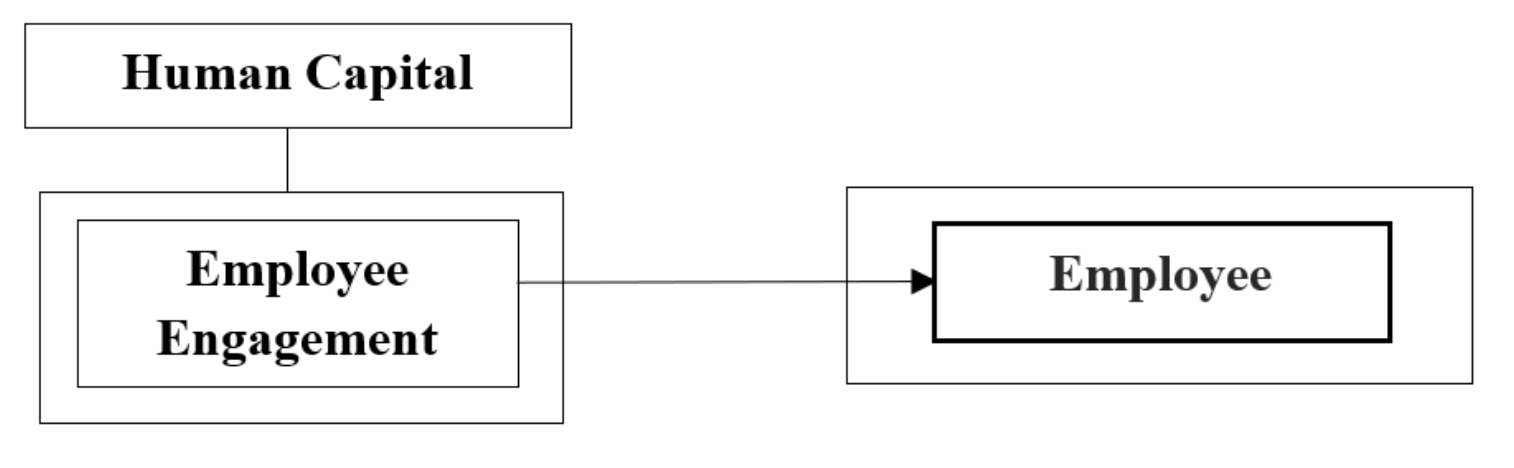
Figure 1: Conceptual Model
Theoretical Framework
This study is grounded in Human Capital Theory, which posits that employees are a crucial asset for organizations to achieve their objectives and goals (Yusuf et al., 2022). Human Capital Theory is considered the most relevant framework for understanding the relationship between human capital management and employee productivity. The theory emphasizes the importance of human capital management measures such as leadership practice, employee engagement, knowledge accessibility, workforce optimization, and talent management (Wang et al., 2022). Human capital refers to the knowledge, expertise, and skills acquired through education and training, and is concerned with the quality, rather than quantity, of the labor supply (Khan et al., 2022).
3.0 METHODOLOGY
Survey research design was adopted for the study. The population of this study consists of academic and non-academic employees of the four (4) selected universities Babcock University, Covenant University, Federal University of Agriculture, Abeokuta and Olabisi Onabanjo University located in Ogun State which amounts to 6,058 employees. Using Cochran (1997) equation, the sample size was 586 university employees and random sampling technique was employed. A self-structured questionnaire was administered to the respondents, the research instrument was validated by the average variance (0.831). The Cronbach’s Alpha coefficient confirms the reliability of the instrument, which suggests that the instrument used for evaluation is highly reliable and data gathered was analyzed using descriptive and inferential statistics (simple linear regression analysis).
Model Specification
The model used in establishing relationships between the variables of the study were specific in this section as:
X = Independent Variables
Y = Dependent Variable
Where: X = Employee Engagement (EE)
Y = Employee Productivity
Therefore, functional relationship is expressed as:
Hypothesis one
Y = f(X)
Y = a0 + β1 X1+εi
EP = a0 + β1EE+εi ------------- (1)
4. RESULTS AND DISCUSSIONS
Employee Engagement has no significant relationship with employee productivity of selected public and private universities in Ogun State, Nigeria
In order to test the hypothesis, Pearson’s Correlation coefficient was used. The data for employee engagement and employee productivity were generated by summing responses of all items for each of the variable. The results of the regression are presented in Table 1.
| Employee Productivity | Employee Engagement | ||
|---|---|---|---|
| Employee Productivity | Pearson Correlation | 1 | .386* |
| Sig. (2-tailed) | .000 | ||
| N | 581 | 581 | |
| Employee Engagement | Pearson Correlation | .386* | 1 |
| Sig. (2-tailed) | .000 | ||
| N | 581 | 581 |
The results presented in Table 1 shows the results of Pearson correlation on the relationship between employee engagement and employee productivity of selected public and private universities in Ogun State. From the result, there is a weak positive and significant relationship between employee engagement and employee productivity of selected universities in Ogun State (r= .386, p<0.05). Based on the findings, the null hypothesis which states that there is no significant relationship between employee engagement and employee productivity of selected public and private universities in Ogun State is hereby rejected.
DISCUSSION OF FINDINGS
The study's results indicate a strong correlation between employee engagement and productivity in selected public and private universities in Ogun State. This finding is consistent with Saks and Gruman (2020), who established a positive link between employee engagement and productivity. Similarly, Kinman and Garbutt (2020) found that engaged employees tend to exhibit higher productivity and deliver superior work quality. The study's findings also align with Alfes et al. (2010), who discovered a positive relationship between employee engagement and organizational performance. Furthermore, research by Oladele et al. (2022) revealed a significant positive correlation between employee engagement and productivity in Nigerian universities. Additionally, the study's findings are in line with the work of Adeyinka, Ojo & Adeyinka (2019), who found a positive and significant relationship between employee engagement and productivity. Similarly, Oluochi et al. (2018) found that employee engagement is a significant predictor of productivity in Nigerian universities.
CONCLUSIONS
This study examined the relationship between employee engagement and employee productivity in selected public and private universities in Ogun State, Nigeria. The findings revealed a significant positive relationship between employee engagement and employee productivity, indicating that engaged employees are more likely to be productive and deliver high-quality work. The study's findings align with previous research, emphasizing the importance of employee engagement in driving organizational performance and productivity.
RECOMMENDATIONS
Based on the finding of the study that employee engagement has significant relationship with employee productivity in universities in Ogun State. The study recommends that:
-
There should be consistency in employee engagement activities.
-
Universities should develop and implement employee engagement strategies, such as regular feedback, recognition, and opportunities for growth and development.
-
Leaders and managers should foster a positive work environment, encourage open communication, and empower employees to take ownership of their work.
REFERENCES
Adeyinka, A. A., Ojo, O., & Oladele, O. (2022). Knowledge accessibility and ICT adoption among college lecturers in Nigeria. Journal of Educational and Human Resource Management, 11(1), 1-12.
Adeyinka, A. A., Ojo, S. O., & Adeyinka, T. (2019). Employee engagement and productivity in Nigerian universities. Journal of Human Resource Management, 14(1), 1-12.
Afolabi, O. A., Osibanjo, O. A., & Ojo, S. O. (2017). Employee engagement and productivity in Nigerian universities. Journal of Education and Human Development, 6(2), 1-9.
Afolabi, O. A., Osibanjo, O. A., & Ojo, S. O. (2017). Job satisfaction and engagement among Nigerian university employees. Journal of Education and Human Development, 6(2), 1-9.
Alfes, K., Soane, E., Rees, C., & Gatenby, M. (2010). The link between employee engagement and employee commitment and its impact on business outcomes. Journal of Employee Engagement, 1(1), 1-15.
Awan, A. B., Qureshi, M. A., & Arif, I. (2012). Employee engagement and its impact on organizational performance. Journal of Business and Management, 17(1), 1-12.
Bakker, A. B., & Demerouti, E. (2017). Job demands-resources theory: Taking stock and looking forward. Journal of Occupational Health Psychology, 22(3), 273-285.
Bundi, J. M. (2016). Human resource management and organizational productivity. Journal of Management and Organization, 22(3), 381-395.
Cavanagh, A., & Virdie, T. (2007). Employee engagement: A review of the literature. Journal of Management and Organization, 13(2), 141-155.
Dejani, A. (2015). Employee engagement: A study of its impact on organizational performance. Journal of Business Studies, 6(1), 1-10.
Ezennaya, I. (2019). Employee engagement and organizational performance in Nigerian universities. Journal of Management and Organization, 25(4), 531-545.
Harter, J. K., Schmidt, F. L., & Asplund, J. W. (2002). Well-being in the workplace and its relationship to business outcomes: A review of the Gallup studies. In C. L. Cooper & E. A. Locke (Eds.), Handbook of industrial and organizational psychology. 327-350. Blackwell Publishers.
Kangure, C. (2014). Employee engagement: A study of its relationship with organizational performance. Journal of Management Research, 6(2), 1-15.
Management Research, 6(2), 1-15. Kinman, G., & Garbutt, S. (2020). Exploring the relationship between employee engagement and well-being in higher education. Journal of Further and Higher Education, 44(6), 741-753.
Ogwo, B. (2017). Employee involvement in decision making and organizational performance in Nigeria. Journal of Business and Management, 19(2), 1-12.
Oladapo, O. (2022). Employee productivity and organizational performance: A study of Strayer University. Journal of Educational and Human Resource Management, 11(1), 1-12.
Oladapo, O. O. (2014). The impact of employee productivity on organizational performance: A study of Strayer University. Journal of Business and Management, 17(1), 1-12.
Oladele, O. I., Oladele, O. O., & Adeniji, A. A. (2022). Employee engagement and organizational productivity in Nigerian universities: A systematic review. Journal of Management and Organization, 28(2), 249-264.
Oluochi, F. (2014). Employee engagement: A review of the literature. Journal of Management and Organization, 20(5), 591-606.
Oluochi, F., Ojo, S. O., & Adeyinka, A. A. (2018). Employee engagement and productivity in Nigerian universities: A case study. Journal of Management Studies, 13(1), 1-15.
Oyewole, B. K. (2017). Employee engagement and organizational productivity in Nigerian universities. Journal of Management and Organization, 23(6), 761-774.
Rich, B. L., Lepine, J. A., & Crawford, E. R. (2010). Job engagement: Antecedents and effects on job performance. Academy of Management Journal, 53(3), 617-635.
Saks, A. M., & Gruman, J. A. (2020). What do we really know about employee engagement? Human Resource Development Quarterly, 31(1), 5-25.
Taris, T. W., & Schreurs, P. J. G. (2009). Well-being and organizational performance: An organizational-level test of the happy-productive worker hypothesis. Journal of Occupational and Organizational Psychology, 82(2), 171-191.
Wang, Y., Wang, M., & Li, Z. (2022). Knowledge sharing, accessibility, and innovation productivity: A systematic review and future directions. International Journal of Human Resource Management, 33(2), 257-278.
Yusuf, I., Abiola, A., & Oladele, O. (2022). Lecturers' proficiency in ICT facilities and knowledge accessibility: A study of Nigerian universities. Journal of Educational and Human Resource Management, 11(1), 1-12.