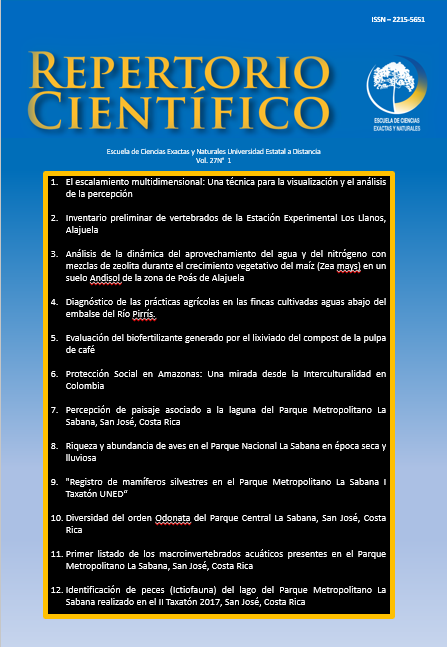
Análisis de la dinámica del aprovechamiento del agua y del nitrógeno con mezclas de zeolita durante el crecimiento vegetativo del maíz (Zea mays) en un suelo Andisol de la zona de Poás de Alajuela
DOI:
https://doi.org/10.22458/rc.v27i1.5059Keywords:
Eficientización, evapotranspiración, zeolita, fertilizante, nitrógeno, agua, C/NAbstract
With a growing world population and a significant reduction in farmland, the efficiency of
agriculture is of utmost importance, both in the use of water and in the correct use of
chemical fertilizers, especially nitrogenous sources. For this reason, it is that zeolite was
evaluated as an improver in the use of water, through the reduction of evapotranspiration
and as an efficientizer of nitrogen fertilizers, thus reducing its.
The experimental trial required an indicative crop (corn), based on five treatments (TA:
100% Fertilizer, TB: 25% Z + 75% ½ fertilizer, TC: 25% Z + 75% fertilizer, TD: 25% Z +
75% double fertilizer, TE: 100% Z + 100% fertilizer), with 15 repetitions, to be able to
evaluate the consumption of water and fresh and dry weights, in addition to chemical
analysis of the soil, to measure the remnant of N and foliar chemical analysis To observe
the nutrient consumption, the C / N ratio was also evaluated, to show the influence of the
mineral on the soil microbiota.
The results show that despite the fact that in the first 21 days there is a statistical difference
between the treatments, for the other measurements (42 and 70 days) the opposite occurs, a
very similar aspect occurs in the development of biomass, where there is no evidence
statistical difference. Regarding the presence of remaining N, the treatments with the
highest percentage are A and E, presenting these at the same time a greater amount of foliar
N, while in terms of the C / N ratio, the highest is presented treatment B (> 10) which, at
the same time, has the least amount of fertilizer.
Downloads
References
vila, H., Dambrine, E., Harmand, J-M. y Jiménez F. 2004. Dinámica del
nitrógeno en el sistema agroforestal Coffea arabica con Eucalyptus deglupta en la
Zona Sur de Costa Rica. Agroforestería en Las Américas, (41-42), 83-91.
Banco Mundial. 2019. El agua en la agricultura. Recuperado de
http://www.bancomundial.org/es/topic/water-in-agriculture
Barbieri, P., Echeverría, H. y Sainz, H. 2018. Pérdidas por volatilización y
eficiencia de uso de nitrógeno en maíz en función de la fuente, dosis y momento de
aplicación. Revista de la Facultad de Agronomía, 117 (1), 111-116.
Barbosa, S. M., De Oliveira, G. C., Carducci, C. E. y Montoani, S. B. 2014.
Potencialidade de uso de zeólitas na atenuação do déficit hídrico em Latossolo do
cerrado. Semina: Ciencias Agrarias, 35(4), 2357-2368.
Díaz, A. H. J., Liriano, G. R. y Abreu, C. E. O. 2019. Evaluación agronómica de
fertilizantes de fórmula completa mezclados con zeolita natural en el cultivo de la
papa (Solanum tuberosum L.). Centro agrícola, 46(1), 24-30.
Food and Agriculture Organization. 2015. El uso de fertilizantes sobrepasará los
millones de toneladas para el 2018. Recuperado de
http://www.fao.org/news/story/es/item/277654/icode/
Gamarra, L. C. C., Díaz, L. M. I., Vera, de O. M., Galeno, M. del P. y Cabrera, J.
N. 2018. Relación carbono-nitrógeno en suelos de sistemas silvopastoriles del
Chaco paraguayo. Revista Mexicana de Ciencias Forestales, 9(46), 1-22.
Gholamhoseini, M., Ghalavand, A., Khodaei-Joghan, A., Dolatabadiam, A.,
Zakikhani, H. y Farmanbar, E. 2013. Zeolite-amended cattle manure effects on
sunflower yield, seed quality, water use efficiency and nutrient leaching. Revista
Soil & Tillage Research, 126(2013), 193–202.
Grassini, P. y Cassman, K. G. 2012. High-yield maize with large net energy yield
and small global warming intensity. Proceedings of the National Academy of
Sciences, 109(4), 1074–1079.
Instituto Interamericano de Cooperación para la Agricultura. 2017. El agua para
la agricultura de las américas. Recuperado de
https://repositorio.iica.int/bitstream/handle/11324/6148/BVE17109367e.pdf;jsession
id=591DA6D8EAAE93B30AF41005B415D0B5?sequence=1
Instituto Nacional de Innovación y Transferencia en Tegnología Agropecuaria.
Cultivo de maíz (Zea mays), Manual de recomendaciones técnicas cultivo de
maíz. San José, Costa Rica.
Leal, V. L. A., Salamanca, J. A. y Sadeghian, K. S. 2007. Pérdidas de nitrógeno
por volatilización en cafetales en etapa productiva. Cenicafé, 58(3), 216-226.
Moradzadeh, M., Moazed, H., Sayyad, G. Y Khaledian, M. 2014. Acta Ecológica
Sinica, 34, 342-350.
Núñez, S. J. 2000. Fundamentos de edafología. San José, Costa Rica, EUNED.
Soca, M. y Constanza, M. 2015. La zeolita y su efecto en la eficiencia del
nitrógeno en arroz y maíz. Revista de Ciencias Agrícolas, 32(2), 46-55.
Urbina, S. E., Baca, C. G., Núñez, E. R., Colinas, L. M., Tijerina, C. L. y Tirado,
T. J. 2011. Zeolita como sustrato en el cultivo hidropónico de gerbera. Terra
Latinoamericana, 29(4), 387-394.
Verhulst, N., Francois, I. y Govaerts, B. 2015. Agricultura de conservación y
captura de carbono en el suelo: entre el mito y la realidad del agricultor. México
D.F., México. CIMMYT-MasAgro.