
A formative research experience in initial teacher education: Attitudes toward old age as a study topic
Una experiencia de investigación formativa en la formación inicial del profesorado: Actitudes hacia la vejez como tema de estúdio
Uma experiência de pesquisa formativa na formação inicial de professores: atitudes em relação à velhice como tema de estudo
Kathia Alvarado Calderón
Universidad de Costa Rica

San José, Costa Rica
Kathia.alvarado@ucr.ac.cr
 ORCID: https://orcid.org/0000-0002-4779-7892
Recibido – Received – Recebido: 31/03/2025 Corregido – Revised – Revisado: 30/05/2025 Aceptado – Accepted – Aprovado: 20/06/2025
DOI: https://doi.org/10.22458/ie.v28i44.5754
URL: https://revistas.uned.ac.cr/index.php/innovaciones/article/view/5754
Abstract: This article presents an innovative didactic experience regarding a formative research process carried out within a human development course in initial teacher education. The didactic proposal had two objectives: the first consisted of providing a learning experience in research on a human development topic, and the second objective intrinsic to the inquiry proposal referred to generating an identification process of the perceptions and stereotypes among different age groups toward older adulthood, including the course students themselves, as a strategy for addressing one of the course thematic units. In the university classroom context, this work proposal aims to impact student awareness regarding their own stereotypes toward old age, promoting a more empathetic understanding of this population for planning educational actions in formal and non-formal contexts. The methodology was based on a descriptive study. For data collection, the CENVE questionnaire by Blanca et al. (2005) was used, which enabled a statistical analysis of the information obtained. Simultaneously, the reflection on attitudes and stereotypes toward older adults was enriched through a variant of the qualitative technique known as photovoice. The results show high reliability of the instrument and a tendency toward negative perceptions of older adulthood. The conclusions highlight the relevance of educational processes as key tools for transforming these attitudes and contributing to the improvement of this population’s quality of life. In this context, formative research emerges as a valuable pedagogical practice, strengthening students’ research skills and fostering a critical perspective on social reality.
Keywords: higher education, teacher education, inclusive education, research, aging.
Resumen: Este artículo presenta una experiencia didáctica innovadora en torno a un proceso de investigación formativa llevado a cabo en el marco de un curso de desarrollo humano en la formación inicial del profesorado. La propuesta didáctica tuvo dos objetivos: el primero consistió en brindar una experiencia de aprendizaje en investigación sobre un tema de desarrollo humano, y el segundo, intrínsecamente ligado a la propuesta indagatoria, se orientó a generar un proceso de identificación de percepciones y estereotipos entre distintos grupos etarios hacia la adultez mayor, incluyendo al propio estudiantado del curso, como estrategia para abordar una de las unidades temáticas. En el contexto del aula universitaria, esta propuesta de trabajo busca incidir en la toma de conciencia del estudiantado respecto de sus propios estereotipos hacia la vejez, promoviendo una comprensión más empática de esta población para la planificación de acciones educativas en contextos formales y no formales. La metodología se basó en un estudio descriptivo. Para la recolección de datos se utilizó el cuestionario CENVE de Blanca et al. (2005), que permitió realizar un análisis estadístico de la información obtenida. De manera simultánea, la reflexión sobre actitudes y estereotipos hacia las personas adultas mayores se enriqueció mediante una variante de la técnica cualitativa conocida como photovoice. Los resultados muestran una alta fiabilidad del instrumento y una tendencia hacia percepciones negativas de la adultez mayor. Las conclusiones destacan la relevancia de los procesos educativos como herramientas clave para transformar estas actitudes y contribuir a la mejora de la calidad de vida de esta población. En este contexto, la investigación formativa emerge como una valiosa práctica pedagógica que fortalece las habilidades investigativas del estudiantado y promueve una perspectiva crítica sobre la realidad social.
Palabras claves: educación superior, formación docente, educación inclusiva, investigación, envejecimiento.
Resumo: Este artigo apresenta uma experiência didática inovadora relacionada a um processo de pesquisa formativa realizado em um curso de desenvolvimento humano na formação inicial de professores. A proposta didática tinha dois objetivos: o primeiro consistia em proporcionar uma experiência de aprendizagem em pesquisa sobre um tema de desenvolvimento humano, e o segundo objetivo, intrínseco à proposta de investigação, referia-se à geração de um processo de identificação das percepções e estereótipos entre diferentes faixas etárias em relação à terceira idade, incluindo os próprios alunos do curso, como estratégia para abordar uma das unidades temáticas do curso. No contexto da sala de aula universitária, esta proposta de trabalho visa impactar a consciência dos alunos em relação aos seus próprios estereótipos em relação à velhice, promovendo uma compreensão mais empática dessa população para o planejamento de ações educativas em contextos formais e não formais. A metodologia baseou-se em um estudo descritivo. Para a coleta de dados, foi utilizado o questionário CENVE de Blanca et al. (2005), que permitiu uma análise estatística das informações obtidas. Simultaneamente, a reflexão sobre atitudes e estereótipos em relação aos idosos foi enriquecida por meio de uma variante da técnica qualitativa conhecida como photovoice. Os resultados mostram alta confiabilidade do instrumento e uma tendência para percepções negativas da terceira idade. As conclusões destacam a relevância dos processos educacionais como ferramentas fundamentais para transformar essas atitudes e contribuir para a melhoria da qualidade de vida dessa população. Nesse contexto, a pesquisa formativa surge como uma prática pedagógica valiosa, fortalecendo as habilidades de pesquisa dos estudantes e promovendo uma perspectiva crítica sobre a realidade social.
Palavras-chave: ensino superior, formação de professores, educação inclusiva, pesquisa, envelhecimento.
INTRODUCTION
This article describes a formative research and awareness-raising teaching-learning process carried out within a human development course framework in a higher education institution. It is a complementary teacher education course within the university’s human development and psychopedagogy training program. The course name is Developmental Processes in Adolescence and Adulthood. Its main objective is that students value the importance of teaching within the accompanying, monitoring, and support people require during the teaching-learning process, considering their life cycle and the characteristics of their surroundings. This course is part of the first-year teacher education program.
Before 2020, this course focused only on studying adolescent developmental processes in formal education. However, today teaching practice not only addresses learning situations in traditional formal teaching contexts but also increasingly promotes training processes in non-formal contexts along the lines of lifelong learning. On the other hand, the country’s demographic situation shows an upward trend in the over-65 population (see statistics from the National Institute of Statistics and Census (INEC) of Costa Rica on this demographic change). These circumstances led to rethink the course to include the study of adulthood and old age.
Since the syllabus was partially modified four years ago, two recurring challenges have been observed: students’ difficulties in approaching research and their negative perceptions of old age, which seem to stem from limited awareness of the ongoing life processes after the age of 50. These attitudes and beliefs may influence how teachers relate to older adults in the classroom and how they assess their learning ability, which could impact the possibility of supporting students from different age groups. (González et al., 2021)
On the other hand, Aguiar (2014), referring to the knowledge of psychology students at the same university, pointed out the difficulties in formulating research questions, problems, and objectives, as well as choosing a methodology to address the problem with the respective data collection and reporting techniques. Consequently, the difficulties identified in students in adequately developing research in the context of the development course led to search for training alternatives that also motivate them to assess research processes as a tool to evolve their teaching career.
Therefore, it was considered appropriate to improve the learning experience in the development course in relation to the research process based on a formative research experience that, from its constructivist approach, allows to recreate knowledge in university classrooms (Restrepo, 2002) but which also allows students to approach real-life contexts, as an opportunity to improve some research skills by participating in discovery learning (Ausubel et al., 1983), which follows rigorous inquiry steps, while contributing to disarticulate some stereotypes and negative attitudes about older adulthood in the students.
Aware of the importance of the teaching role in building inclusive attitudes within the different educational processes and the importance of research in university education, a didactic strategy was designed (Casasola, 2020). It was directed to raising awareness among future teachers about their perceptions and attitudes toward older adulthood by involving them in both roles as research subjects and researchers in a stereotype-deconstruction process regarding old age. The article presents this research experience to promote non-traditional and inclusive educational environments that contribute to improving this older adult population’s quality of life, which can be impacted by the work of teachers in their various disciplines (social studies, civics, mathematics, and librarianship, among others).
Hence, the innovation in this didactic proposal was aimed at improving the processes related to research, which is part of the competencies expected to improve in the human development course, as part of general teacher education, but in an articulated manner by teaching human development theories and recent findings.
This implies conceiving learning from a constructivist perspective as an epistemological framework for educational research, meaning that learning is constructed by doing and in contexts outside the university classroom, which allows students to interact with other people from whom they also learn. Thus, learning how to accomplish research transcends the traditional methodology, seeks to improve the inquiry and critical analysis processes of the results obtained, and rethinks the class methodological proposal. At the same time, , in the particular case of this experience, it promotes a change in perceptions and stereotypes about a population that is sometimes ignored, raising awareness in teachers in training about their role in the quality of life of older adults, promoting a human rights approach to this population, and a political transformation in a broad sense, as a practice committed to people in vulnerable situations in society.
From this perspective, innovation, then, is not limited to the use of technology, as already discussed by Aguiar (2014) but refers to the educational act whose objective is to improve teaching and learning processes, as well as the transformation of attitudes and beliefs for skill development aimed at social transformation.
DEVELOPMENT OF THE EXPERIENCE
Formative research requires teachers to maintain a reflective and critical attitude toward their own teaching practice. Therefore, some basic questions were first asked about the process experienced in this course over the years, such as the level of satisfaction with the students’ achievements and reflections on how to improve the educational experience. This allowed us to develop a diagnosis of the training in human development and educational research of the students enrolled in the Developmental Processes in Adolescence and Adulthood course based on an analysis of the research papers that the students prepared between 2021 and 2024 as a partial requirement for passing this course. This revealed that students have focused on researching topics related exclusively to the adolescent population, covering a wide range of topics, from identity building and the educational context, the role of music in adolescent identity development, and the influence of social networks in adolescence, among others. In addition, significant differences were observed in the quality of the papers due in part to student limited knowledge on research processes. For example, the studies contained little elaboration of a conceptual framework, were largely drawn from documentary studies, and a few using the questionnaire technique, lacked methodological clarity with basic frequency analysis.
Initial findings
Before the beginning of the course, the teacher established the research status on attitudes and stereotypes toward older adulthood was established. Various instruments that could provide valuable information in this regard were also identified and the scale to be used in the course was also established.
The results of various studies show that these perceptions toward old age can influence public policy, professional practice, and the quality of life of older people (Blanca et al., 2005; Barrios et al., 2016; Menéndez et al., 2016; Barranquero and Ausín, 2019). According to De Miguel and Castellano (2012), citing Vicente 1999, prejudice refers to a negative attitude directed toward an individual, whereas a stereotype constitutes a generalized perception of a group’s characteristic, which may contribute to the emergence of prejudice. In this context, prejudice entails an evaluative stance and evokes an emotional reaction in relation to these attributed characteristics.
In this regard, education in general, but university education in particular, has a call to develop critical thinking and reflection on the negative impact this type of belief has on quality of life, motivating in turn to empathy and solidarity action and particularly in future teachers training processes.
Investigating these aspects contributes to identifying and reducing the impact these prejudices have. As Blanca et al. (2005) point out, evidence confirms that the most common beliefs concerning old age refer to two dimensions: illness and the deterioration of physical and cognitive abilities and lack of vital interests. These stereotypes are acquired in early childhood but have also been observed in older adults themselves, showing the relevance of the topic in teacher education since they can be learning mediators on the different stages of human development, their challenges and opportunities from the life cycle perspective in their younger students, their impact on building a peace culture for all and preparing for the challenge of educating adults and older adults in non-formal contexts.
Various study findings on the attitudes of university students in service professions toward older adulthood (Campos and Salgado, 2013; Fernández et al., 2017; Gutiérrez and Mayordomo, 2019; Heckemann et al., 2022; González et al., 2021; Enríquez-Reyna et al., 2024; Guzmán-Siles, 2024, and López et al., 2024), emphasize the importance of continuing to foster awareness processes regarding the developmental needs of older people. Thus, training future teachers to be aware of and sensitive to issues related to aging can have a lasting impact on their educational practices and benefit the growth of adult education programs.
This literature review identified a wide variety of instruments used to assess stereotypes toward old age; a fairly comprehensive analysis is provided by López (2019). However, for this experiment, the questionnaire proposed by Blanca et al. was chosen (2005) since it guarantees the adequate psychometric properties of the Questionnaire for the evaluation of negative stereotypes toward old age (CENVE, for its acronym in Spanish) was chosen. This instrument was created based on research with a Spanish population and has been used in a Costa Rican university population by Campos and Salgado (2013) and Guzmán-Siles (2024).
The CENVE was created using 20 items from the Montorio and Izal (1991, cited by Blanca et al., 2005) negative stereotypes of old age questionnaire and two additional items related to mental health from the FAQMH questionnaire by Palmore (1990, cited by Blanca et al., 2005). These items appear as negative statements about old age and answers are distributed on a 4-level Likert-type scale: strongly agree, agree, disagree, and strongly disagree.
The factor analysis carried out by these authors identified three-factor groups: health, motivational-social, and character-personality. They also found seven items that did not fit their factorial model, resulting in the CENVE questionnaire consisting of 15 items. If the scores obtained are high in these factors (the score ranges between 5 and 20 in each factor), it is interpreted as a greater tendency to respond to the negative stereotype. Cronbach’s alpha reliability coefficients in research by Blanca, et al. (2005) for each of these three dimensions were .67, .64, and .66, respectively.
This research review also showed the need to develop a general information questionnaire with sociodemographic data and questions about the frequency and closeness with their grandparents of the person interviewed, which provides elements of analysis concerning attitudes toward older adults.
With the information gathered, a formative research exercise is proposed from the teaching planning stage. However, it should be clarified, as indicated in the literature (Tapia et al., 2017; Restrepo, 2002, and Corona, 2023), that this type of formative experience does not pursue methodological rigor, unlike research in the strict sense, but rather is interested in carrying out different research activities, sometimes in an eclectic manner, to train students in their use, which in turn improves research practices and competencies.
Learning sequence
First, the CENVE questionnaire was administered to students on the first day of class with two objectives: to familiarize them with the instrument and to assess their attitudes toward older adulthood before studying the course topic so that they could later compare their beliefs with the knowledge acquired throughout the training process.
The Developmental Processes in Adolescence and Adulthood course enrolled 35 students, aged between 17 and 32. A research-based learning strategy was established with the group, consisting of a descriptive study based on the application of selected questionnaires (as quantitative techniques) and the use of a variation of the photovoice technique (a qualitative technique). This involved the students conducting a literature review on stereotypes and negative attitudes toward old age and studying the methodological approach to research, particularly the photo voice technique.
Since this is a formative experience, the research process was designed as a learning experience, accompanied by critical reflection that sought to transform attitudes toward older adulthood as an object of knowledge, within the context of a human development course in initial teacher training. This transformation of perceptions or beliefs about older adulthood is reflected in the use of the various photographs chosen by the working subgroups, complementing their reflection with the information obtained from the questionnaires and the statistical analysis of this information
The students formed seven working subgroups, each of which defined a target population for administering questionnaires or conducting fieldwork. Using convenience sampling, they obtained the participation of 115 people aged between 18 and 87, who were given the general information questionnaire and the CENVE. The questionnaire was transferred to an online survey format using the Microsoft Office 365 form application. Individuals who could complete the questionnaires on their own were sent the link, but each student-researcher completed the survey when interviewing older adults with any access barriers. The appropriate forms of informed consent were used.
The progress of the research was submitted for review in three stages. First, the students established their research problem, objectives, and rationale related to negative attitudes and stereotypes toward older adults. Then, they presented their background and theoretical approaches to the topic, the methodological justification guided by the course teacher, who facilitates the instruments of inquiry. Establishing the study’s conceptual framework involved reviewing documents throughout the school cycle (four months), which also allowed a gradual training process in human development theory, providing key elements for analyzing the results obtained with the CENVE instrument.
In addition, the photovoice technique adaptation was a very important element in the final presentation of the research. Each group chose two photographs that were somehow related to their critical analysis and reflection on older adulthood, as well as on their own perceptions, emotions, and experiences (Dedotsi and Cabiati, 2024), serving as a synthesis and a conclusion of lessons learned.
Further, during the course, various reflection and analysis activities designed to promote a deeper and more empathetic understanding of the diversity of life trajectories in the life cycle context were implemented. These activities are part of the course curriculum proposal, which allows for a constant awareness-raising process based on required readings and teacher mediation.
The analysis of the information provided by CENVE was conducted using descriptive statistical techniques, as well as mean comparison analysis. To this end, the course instructor proposed two working sessions with the students, during which the information was processed using SPSS v22 and the findings were explained. In light of their theoretical framework and research objectives, each subgroup proposed their conclusions, which encouraged working in learning teams since it was not possible to divide the task.
Research subgroups presented their conclusions and reflections during the course’s final class. As a presentation strategy to encourage reflection on attitudes and stereotypes toward older adults, they used various participatory techniques based on what they learned. This session was also an opportunity for students to present their photographs, why they chose them, the feelings they evoked, and their views on older adulthood.
Results of the experience
The results obtained from this training experience are organized in two ways. The first shows findings obtained from analyzing information obtained with the CENVE questionnaire, a study carried out among students and teachers, a characteristic of formative research. The second considered learning related to the student research process.
In relation to the instruments, the students obtained responses from 115 people aged between 18 and 87, with the 22-23 age group showing the highest participation rate. Most respondents were women (55.7%), followed by men (42.6%). Most participants were university students (33.9%). Among them, 48.7% reported having living grandparents, whose average age was approximately 70 years. Only 10% live with one of them, but the frequency of visits varies, the most common being that they visit their grandparents on weekends. This information was important to consider in the analysis of the results, since it has shown the importance of living with older adults to confront stereotypes and improve attitudes toward them.
Regarding the CENVE questionnaire question analysis, the initial 22-item Blanca et al. (2005) format was used. All items performed well according to the corrected Item-Total correlation value higher than 0.30 (Delgado, 2014). Therefore, the scale’s 22 items are used to perform an exploratory factor analysis. The factorial solution indicated only one dimension, hence establishing the three dimensions initially reported by the authors is not possible. The reliability analysis of the scores obtained is excellent since achieving an alpha of 0.9, an indicator of internal consistency for the 22 items that make up the original scale. On the other hand, no significant age or gender differences were found, nor correlations between gender and other study variables, as is the case for age and schooling.
The conclusion based on these findings is that the CENVE instrument can continue to be used in the Costa Rican population since it presents evidence of reliability and good performance of each item.
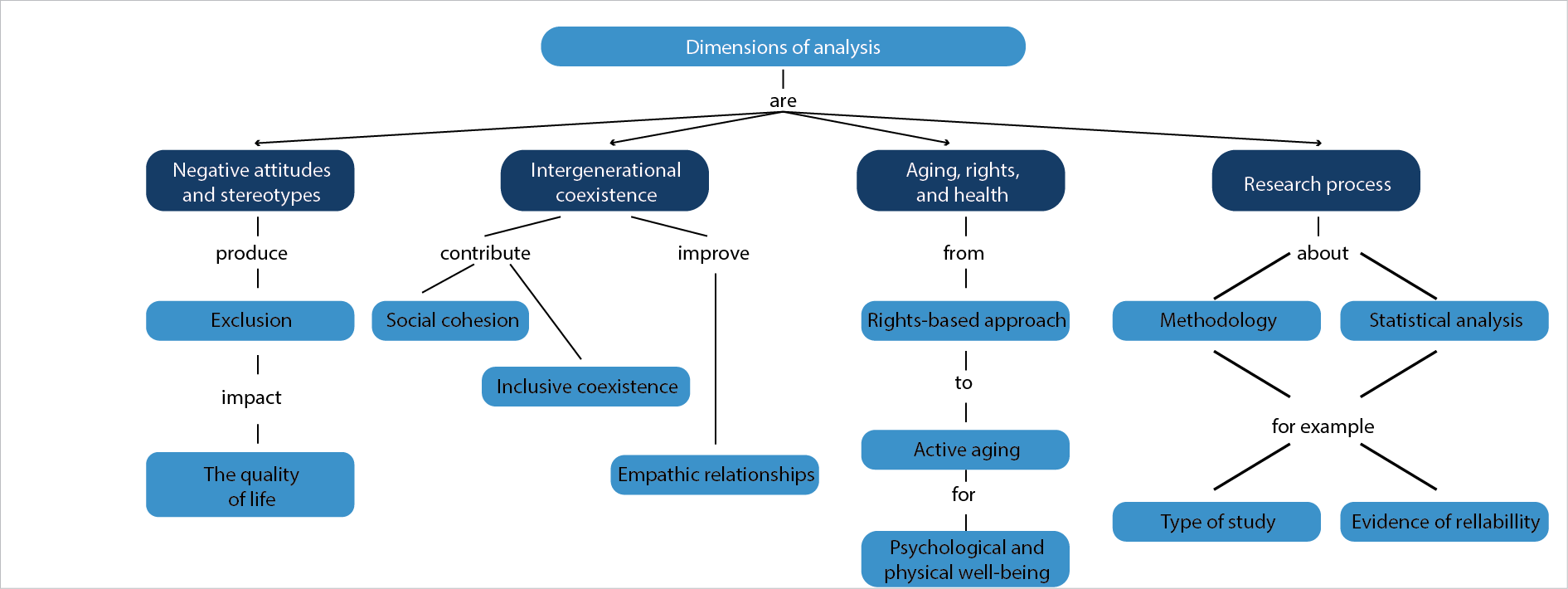
The students prepared their discussion, conclusions and reflections based on these results, which constitutes the second moment of analysis in this formative research experience. The conclusions and recommendations proposed by the students were reviewed and categorized by the course instructor according to the various themes addressed in their work. From this analysis, four main dimensions emerged: attitudes and stereotypes; intergenerational coexistence and social cohesion; aging, rights and health; and finally, the research process (Figure 1).
Figure 1. Student work dimensions
Source: Prepared by the author based upon a review of student research findings.
Dimensions of analysis of students’ production:
As indicated above in the text, negative attitudes and stereotypes are attributions that people make about others, the former being descriptive in nature but the latter being evaluative, which makes them risky as they can lead to the construction of prejudices and, consequently, to exclusion.
In this dimension, students work on the theoretical development related to attitudes and stereotypes toward old age, which is the first approach to the topic. Therefore, their conclusions refer to the impact these stereotyped constructions toward old age have on older adults’ quality of life. Below is a general description of some of the conclusions reached by the working groups, each identified by the letter G and the corresponding number from 1 to 7. As these are extensive reports, an effort has been made to summarize them here:
The young population perceives older adults based on common stereotypes such as cognitive deterioration that reduces their ability to learn (Group 5), loss of skills and dependence, and their relationship with attitudes toward aging (Groups 1, 3, 4), loss of social relevance and inactivity (Group 4). They highlight the complexity and diversity of these perceptions (G3) affecting attitudes toward older adults (G4) since these attitudes affect their self-esteem and well-being and generate exclusion and harm for both older adults and society in general (G7). The concept of ageism is also acknowledged as a form of discrimination against older adults (G4), which has a negative influence on this group’s social perception (G5).
As recommendations, emphasis is placed on the need for social inclusion and reducing prejudices toward this age group (G1, G4), based on educational processes that train the general population in this regard (G3, G6). Since the experience and skills of older adults are valued (G6), this can mitigate ageism, favoring the emotional and physical health of older adults (G6), as well as their social participation (G7).
At the same time, positive attitudes toward aging are recognized and are described as transformative for the physical and emotional health of older adults. This supports the importance of these attitudes from a psychosocial development approach (G2).
People with studies in librarianship consider that there is a vein of work regarding the inclusion of older adults in activities that can be organized by public libraries, which can help combat these prejudices and promote a more positive attitude toward aging (G.5, G7). Public libraries can promote awareness campaigns to eradicate stereotypes about older adults and promote respect for them, highlighting their abilities and contributions (G7). In addition, they can generate activities for older adults (information literacy to train older adults in friendly technological tools [G1 and G7] so that the lack of technological skills does not further isolate people [G1], reading clubs, storytelling workshops, etc.) and the use of bibliotherapy as a complementary tool for emotional well-being. All this requires staff trained in bibliotherapy techniques and inclusive care to provide adequate service to older adults. They also reflect on the need to promote cultural change to eliminate stereotypes and foster a more inclusive and respectful view of aging, especially within Costa Rican society.
Intergenerational coexistence and social cohesion: In this dimension, students offer a reflection on the intergenerationality concept as an alternative to participation that can impact the different forms of discrimination toward aging. The working subgroups propose the inclusion of older adults in various social, labor, and recreational spaces. They emphasize the importance of promoting a healthy and respectful coexistence between generations, highlighting the need to sensitize young adults about perceptions and attitudes toward older adults (G1, G2) since the lack of knowledge and exposure between young and older adults contributes to intergenerational distancing, which highlights the importance of promoting interaction between both groups for a more inclusive (G4), collaborative (G7) and empathetic coexistence (G1).
They also advocate the need to raise awareness among families and communities on how to support older adults while respecting their independence and dignity and propose raising awareness among younger generations about aging and the importance of improving relations between generations by proposing community and educational actions to foster harmonious intergenerational relations (G5, G7). Also carry out activities or projects in which there are more spaces for sharing between generations, favoring mutual understanding and cooperation (G6).
They propose that understanding the needs of older adults and improving intergenerational coexistence can contribute to the psychosocial development of both generations. The idea of promoting an empathetic and collaborative relationship between youth and older adults has a practical approach based on social development (G4).
Aging, rights, and health: This dimension presents a reflection on the fact that although aging implies significant physical changes, not everything is negative, and these do not limit the capacity to learn or develop (a reference of all groups when delving into the theories of aging). They emphasize that older adults have rights and the capacity to continue participating actively in society (G5). Therefore, they emphasize the need to modify public regulations to assist the aging population, which reflects a concern for social dynamics involving older adults (G6).
In turn, they mention that the exclusion of older adults from social life is a phenomenon that affects their emotional well-being and self-esteem and reflect on the lack of social understanding regarding the challenges they face at this stage of life (G6). Also, the social isolation of older adults is a relevant risk factor for their cognitive deterioration, which becomes a challenge for the quality of life of older adults (G5).
Education and learning during old age are valued as fundamental alternatives for personal development in old age. These activities allow them to feel useful and combat emotional and psychosocial problems such as depression and loneliness (G7).
Thus, public libraries again become a source of activities and projects that play a fundamental role in improving the mental health of older adults (G5). They consider it important for students and future professionals to acquire knowledge about the development of people as they age and use this knowledge to promote changes in attitudes toward aging in society (G7).
On the other hand, integrating topics on active aging in educational curricula, especially in teacher education programs (G6) is considered very relevant. Implementing strategies promoting active aging is recommended, which can have a positive impact on perceptions and stigmas toward old age (G6). Promoting education on active aging and spaces where older adults participate in educational and community activities is suggested, which can improve the social perception of old age (G6).
Research process: Regarding the research process, students mentioned that one of the main objectives when posing this didactic strategy was to understand the reality of older adults and how young people’s perceptions can affect intergenerational relationships. Also, social research on aging can provide answers regarding the challenges and opportunities that aging presents for society (G3, G4).
The students make assessments regarding the methodology used, suggesting some improvements to obtain more representative results (G1), as well as highlighting the high reliability of the instrument used in the research (all groups refer to this result of the instrument’s reliability analysis). This constitutes an important advance related to understanding the methodological steps of the research conducted in the context of the course. In the same sense, they highlight the use of a robust methodological approach that includes tools such as photovoice combined with quantitative methods, which allows for a deep and reliable analysis of the subject (G6).
In this dimension, they offer recommendations such as the development of longitudinal research that allows comparison between groups (by age) to identify how perceptions of old age evolve and whether there are patterns according to educational level or living with older adults (G6). They also mention that schooling levels can influence prejudice, which opens up the issue of how education impacts social perceptions (G1). They recommend expanding the sample in future research and using open-ended questions to get a more complete picture (G2). More research in the field can contribute to better understand aging perceptions and raise societal awareness (G6).
Finally, the recommendations focus on improving education about old age and challenging stereotypes through educational programs in universities, intergenerational activities, and using qualitative techniques such as photovoice. These actions intend to raise awareness among young people and foster a more positive view of old age. (G4)
Photographic resource
In this formative process, photographs represent the lessons learned by the research subgroups in ways that go beyond words, which is why their use is recommended. The following photographs are a selection of the lessons learned by students regarding the possibility of active and, therefore, healthy aging (Figure 2).
Figure 2. Old age and apprenticeship have much in common: both have years of divine experience.
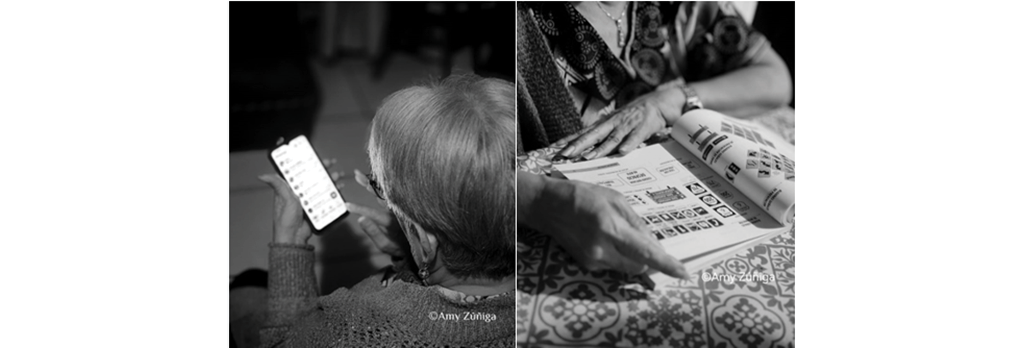
By Zúñiga, A, (2024). Research group student. Photograph used with the author’s permission.
SYNTHESIS AND FINAL THOUGHT
This teaching experience has been enriching because it allows, from collaborative work, not only among students but also between students and teachers, practical learning on a research approach in education and because through the same process, it contributes to generating greater awareness of their perceptions and beliefs regarding older adulthood. This view was present in the people’s reflection about how they can impact improving the quality of life of older adults from their teaching role.
In summary, the research projects conclusions show knowledge of the human development theory and the application of ageism, active aging, and life cycle concepts, thus fulfilling the primary objective set by the course instructor. An important contribution refers to the educational strategies proposed to change negative attitudes toward older adults, as well as promoting intergenerational coexistence and recommendations for future research and pedagogical practices in this field.
A significant reflection is observed regarding professional librarianship practice and its contribution to integral health, particularly its proposal of bibliotherapy as a complementary tool that can be useful for improving the emotional and cognitive well-being of older adults. This practical application is based on the psychosocial development theory and the importance of non-conventional resources for well-being.
This analysis reflects how perceptions toward older adults and aging affect society. It also emphasizes the importance of education and cultural change to foster a more inclusive and respectful view of aging, promoting societal inclusion of older adults through educational policies, programs, and cultural change in new generations.
Likewise, students expressed a greater interest in incorporating more inclusive and empathetic approaches in their future teaching practices. This transformation in perception not only enriches teacher education but also contributes to an educational culture that is more inclusive and respectful of differences and learning processes.
On the other hand, this learning process takes place in the context of a developmental course, so it is relevant to raise awareness about the recognition, respect, and value of each life trajectory and about how each event and decision orients life purpose, giving it meaning and integration as the person approaches old age.
As part of the lessons learned, continuing to strengthen research processes in initial teacher education is recommended, as well as developing specific modules on aging and intergenerational diversity, which integrate practical activities that facilitate understanding older adult experiences. Promoting an inclusive educational approach in initial teacher education can positively impact how new generations interact with and value the older adult population.
This process confirms the need to include awareness components when addressing stereotypes and negative attitudes, specifically toward older adults in different teacher education programs. Continuing to strengthen formative research processes in initial teacher education is recommended, as well as developing specific modules on aging and intergenerational diversity, which integrate practical activities that facilitate understanding older adult experiences. Promoting an inclusive educational approach in initial teacher education can positively impact how new generations interact with and value the older adult population.
On the other hand, the pedagogical practice of formative research requires additional time from the instructor, making the implementation of such experiences a challenge for the educational curriculum in terms of accommodating both formative research and the development of classroom learning content.
Finally, the transformation of attitudes and stereotypes can be achieved through awareness-raising efforts; a mere review of theoretical content within a course is not sufficient. Therefore, this formative research exercise significantly contributes to the objective of fostering critical reflection.
REFERENCES
Aguiar, T. (2014). La papa caliente: una adaptación didáctica para aprender a redactar preguntas de investigación en psicología. Enseñanza e investigación en psicología, 19(1), 5-20. https://www.redalyc.org/articulo.oa?id=29232614001
Asís, M., Monzón, E., & Hernández, E. (2022). Investigación formativa para la enseñanza y aprendizaje en las universidades. Mendive. Revista de Educación, 20(2), 675-691. http://scielo.sld.cu/scielo.php?script=sci_arttext&pid=S1815-76962022000200675&lng=es&tlng=es
Ausubel, D., Novak, J., & Hanesian, H. (1983). Psicología educativa. Un punto de vista cognoscitivo. Trillas.
Badilla, I.; Jiménez, R.; Arce, H.; García, A.; Esquivel, S., & Sánchez, G. (2021). Reflexiones teórico-metodológicas para el abordaje de las personas adultas mayores en situación de vulnerabilidad: de la educación social a la pedagogía social, un estudio en la provincia de Alajuela, Costa Rica. Revista Universidad en Diálogo: Revista de Extensión, 11(2), 95-123. http://hdl.handle.net/11056/28499
Barrios, M., Sánchez, M., Pirela, L., & Mariotti, L. (2016). Actitud de adultos venezolanos hacia la vejez. Espacio Abierto Cuaderno Venezolano de Sociología, 25(4), 299-313. https://www.redalyc.org/pdf/122/12249087023.pdf
Blanca, J.M., Palacios, C., & Trianes, M. V. (2005). Cuestionario de evaluación de estereotipos negativos hacia la vejez. Revista Multidisciplinar de Gerontología, 15(4), 212-220. https://bit.ly/4mQHUPH
Barranquero, R., & Ausín, R. (2019). Impacto de los estereotipos negativos sobre la vejez en la salud mental y física de las personas mayores. Revista de Psicogeriatria, 9(1), 41-47. https://bit.ly/3FEoehe
Campos, M., & Salgado, E. (2013). Percepción sobre la tercera edad en estudiantes de primer nivel dela facultad de psicología de ULACIT y su relación con el desarrollo de competencias profesionales para el trabajo con adultos mayores. Revista Rhombus, (1), 1-30. https://bit.ly/43LfOwn
Casasola, W. (2020). El papel de la didáctica en los procesos de enseñanza y aprendizaje universitarios. Comunicación, 29(1), 38-51. https://dx.doi.org/10.18845/rc.v29i1-2020.5258
Corona, W. (2023). Caracterización de los componentes de la investigación formativa en la universidad contemporánea en Latinoamérica. Revista Educación, 47 (1), 605-622. http://dx.doi.org/10.15517/revedu.v47i1.51880
De Miguel Negredo, A., & Castellano Fuentes, C. L. (2012). Evaluación del componente afectivo de las actitudes viejistas en ancianos: escala sobre el Prejuicio hacia la Vejez y el Envejecimiento (PREJ-ENV). International Journal of Psychology and Psychological Therapy, 12(1), 69-83. https://www.redalyc.org/articulo.oa?id=56023335010
Dedotsi, S. & Cabiatib, E. (2024). ‘Say it with a photograph!’ exploring Greek and Italian students’ opinions and feelings about social work and migration through photovoice. Social Work Education, 43 (9), 2503–2519. https://doi.org/10.1080/02615479.2023.2269171
Delgado, C, (2014). Viajando a Ítaca por mares cuantitativos. Manual de ruta para investigar en grado y postgrado. Amarú.
Enríquez-Reyna, M., Gurrola-Mata, M., Torres-Saucedo, C., Hernández-Cortés, P. & Juno-Vanegas-Farfano, M. (2024). Actitudes hacia adultos mayores y percepciones por tipo de envejecimiento en universitarios. Gerokomos, 35(2), 78-83. Actitudes hacia adultos mayores y percepciones por tipo de envejecimiento en universitarios
Heckemann, B., Großschädl, F., Schüttengruber, G. y Holmberg, C. (2022). Attitudes towards oldest-old adults (age ≥80 years): A survey and international comparison between Swedish and Austrian nursing students. Scandinavian Journal of Caring Sciences, 36(4), 1083-1093. https://doi.org/10.1111/scs.13005
Fernández, E., Padilla, P., Monardes, H. & Diaz, C. (2017). Actitud hacia el adulto mayor en estudiantes del pregrado de la Facultad de odontología Universidad San Sebastián, Santiago. Revista Estomatológica Herediana, 27(1), 21-29. a04v27n1.pdf
García, G.; (2015). La investigación en la formación docente inicial. Una mirada desde la perspectiva socio transformadora. Saber, 27(1), 143-151. https://www.redalyc.org/pdf/4277/427739474018.pdf
González, J., Agusti, A., Guillem, J., Parra, M., & Cantero, M. (2021). Actitud hacia las personas mayores y variables asociadas en un grupo de estudiantes universitarios del ámbito de la educación. Revista INFAD De Psicología. International Journal of Developmental and Educational Psychology, 3(2), 115–120. https://doi.org/10.17060/ijodaep.2021.n2.v3.2278
Gutierrez, M. & Mayordomo, T. (2019). Edadismo en la escuela. ¿Tienen estereotipos sobre la vejez los futuros docentes? Revista , 577-587.
Guzmán-Siles, P. (2024). Actitud hacia el adulto mayor en estudiantes universitarios de la Universidad Técnica Nacional y de la Universidad de Iberoamérica. Revista PsicoInnova, 8(1), 26-37. https://doi.org/10.54376/psicoinnova.v8i1.206
López, A. (2019). Evaluación de las actitudes hacia el adulto mayor: Estudio comparativo entre Baja California (México) y Castilla y León (España). [Doctoral dissertation]. University of Salamanca. https://summa.upsa.es/viewer.vm?id=108361&page=94
López, J., Barrera, A., Paz, G., Gutiérrez, M., & Aragón, D. (2024). Actitudes hacia los adultos mayores en estudiantes universitarios de la Facultad de Estudios Superiores Zaragoza de la Universidad Nacional Autónoma de México. LATAM Revista Latinoamericana De Ciencias Sociales Y Humanidades, 5(3), 1355 – 1363. https://doi.org/10.56712/latam.v5i3.2119
Menéndez, S., Álvarez‐Dardet, A., Cuevas‐Toro, J., Pérez, B., & Lara, L. (2016). Evaluación de los estereotipos negativos hacia la vejez en jóvenes y adultos. Revista Española de Geriatría y Gerontología, 51(6), 323-328. http://dx.doi.org/10.1016/j.regg.2015.12.003
Restrepo, B. (2002). Conceptos y Aplicaciones de la Investigación Formativa, y Criterios para Evaluar la Investigación científica en sentido estricto. Ministerio de Educación Nacional. Colombia. https://bit.ly/45esX3x
Tapia, E., Ledo, C., & Estrabao, A. (2017). Fundamentos epistemológicos de la investigación formativa en las universidades de ecuador. Didáctica y educación, 8 (7), 1-13. https://dialnet.unirioja.es/descarga/articulo/6694488.pdf