Año 25, n.º 52: 106-131,
julio-diciembre 2026
Students’ Perceptions of Collaborative
Learning Resources in EFL Teacher Education: The English Teaching
Major for I and II Cycles at Universidad Estatal a Distancia
Tricia
Henderson-Carman *
https://orcid.org/0009-0007-4646-888X
*
Master’s in Teaching English as a Foreign Language from the University of Costa
Rica. Is an experienced educator currently working at Universidad Estatal a
Distancia (UNED), from Costa Rica. Mail: tjane@uned.ac.cr
Abstract
This
article examines the use of visual organization resources within collaborative
practices in English as a Foreign Language (EFL) teacher education and their perceived
contribution to learning and soft skill development. The study analyzed pre-service
teachers’ perceptions of two resources, color coding and graphic organizers,
and their contribution to learning. The study was grounded in several theories that
emphasize social interaction, scaffolding, and positive interdependence. A descriptive mixed-methods approach was utilized
through a diagnostic questionnaire and two post-implementation instruments
administered to pre-service English teachers at the Universidad Estatal a
Distancia (UNED) in Costa Rica. Quantitative data indicate that both resources
supported organization, comprehension, and collaborative work, while
qualitative findings highlight perceived growth in soft skills such as
teamwork, responsibility, accountability, creativity, and critical thinking. Participants
also reported challenges related to time, unequal participation, and task clarity.
Overall, the findings suggest that color coding and graphic organizers can
support collaborative learning and soft skill development when implemented with
clear structure, sufficient time, and explicit role assignment. As the findings
are based on participants’ perceptions, they should be interpreted as perceived
contributions rather than direct measures of learning or skill development.
Keywords:
distance education, instructional materials, linguistic competence, soft
skills.
Received: March 17, 2026
Accepted: October 07, 2026
Percepciones de los estudiantes
sobre los recursos de aprendizaje colaborativo en la formación docente en
inglés como lengua extranjera: la Carrera de Enseñanza del Inglés para I y II
ciclos de la Universidad Estatal a Distancia
Resumen
Este artículo examina el uso de recursos
de aprendizaje colaborativo en un programa de formación de docentes de inglés
como lengua extranjera (EFL) y la contribución percibida al aprendizaje y al
desarrollo de habilidades blandas. El estudio analizó la percepción del
estudiantado sobre la codificación por colores y los organizadores gráficos. La
investigación se fundamentó en teorías que destacan la interacción social y la
interdependencia positiva. Se empleó un enfoque de métodos mixtos descriptivos mediante
un cuestionario diagnóstico y dos instrumentos posteriores a la implementación con
futuros docentes de inglés de la Universidad Estatal a Distancia, de Costa Rica.
Los datos indican que ambos recursos apoyaron la organización, la comprensión y
el trabajo colaborativo. Los hallazgos cualitativos destacan el desarrollo
percibido de habilidades blandas como el trabajo en equipo, la responsabilidad,
la creatividad y el pensamiento crítico. También se reportaron desafíos
relacionados con el tiempo, la participación desigual y la claridad de las
tareas. Los hallazgos sugieren que estos recursos pueden apoyar el aprendizaje
colaborativo y el desarrollo de habilidades blandas en la formación docente. Dado
que los resultados se basan en las percepciones de quienes respondieron, deben
interpretarse como contribuciones percibidas y no como medidas directas del
aprendizaje o del desarrollo de habilidades.
Palabras clave: competencia
lingüística, educación a distancia, habilidades blandas, material didáctico.
Perceptions des étudiants à l’égard
des ressources d’apprentissage collaboratif dans la formation des enseignants
d’anglais langue étrangère : le cours de formation des enseignants d’anglais
pour le premier et LEdeuxième cycles de
l’enseignement primaire à l’Université d’État à Distance
Résumé
Cet article examine le recours aux
ressources d’apprentissage collaboratif dans un programme de formation des
enseignants d’anglais langue étrangère (ALE), ainsi que leur contribution
perçue aux apprentissages et au développement des compétences transversales.
L’étude porte sur les perceptions des étudiants concernant le codage couleur et
les organisateurs graphiques. Elle s’appuie sur des approches théoriques qui
mettent en avant l’interaction sociale et l’interdépendance positive. La
recherche adopte une approche descriptive fondée sur des méthodes mixtes. Elle
repose sur un questionnaire diagnostique et deux instruments administrés à
l’issue de la mise en œuvre des ressources auprès de futurs enseignants
d’anglais de l’Université d’État à Distance, au Costa Rica. Les données
recueillies indiquent que ces deux ressources ont contribué, selon les
participants, à l’organisation des idées, à la compréhension et au travail
collaboratif. Les résultats qualitatifs mettent en évidence le développement
perçu de compétences transversales telles que le travail en équipe, le sens des
responsabilités, la créativité et l’esprit critique. Des difficultés liées à la
gestion du temps, à la participation inégale des membres des groupes et au
manque de clarté des consignes ont également été signalées. Les résultats
suggèrent que ces ressources peuvent favoriser l’apprentissage collaboratif et
le développement des compétences transversales dans le cadre de la formation
des enseignants. Toutefois, dans la mesure où ils reposent sur les perceptions
des répondants, ils doivent être interprétés comme des contributions perçues et
non comme des mesures directes des apprentissages ou du développement des
compétences
Mots-clés : Compétence linguistique, compétences
transversales, enseignement à distance,
matériel pédagogique.
Introduction
«Most
great learning happens in groups. Collaboration is the stuff of growth».[1]
Collaborative
learning has become a central approach in education at all levels, particularly
in teacher education programs that seek to prepare future educators for
learner-centered and communicative classrooms. In English as a Foreign Language
(EFL) contexts, collaboration is connected not only to linguistic development
but also to the strengthening of soft skills, such as teamwork, accountability,
critical thinking, and creativity. These competences are relevant for
pre-service teachers.
The
sociocultural and cooperative learning perspectives discussed in the following
section provide a framework for understanding how interaction, dialogue, and
shared problem-solving contribute to knowledge construction. Collaborative
settings offer learners opportunities to exchange ideas, negotiate meaning, and
organize information collectively. These experiences are particularly relevant
in pre-service teacher education, where future teachers can reflect on
pedagogical practices they may later use in their own classrooms.
This
article draws on a research project conducted at Universidad Estatal a
Distancia (UNED), Costa Rica, with pre-service teachers enrolled in the course
Evaluation of Learning while Teaching EFL during the second quarter of 2024.
Many of these students were in their second or third year of the English
Teaching Major for I and II Cycles.
At
UNED, specifically in the English Teaching Major for I and II Cycles, courses
incorporate both collaborative and individual learning experiences. Since the
courses are taught through distance education, individual tasks are used to
build personal comprehension, autonomy, and self-discipline, while
collaborative activities are incorporated to encourage the co-construction of
knowledge, teamwork, and peer learning, and are often used to help maximize the
virtual learning experience. Within this context, color-coding and graphic
organizers were incorporated into collaborative activities during two online
workshops in the course. These activities involved organizing, synthesizing,
categorizing, and communicating information. The findings may inform the design
of similar activities in teacher education courses, including those involving
educational analysis, reading comprehension, and collaborative discussion in
distance and face-to-face settings.
The
main objective of the study was to explore pre-service English teachers’
perceptions of color-coding and graphic organizers as visual organization
resources used within collaborative learning activities in an EFL teacher
education context. Specifically, the study examined their perceived usefulness
for organizing and understanding information, supporting collaborative work,
and contributing to soft skill development, as well as the difficulties
participants encountered when using these resources.
Theoretical
background
Both
the research project and this article are guided by an integrated theoretical background
based primarily on the Sociocultural (Constructivist) Learning Theory, along
with several supporting theories, including Social Cognitive Theory, Multiple
Intelligences Theory, Cooperative Learning principles, and more contemporary
theories that build on collaboration in the classroom. This background aims to provide
a clear path to better understand how learning comes through interaction,
scaffolding, and engagement through dialogue, and how specific instructional practices
can put these theoretical assumptions into play in teacher education contexts.
Each
theoretical perspective included in the study supports a specific aspect of the
analysis. Sociocultural Learning Theory provides the main framework for
understanding learning through social interaction, mediation, and shared
activity. Social Cognitive Theory supports the consideration of observational
learning, modeling, and students’ regulation of their participation in
collaborative contexts. Multiple Intelligences Theory provides a complementary
perspective on the use of visual resources and different ways of engaging with
information. Cooperative Learning Theory supports the analysis of collaboration
through positive interdependence, individual accountability, and interpersonal
interaction. The perspectives proposed by Bruffee, Sawyer, and Harasim further
inform the understanding of knowledge construction through dialogue, shared
questioning, group creativity, and online collaborative knowledge building. A
more thorough description of each theoretical perspective is included in the
following paragraphs.
Collaborative
learning in teacher education can be understood through perspectives that focus
on the social construction of knowledge. Sociocultural Learning Theory,
originally proposed by Lev Vygotsky[2],
argues that cognitive development occurs through social interaction and
mediated learning experiences. From this
perspective, knowledge is not only constructed individually but rather emerges
through conversation, collaboration, and participation in shared learning
activities, which are the basis of the study that was conducted.
A key
concept within Vygotsky’s theory is the Zone of Proximal Development (ZPD),
defined as the space in which learners can accomplish tasks with the support of
peers or instructors that they would not yet be able to complete on their own.
Within this zone, learning is supported through scaffolding, discussion, and
collaborative problem-solving. Contemporary research has continued to
demonstrate the relevance of sociocultural principles in higher education
settings, highlighting how collaborative learning environments allow students
with varying levels of expertise to support one another’s development through
peer interaction and shared knowledge construction. Dewi, Yusuf, and Subagya[3],
for example, demonstrated that implementing social constructivist principles in
classroom learning strengthens cooperative attitudes and collaborative
behaviors. Their study, grounded in Vygotsky’s theory, linked constructivist
principles to collaborative behavior in group tasks. Wibowo and colleagues[4]
examined the relevance of Vygotsky’s constructivist learning theory in
different learning environments. The authors highlighted the importance of
scaffolding, peer interaction, and guided collaboration within the ZPD. Their findings show that collaborative
learning activities enable learners with varying abilities to support one
another’s progress.
While
sociocultural theory provides the primary basis for this article, other
perspectives help support the understanding of collaborative learning
processes. For example, Social Cognitive Theory, developed by Albert Bandura[5], highlights
the role of observational learning, imitation, and modeling in shaping
behavior. It suggests that people acquire knowledge and behavioral patterns by
observing others, as well as by reflecting on the consequences of their own and
others’ actions. In other words, although learning can occur through direct
instruction, it also occurs through observation, modeling, and social
interaction. Within collaborative
learning environments in educational settings, students learn by observing
peers, discussing shared goals,
and regulating their contributions in response to group dynamics. Other, more contemporary
researchers have continued the research started by Bandura years ago. For
example, Nur Syafiqah Abdul Kadar and colleagues examined online group work
through a social cognitive lens, linking personal, behavioral, and
environmental factors to collaborative outcomes in higher education[6].
They
build on the same principles introduced by Bandura and apply them to online
higher education contexts.
Furthermore,
Howard Gardner’s Multiple Intelligences Theory questions traditional views of
intelligence by suggesting that individuals hold varied cognitive strengths,
including linguistic, logical-mathematical, visual-spatial, interpersonal, and
intrapersonal intelligences[7].
From this perspective, learning is improved when instructional strategies
engage multiple means of interaction. The use of color-coding and graphic
organizers aligns closely with this theoretical view by engaging visual-spatial
and interpersonal intelligences while at the same time supporting linguistic
processing when used in EFL classroom contexts. When used collaboratively,
these visual organization resources allow learners to negotiate meaning,
organize information visually, and draw on others’ strengths within the group. This
theory aligns with Vygotsky since students who are allowed to work with
individuals who possess different types of intelligence have the opportunity to
learn from those individuals in their collaborative processes.
Another
complementary perspective is Cooperative Learning Theory, developed by David
and Roger Johnson, which emphasizes positive interdependence, individual
accountability, creative interactions, and social skills development within
cooperative learning. Johnson and Johnson state, «Cooperative learning
groups are based on positive interdependence among group members, where
goals are structured so that students need to be concerned about the
performance of all group members as well as their own»[8]. These
principles highlight the importance of structuring tasks in ways that require
students to rely on one another to achieve shared goals. Visual organization
resources such as color-coding and graphic organizers implemented
collaboratively can support these principles by distributing responsibilities
among group members and encouraging discussion, feedback, and collective
problem-solving.
In
addition, perspectives on collaborative knowledge construction have been
explored by scholars such as Kenneth A. Bruffee[9]
and R. Keith Sawyer[10],
who emphasize that learning often develops through dialogue, shared
questioning, and group creativity. These ideas have also been extended to
digital learning contexts through Linda Harasim’s theory of Online
Collaborative Learning[11],
which highlights communicative knowledge-building processes that occur when
learners generate, organize, and process ideas collectively.
Collaborative
learning environments also provide opportunities for students to develop soft
skills, which are increasingly recognized as essential for professional
success. Soft skills include interpersonal communication, teamwork,
responsibility, creativity, and critical thinking. In teacher education
programs, these competences are particularly important because future educators
must not only master disciplinary knowledge but also develop the interpersonal
and organizational abilities required to manage collaborative and communicative
classrooms.
Within
this framework, the use of visual organization resources such as color-coding
and graphic organizers serves both cognitive and collaborative functions. These
resources can help learners organize information visually, clarify
relationships among ideas, and communicate their understanding to peers. When implemented in group contexts, they also
encourage negotiation of meaning, shared decision-making, and collective
problem-solving.
Together,
the theoretical perspectives presented here help frame collaborative learning
as a social, cognitive, and professional process. By basing the analysis
primarily on sociocultural theory while incorporating complementary
perspectives on collaboration, it provides a lens for understanding how these visual
organization resources used within collaborative learning activities may
support both linguistic development and the improvement of soft skills among
pre-service English teachers.
Within
the study, regarding color-coding as a resource used within collaborative
learning activities, it was key to demonstrate how the use of color-coding
could aid students in the organization of their ideas, in the incorporation of creativity
and clarity in their organization, and in the ability to work together in teams
to communicate their ideas effectively. As France Preechawitayakul
states in «The Ultimate Guide to Color Coding in E-learning», «Although you
might associate colors with something that only children would use, you would
be surprised by how effective they actually are for college students and adults»[12].
Color-coding is often used in research, especially because the content can be
lengthy and varied, and students find this resource useful to decode and
organize the information. It would seem that this same resource could be used
and applied to smaller chunks, such as in the construction of the indicators of
learning and of the Table of Specifications (TOS), which were the two
assignments that the students in the study were given to use color-coding.
Along
the same lines, the creation of graphic organizers is a visual organization
resource that can be used in a collaborative learning environment. The use of
this resource can aid students in organizing their ideas effectively and
conveying information in a way that is more visually appealing and more clearly
understood. Patricia Lupion
Torres talks about this in her Handbook of Research on Collaborative
Learning Using Concept Mapping:
Students can work with each other online,
collaborating, interfering, modifying, doing research, inserting annotations,
documents, links, and pictures and setting up discussion threads. By engaging
in the construction of concept maps, students think about both the content and
the form. The organized visual
representation of content also helps in the transfer of knowledge from the
short-term memory to the long-term memory, anchoring new concepts to previously
acquired ones.[13]
While
previous studies provide theoretical and experiential support for
collaboration, visual organization, and knowledge construction, the study
referred to in this article contributes a more specific perspective by
examining pre-service English teachers’ perceptions of two visual organization
resources within a distance teacher education course. In particular, the study
focuses on their use in assessment-related tasks, the use of colors to better
identify important parts of the table of specifications, and the use of graphic
organizers to synthesize information from teacher interviews and course
readings, alongside participants’ perceived benefits and difficulties while
using these resources. Therefore, the contribution of the study does not
establish the effectiveness of these resources, but documents and describes how
a specific group of pre-service teachers perceived their use within these
particular academic activities while working collaboratively.
As
mentioned by Angela Izuagba and Adaku Afurobi, in
their article, Equipping Learners with Soft Skills Using Collaborative
Teaching/Learning Strategies, «Soft skills are personal attributes that
enhance an individual’s inter-personal interactions and job performance in
spite of his/her level of hard skills’ knowledge»[14].
While it is obvious that students in the English Teaching major need to develop
a high level of linguistic competence, not everyone thinks about the importance
of developing soft skills.
Providing
spaces where learners have opportunities to develop soft skills and linguistic
competence through collaborative learning practices is key for current and
future academic settings and professional situations. As the English Teaching Major
for I and II Cycles is in charge of producing quality English teachers who, in
turn, will adequately prepare youth for both English language use and normal
challenges in life, it is of utmost importance to implement effective ways to
aid students in this major to work collaboratively, improve linguistic competence,
and develop important soft skills. Of course, participants must be able to put
all of this into practice in both their studies and in their future classrooms
as teachers. Teachers who can
collaborate, think critically, organize their ideas, communicate their thoughts
comprehensively, apply creativity, and act responsibly will be more impactful
as examples of those important soft skills for their own students. So, the
ideas and the theory that are proposed and included here would hopefully not
only benefit the participants in the study but also their future students.
The
theories discussed previously provide a rational foundation for analyzing the
implementation and outcomes of visual organization resources used within collaborative
learning activities in EFL teacher education. They frame collaboration as a
cognitive, social, and professional process, offering a clear lens through
which the findings of the study are interpreted.
Methodology[15]
This
article describes the steps taken to carry out the study and provide
transparency regarding the research process. Although the instruments were
reviewed by four peers for clarity and relevance, no statistical reliability
analysis or empirical validation with a larger sample was conducted. Therefore,
the findings should be interpreted as descriptive accounts of the perceptions
of the participants in this particular course and context rather than as
generalizable evidence of the effectiveness of the resources.
The
study used a descriptive mixed-methods approach to examine participants’
perceptions of two visual organization resources used within collaborative
learning activities. Quantitative data were obtained from closed-ended
questionnaire items and summarized using the descriptive statistics provided by
Google Forms. Qualitative data were obtained from open-ended questions and were
reviewed and grouped according to recurring categories related to the perceived
usefulness of the resources, collaborative work, soft skills, linguistic
competence, and difficulties encountered. The quantitative and qualitative
findings were integrated during interpretation by comparing the patterns
identified in the closed-ended responses with the explanations and examples
provided in the open-ended responses. This integration allowed the qualitative
responses to give context to the quantitative patterns, especially in relation
to the perceived benefits and challenges.
The
research was conducted in the English Teaching Major for I and II Cycles at
Universidad Estatal a Distancia (UNED) in Costa Rica. Participants were
pre-service English teachers enrolled in a university-level virtual modality course,
Evaluation of Learning while Teaching EFL, that incorporated
collaborative learning as a regular instructional practice. Both quantitative
and qualitative data were collected through three instruments: a Diagnostic
Questionnaire, administered before the implementation of the strategies to retrieve
demographic information and prior knowledge from participants; Post-Implementation
Instrument #1, administered after the use of color-coding to better understand
the participants’ perceptions of the use of color-coding as a visual
organization resource used within collaborative learning activities; and
Post-Implementation Instrument #2, administered after the use of graphic
organizers to have a better idea of participants’ perceptions of the use of
graphic organizers as a visual organization resource used within collaborative
learning activities. All instruments included a disclaimer informing
participants about the purpose of the research and the voluntary and anonymous
nature of their participation. Participants were informed that their responses
would be used for research purposes and that participation or non-participation
in the questionnaires would not affect their course evaluation or academic
standing.
Participants
were selected because they were enrolled in the course where both visual
organization resources could be naturally integrated into existing collaborative
course activities. A total of 29 students from different regions of Costa Rica
including Guapiles, Alajuela, Palmares, Heredia and
San José, were enrolled in the course during the second quarter of 2024 and
were distributed across two groups. Throughout the course, students worked on
different activities related to the evaluation of learning while teaching EFL,
including the construction of tests for the different skills, the creation of
rubrics, and the construction of the Table of Specifications, among other
important topics. All enrolled students were invited to participate in each
questionnaire; however, since participation was voluntary, the number of
responses varied across the three instruments, as shown in Table 1.
Table 1.
Student participation in data collection
|
Data
collection instrument |
Students
enrolled |
Responses |
Response
rate |
|
Diagnostic
questionnaire |
29 |
13 |
44.8
% |
|
Post-implementation
instrument #1: Color coding |
29 |
19 |
65.5
% |
|
Post-implementation
Instrument #2: Graphic organizers |
29 |
25 |
86.2
% |
Source:
Based on course enrollment and questionnaire response data reported by Tricia
Henderson, 2024.
At
different moments throughout the course, all 29 enrolled students were invited
to participate in all three stages of data collection, and all participated in
the in-class collaborative learning activities. However, as the table shows,
the number of responses varied across instruments. Because the response groups
were not identical across the three instruments, comparisons between diagnostic
and post-implementation responses cannot be interpreted as evidence of change
among the same participants. Also, since the demographic information was
retrieved only from those who filled out the diagnostic questionnaire, it is
not a real representation of the total number of participants. This indicates a
methodological limitation of the study. Nonetheless, it is possible to include
important information about the group profile in general.
Overall,
the group represented a heterogeneous population for the most part in terms of
prior academic experience and linguistic proficiency, reflecting common
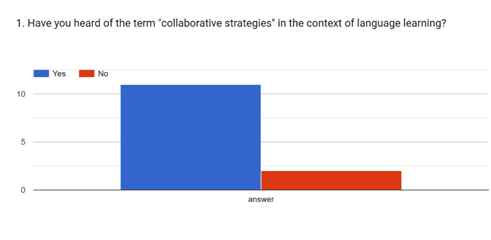
characteristics of students in teacher education programs. Nearly all of the
participants had previously heard of the term «collaborative strategies» in the
context of language learning, and several «collaborative strategies» were
identified as having been previously used, as reflected in Figures 1 and 2.
It is
relevant to clarify that the questionnaires used the term «strategy» when
referring to color-coding and graphic organizers, reflecting the terminology
used in the instruments administered to participants. In this article, however, these two practices
are referred to as visual organization resources to avoid implying the study
establishes their validity or effectiveness as instructional strategies. When
reporting questionnaire items or participants’ responses, the original term
«strategy» is used to accurately represent the data collected. Figure 1 presents participants’ responses
regarding their prior familiarity with the term «collaborative strategies».
Figure
1. Prior knowledge
|
|
Source:
Based on Tricia Henderson, «Diagnostic Questionnaire», Google Forms survey, June
2024.[16]
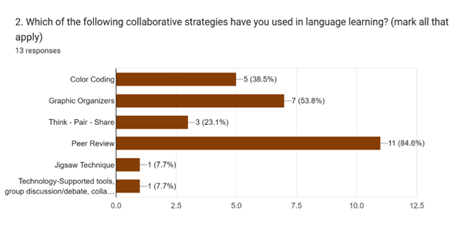
Figure
2 presents participants’ reported prior experience with different collaborative
strategies in language learning.
Figure
2. Previously used collaborative strategies
|
|
Source:
Based on Tricia Henderson, «Diagnostic Questionnaire», Google Forms survey,
June 2024.[17]
Both visual
organization resources, color coding and graphic organizers, were implemented
as part of regular collaborative course activities. They were selected due to
their alignment with the activities to be implemented, their potential to
support collaborative work and provide opportunities to practice soft skills
with appropriate guidance, and their connection to the theoretical framework
discussed above. Color-coding was used to support visual organization,
categorization of information, and shared meaning-making, while graphic
organizers were used to facilitate collective organization of ideas, synthesis,
and representation of ideas.
Prior
to the implementation of each resource, students were provided with short
instructional videos explaining the purpose of the visual organization resource
and demonstrating how it could be applied in the course assignments. The videos
were created by the researcher and shared through the course platform[18]. Color-coding
was incorporated into an assignment related to the construction of a Table of
Specifications (TOS) used in language assessment design. Graphic organizers were
incorporated into an activity in which students synthesized information
obtained from interviews with English teachers and analyzed course readings. The
steps for implementing each visual organization resource are presented in Table
2.
Table 2.
Steps for implementing visual organization resources
|
For
color coding |
For
graphic organizers |
|
1. Students
watched the instructional video. 2. Students
reviewed what was expected of them for the construction of the Table of
Specifications (TOS). 3. Students
assigned colors to components of the TOS as they worked on its construction. 4. Students
discussed their coding decisions. 5. Students
collaboratively completed the task. |
Before
the workshop, students had to have already analyzed their assigned readings
and completed an assignment including interviews with teachers about
appropriate assessment practices. 1. Students
watched the instructional video. 2. Students
synthesized findings collaboratively and selected a graphic organizer type
that best displayed their findings from the interviews. 3. Students
shared and discussed their results using their graphic organizers. |
Source:
Based on lesson plans developed for the course Evaluation of Learning while teaching
EFL at Universidad Estatal a Distancia (UNED), second quarter of 2024. Table
prepared by the author.
Regarding
data analysis from the instruments, quantitative data obtained from the
closed-ended questionnaire items were analyzed using the statistics provided by
Google Forms. The qualitative responses were organized into the following categories:
perceived usefulness for organizing and understanding information,
collaborative interaction, perceived contribution to soft skills, perceived
contribution to linguistic competence, and difficulties or suggestions for
improvement. Responses were reviewed and grouped according to recurring ideas
within these categories. Quotations were selected because they clearly
illustrated recurring perceptions identified in the qualitative responses and
because they represented either a commonly expressed benefit or a relevant
challenge. The quotations were used illustratively and were not used as
independent evidence of effectiveness.
Results
This
section presents the findings from the diagnostic questionnaire and the two
post-implementation instruments.
Diagnostic questionnaire
The
diagnostic questionnaire was administered to explore participants’ prior
familiarity with collaborative learning strategies and their perceptions of
their role in language learning and soft skill development. Two of the charts
can be found in the Methodology section above, Figures 1 and 2.
Most
participants (11 out of 13; 84.6 %) reported that they had previously heard the
term collaborative learning strategies, indicating general awareness of
the concept. However, two participants reported no prior familiarity with the
term.
Regarding
prior experience with collaborative strategies, peer review and group
discussions/debates were the most commonly used, reported by 84.6 % of
participants. In contrast, participants reported less frequent prior experience
with color coding (38.5 %) and graphic organizers (53.8 %). Other collaborative
learning strategies, such as jigsaw activities and technology-supported tools,
were mentioned by only 7.7 % of participants.
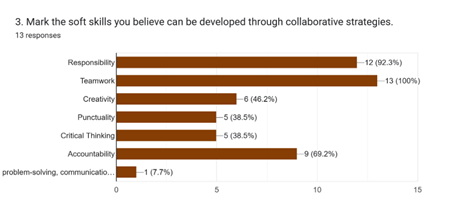
Participants
also identified several soft skills they believed could be developed through
collaborative strategies. Teamwork (100 %) and responsibility (92.3 %) were the
most frequently identified skills.
Creativity and critical thinking were recognized by 46.2 % of
participants. Figure 3 summarizes participants’ responses regarding the soft
skills they believed could be developed through collaborative strategies.
Figure
3. Soft skills
|
|
Source:
Based on Tricia Henderson, «Diagnostic Questionnaire», Google Forms survey, June
2024.[19]
When
asked about the importance of collaborative strategies in language learning,
most participants expressed positive perceptions. Seven participants strongly
agreed, and five agreed that collaborative strategies contribute to the
development of linguistic competence and soft skills.
Participants
also described several challenges in connection with collaborative learning
based on their own experiences. The most frequently mentioned issues included:
unequal participation among group members, differences in work styles and opinions,
difficulties coordinating schedules, and concerns about fairness in group
assessment. Table 3 presents selected verbatim responses from participants
illustrating these challenges.
Table
3. Participants’ perception of challenges in collaborative learning activities:
verbatim comments
|
Participant
1 |
«The
challenge for me is about being able to really commit to invest the time to
develop the collaborative strategy appropriately, because sometimes you are
running out of time or you have other duties and you don’t really apply the
technique as it should be applied». |
|
Participant
2 |
«Although
I agree that we can learn from social interactions and group activities, it
is very difficult to coordinate with peers». |
|
Participant
3 |
«Often,
some group members contribute more than others, miscommunications or lack of
clear communication, and differences in options and work styles». |
|
Participant
4 |
«Several
challenges can arise while using collaborative learning strategies as a
student. Some significant challenges are: coordinating schedules and ensuring
that all group members are available for meetings and discussions; unequal
participation of group members can lead to frustration, differences in
opinions, working styles or personal goals». |
Source:
Based on participants’ responses to Tricia Henderson’s «Diagnostic
Questionnaire», Google Forms survey, June 2024.
These
responses indicate that while students recognize the potential benefits of
collaborative learning based on the quantitative data, they also perceive
several challenges related to group dynamics and responsibility, which they
expressed in the qualitative data.
Post-implementation
instrument 1: Color-coding
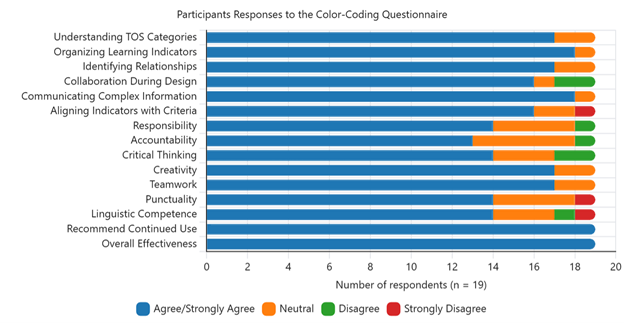
Post-implementation
instrument #1 examined participants’ perceptions after implementing color-coding
as a visual organization resource within a collaborative activity during the design
of a Table of Specifications (TOS). Overall, participants reported high levels
of agreement that the resource supported the organization of information and
the understanding of relationships among learning indicators. Nearly 95 % of
participants agreed or strongly agreed that color coding helped in the
categorization and organization of learning indicators within the TOS. Participants
also indicated that the use of color-coding supported collaborative interaction
during the design process, with most respondents reporting agreement that the
activity facilitated group interaction and discussion.
Regarding
soft skill development, the majority of participants reported that the activity
contributed to the development of several skills, including responsibility,
accountability, critical thinking, creativity, teamwork, and punctuality. Most
participants also reported that they would recommend the continued use of color
coding for organizing learning indicators and designing Tables of
Specifications. Figure 4 presents participants’ levels of agreement with
statements regarding the perceived usefulness of color-coding in the
collaborative activity.
Figure
4. The use of color-coding
|
|
Source:
Figure created by the author with assistance from Microsoft Copilot (GPT-5) for
data processing, visualization coding, and graphic design. Based on response
data from Tricia Henderson’s «Post-Implementation Instrument #1», Google Forms
survey, July 2024.[20]
Open-ended
responses generally reflected positive perceptions of the resource,
particularly highlighting its usefulness for organizing complex information and
improving clarity in collaborative tasks.
However, a small number of participants indicated uncertainty regarding
whether they had used the resource correctly. Table 4 presents selected
participants’ comments on the perceived usefulness of color-coding and the
clarity of its implementation.
Table 4.
Participants’ perception of the use of color-coding: verbatim comments
|
Comment
1 |
«Not sure if we did this correctly. It’s not
clear». |
|
Comment
2 |
«Color-coding is a helpful technique for
activities where students need to do multiple steps such as building a TOS». |
|
Comment
3 |
«It is easier to organize and understand it». |
|
Comment
4 |
«Color-coding
helps teachers to be more organized while students learn the subject easier». |
Source:
Based on participants’ responses to Tricia Henderson’s «Post-Implementation
Instrument #1», Google Forms survey, July 2024.
Post-implementation
instrument 2: Graphic organizers
Post-implementation
instrument #2 examined participants’ perceptions after using graphic organizers
as a visual organization resource within a collaborative activity for
synthesizing information from teacher interviews and analyzing an assigned
course reading. Most participants reported that graphic organizers supported
the organization and synthesis of information, particularly in identifying key
ideas from teacher interviews and analyzing course readings.
Participants
also reported that the use of graphic organizers facilitated collaborative discussion
and idea sharing among group members. In addition, most participants perceived
graphic organizers as supporting opportunities to practice several soft skills,
including responsibility, accountability, critical thinking, creativity,
teamwork, and punctuality. Most participants also indicated that they would
recommend the continued use of graphic organizers for future assignments
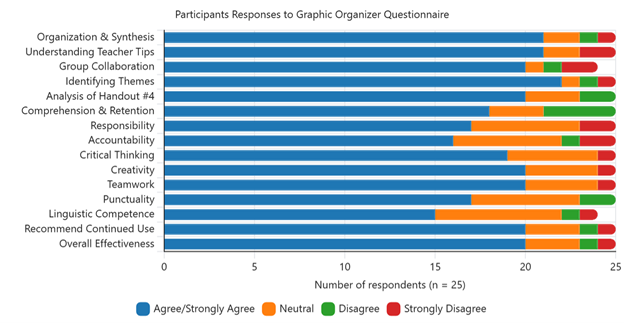
involving discussion and analysis of course materials. Figure 5 visually shows
the results, indicating that the majority of the students marked between
strongly agree and agree to the statements related to the perceived
contribution of graphic organizers to the assigned tasks.
Figure
5. The use of a graphic organizer
|
|
Source:
Figure created by the author with assistance from Microsoft Copilot (GPT-5) for
data processing, visualization coding, and graphic design. Based on response
data from Tricia Henderson’s «Post-Implementation Instrument #2», Google Forms
survey, July 2024.[21]
Responses
to the open-ended question highlighted both perceived benefits and challenges.
Several participants noted that graphic organizers helped them organize and
communicate ideas more clearly. However,
some participants suggested that additional time would be helpful when
completing the activity and that further explanation of different types of
graphic organizers could improve implementation. In Table 5, there are a few of
their quotes to back this up and show the results more clearly.
Table 5.
Participants’ perception of the use of graphic organizers: verbatim comments
|
Participant
1 |
«Provide
more information, like the different types of organizers». |
|
Participant
2 |
«It’s a good way to organize information and
mark the important details». |
|
Participant
3 |
«It would be better if we had more time to
fill out the graphic organizer. In the
workshop, we had limited time, and it was difficult to fill it out in that
short period». |
|
Participant
4 |
«Every
graphic organizer contributed to a deeper understanding of the discussed
topics, so no further comments are necessary». |
|
Participant
5 |
«The adaptability and communication
abilities of the people involved might be a challenge in the use of the
tools». |
Source:
Based on participants’ responses to Tricia Henderson’s «Post-Implementation
Instrument #2», Google Forms survey, July 2024.
Discussion
Taken
together, the quantitative and qualitative findings indicate that participants
generally perceived both visual organization resources as useful for organizing
information and supporting collaborative work.
The open-ended responses complemented these findings by explaining how
participants experienced these benefits in practice, while also identifying
difficulties related to time, clarity of instructions, and confidence in
applying the resources. Therefore, the two sources of data provide a
complementary account of participants´ perceptions rather than independent sets
of findings.
The
purpose of this study was to explore the use of visual organization resources
used within collaborative learning activities, specifically color-coding and
graphic organizers, in the context of teacher education and to examine their
potential contribution to the development of linguistic competence and soft
skills among students based on the participants’ perceptions. The findings from
the diagnostic questionnaire and the two post-implementation instruments
provide insights into students’ prior experiences with «collaborative
strategies» in general, their perceptions of the implemented visual
organization resources, and the potential benefits and challenges associated
with their use.
The
results of the diagnostic questionnaire indicate that most participants were
already familiar with the concept of «collaborative strategies» in language
learning. However, this familiarity appeared to be primarily associated with
commonly used interaction-based activities such as peer review, group
discussions, and debates. The majority of participants reported that they had experienced
these activities in their language learning courses.
The
familiarity that participants demonstrated with collaborative learning is
consistent with the sociocultural perspective proposed by Vygotsky[22],
which views learning as a process that emerges through interaction and shared
activity, which is already incorporated in the UNED courses. Similarly, Dewi,
Yusuf, and Subagya[23]
found that learning environments grounded in social constructivist principles
promote collaborative behaviors.
However, while participants in the present study reported frequent
exposure to discussion-based collaborative activities, they reported less
experience with more structured visual organization resources such as
color-coding and graphic organizers. This finding suggests that although collaborative
learning may be present in educational contexts, the range of visual
organization resources implemented collaboratively may still be somewhat
limited.
These
findings highlight the importance of explicitly introducing diverse visual
organization resources to be used in collaborative practices in teacher
education programs. Exposure to a broader range of resources may help future
teachers consider how to incorporate them into their own classroom practices.
The
results from the post-implementation instruments suggest that both color-coding
and graphic organizers were perceived as useful resources for organizing information
and supporting learning processes. Participants perceived color-coding as
helping them identify relationships among different components of the TOS and
helped them categorize learning indicators more effectively. Similarly, the use
of graphic organizers was reported to support the synthesis of information
obtained from teacher interviews and the analysis of course readings.
These
findings, based on the participants’ responses, are consistent with
Sociocultural Learning Theory[24]
because they show that learning can be mediated through tools, interaction, and
social participation. In this context, both color-coding and graphic organizers
functioned as mediating resources that supported students in organizing
information and constructing meaning collaboratively. Likewise, the findings
align with principles of Cooperative Learning previously described, which
suggest that structured tasks facilitate interaction and support the
achievement of shared academic goals.
Participants’
perceptions of these visual organization resources when used collaboratively are
consistent with the observations of Preechawitayakul[25],
who argues that color-coding helps learners organize and decode information
more effectively. Although her
discussion focuses primarily on e-learning contexts, participants in this study
perceived similar benefits when applying color-coding to assessment design
tasks. Likewise, the positive perceptions of graphic organizers are consistent
with Torres’ argument that visual representations help learners organize
information and connect new knowledge with previously acquired concepts[26].
However,
some participants also reported challenges associated with the use of these resources,
particularly regarding time constraints and uncertainty about whether resources
were being used correctly. These
responses suggest that while these resources used within collaborative
activities can be beneficial, their usefulness in the activities or
participants’ experiences with the resources may depend on the clarity of
instructions and the amount of time allowed for their implementation.
Another
important part of this study was to examine participants’ perceptions of whether
collaborative practices using these visual organization resources could
contribute to the development of soft skills.
Across both post-implementation instruments, participants generally
agreed that the use of the resources within collaborative practices provided
opportunities to help develop skills such as responsibility, accountability,
teamwork, critical thinking, creativity, and punctuality.
These
perceptions are consistent with the collaborative nature of the tasks
implemented in the workshops. The
activities required students to work together to analyze information, organize
ideas, and produce shared outputs, which likely encouraged communication,
negotiation, and shared decision-making. Such processes are often associated
with the development of interpersonal and professional skills that are highly
valued in educational and workplace contexts.
These
perceptions are consistent with Cooperative Learning Theory, particularly
Johnson and Johnson’s emphasis on positive interdependence, individual
accountability, and interpersonal interaction as important elements of
collaborative work[27].
The activities required students to analyze information, organize ideas, and
produce shared outputs, creating opportunities for communication, negotiation,
and shared decision-making. Participants’ recognition of responsibility,
teamwork, and accountability suggests that they perceived these skills as
relevant to the collaborative activities. Similarly, Bruffee[28]
and Sawyer[29]
emphasize the role of dialogue and shared questioning in knowledge
construction. The activities incorporating color-coding and graphic organizers
may have provided opportunities for these forms of interaction.
Interestingly,
the diagnostic questionnaire results indicated that participants tended to
associate «collaborative strategies» primarily with teamwork and responsibility,
while the post-implementation responses included recognition of a broader set
of soft skills, including critical thinking and creativity. Because the
response groups were not identical across the instruments, this difference
should be interpreted descriptively rather than as evidence of change among the
same participants.
Despite
the overall positive perceptions of the use of visual organization resources
used within collaborative activities, participants also identified several
challenges related to group work. These challenges included unequal
participation among group members, difficulties coordinating schedules,
differences in work styles, and concerns about fairness in assessment. Such
issues are frequently reported in collaborative learning contexts and reflect
the complexity of coordinating group-based academic tasks.
Some
participants also indicated that the limited time during workshops made it
difficult to fully develop graphic organizers or to ensure equal participation
among group members. These comments highlight the importance of carefully
planning collaborative activities to ensure that students have sufficient time
and guidance to engage meaningfully in the process and use the resources successfully.
While
the overall perceptions of collaborative learning were positive, the challenges
identified by participants illustrate that collaboration does not automatically
result in effective learning experiences.
Although Cooperative Learning Theory[30]
emphasizes positive interdependence and shared responsibility, the concerns
regarding unequal participation and coordination difficulties suggest that
these conditions may not always emerge naturally. This finding reinforces
Johnson and Johnson’s argument that collaborative activities require careful
structuring and monitoring to achieve their intended benefits.
This study
presents several limitations that should be considered when interpreting the
findings. First, the data are based on participants’ self-reported perceptions
rather than direct measures of learning outcomes, linguistic development or
soft skills development. Second, the research was conducted with a relatively
small group of pre-service teachers enrolled in the aforementioned course at
UNED, which limits the generalizability of the findings. Third, since participation
in the questionnaires was voluntary, there were different numbers of
respondents across the three instruments. Therefore, the response groups were
not identical, and differences between the diagnostic and post-implementation
responses cannot be interpreted as evidence of change among the same
participants. Fourth, the questionnaires referred to color-coding and graphic
organizers as «strategies». This terminology was retained when reporting the
original questionnaire items and participants’ responses to accurately
represent the data collected. Throughout the article, however, these practices
are referred to as «visual organization resources» to avoid implying that the
study established their validity or effectiveness as instructional strategies. Finally,
the implementation of the resources occurred within a specific instructional
context over a limited period, making it difficult to determine their long-term
impact on learning and professional development.
The findings
of this study have several implications for teacher education programs. First,
the results suggest that introducing the structured use of visual organization resources
such as color-coding and graphic organizers within collaborative activities can
support both cognitive organization and collaborative interaction during
academic tasks. These resources may therefore be useful tools for helping
future teachers design assessments, analyze educational information, and engage
in reflective discussions about teaching practices. From a practical
perspective, educators may consider integrating color-coding into assessment
courses by assigning specific colors to learning outcomes, indicators, item
types, or other specific aspects. This approach may help students visualize
relationships among assessment components and reduce errors during the
construction of Tables of Specification. In a similar way, graphic organizers
can be incorporated into activities that require synthesis of readings,
classroom observations, or interview data, providing students with structured
opportunities to analyze and organize information collaboratively.
Second,
the positive perceptions of soft-skill development suggest that collaborative
learning activities may contribute not only to academic learning but also to
the development of professional competences that are essential for educators.
Skills such as teamwork, responsibility, and critical thinking are particularly
relevant for teachers who must often collaborate with colleagues,
administrators, and students in educational environments.
Finally,
the challenges reported by participants highlight the need for careful
instructional design when implementing the use of visual organization resources
within collaborative activities. Clear instructions, sufficient time, and
structured support mechanisms may help maximize the benefits of these resources
while minimizing potential difficulties associated with group work.
Overall,
based on the participants’ perceptions, the findings suggest that visual
organization resources such as color-coding and graphic organizers can play a
valuable role in supporting both collaborative learning processes and soft
skill development in teacher education contexts if implemented appropriately.
Conclusions
This
study explored pre-service teachers’ perceptions of color-coding and graphic
organizers as visual organization resources used within collaborative learning activities,
including their perceived contributions to linguistic competence and soft-skill
development. Overall, the findings suggest that although participants were
already familiar with collaborative learning, their previous experiences were
limited primarily to more discussion-based activities, with less exposure to
more structured collaborative resources. Participants perceived both resources
as useful for organizing and synthesizing information during academic tasks. Color-coding
was identified as helping participants distinguish categories and identify
relationships among assessment components, while graphic organizers were
perceived as useful for synthesizing information from teacher interviews and
course readings and facilitating the sharing of ideas.
Regarding
perceived contributions to soft skills and linguistic competence, participants
perceived positive outcomes particularly in teamwork, responsibility, and
accountability, with some recognition of more complex skills such as critical
thinking and creativity. They also perceived that the resources could support
linguistic competence when integrated with communicative and interaction-based
activities. While these findings are based on self-reported perceptions and do
not demonstrate direct causality or measurable development, they suggest that
collaborative tasks may create meaningful opportunities for interpersonal, professional,
and language-related learning within teacher education contexts.
At the
same time, based on participants’ reports, the study identified important
challenges, including unequal participation, time constraints, and uncertainty
in the application of the resources. These findings suggest that the benefits
perceived by participants depend in part on how collaborative activities are
designed and implemented. This reinforces key principles of Cooperative
Learning, particularly the importance of clear guidelines, defined role
distribution, sufficient time, opportunities for practice, and accountability
when using collaborative resources. Providing examples of different types of
graphic organizers and establishing consistent color-coding systems may also
help students use these resources with greater confidence and clarity. Offering
additional practice opportunities may also help students feel more confident
when using these.
At the
program level, teacher education, both here at UNED and elsewhere, may benefit
from incorporating a wider variety of structured collaborative resources into
methodology courses. Providing explicit instruction and examples of how to
implement color-coding, graphic organizers, and other visual organization
resources within collaborative activities may help future teachers develop
practical tools they can later apply in their own classrooms. Another more innovative
idea could be for teacher education programs to incorporate digital
collaborative resource libraries available to students in the program, where
students experience, evaluate, and adapt resources such as color-coding,
graphic organizers, jigsaw activities, and digital collaborative platforms
before implementing them in their own teaching practice.
Future
research could examine the use of resources used within different collaborative
activities in different educational contexts or with larger groups of
participants. Another possibility for future research could be to compare the perceived
usefulness of color-coding and graphic organizers with other collaborative
learning resources or activities, such as jigsaw activities or digital
collaborative platforms. Longitudinal research could explore whether repeated
exposure to collaborative resources during teacher education is associated with
professional competencies during teaching practicum experiences. Such studies could also examine learning
outcomes and linguistic or professional development using measures beyond
self-reported perceptions.
Formato de citación según APA
Henderson, T. (2026). Students’ perceptions of collaborative
learning resources in EFL teacher education: The English teaching major for I
and II cycles at Universidad Estatal a Distancia. Revista Espiga, 25(52), 106-131.
Formato de citación según Chicago-Deusto
Henderson, Tricia. «Students’ Perceptions of Collaborative
Learning Resources in EFL Teacher Education: The English Teaching Major for I
and II Cycles at Universidad Estatal a Distancia». Revista Espiga 25,
n.º 52 (2026): 106-131.
Bibliography
Bandura,
Albert. Social Foundations of Thought and Action: A Social Cognitive Theory.
Englewood
Cliffs, NJ: Prentice Hall, 1986.
Bruffee,
Kenneth A. Collaborative Learning: Higher Education, Interdependence, and
the
Authority
of Knowledge. 2nd ed. Baltimore: Johns Hopkins
University Press, 1999.
Dewi, Ressi Kartika, Munawir Yusuf, and
Subagya. «Implementation of Vygotsky’s Theory of
Social Constructivism
in Elementary School Learning». Journal of Educational Research
and
Practice 15,
n.º 1 (2025).
Gardner,
Howard. Frames of Mind: The Theory of Multiple Intelligences. New York:
Basic Books, 1983.
Harasim,
Linda. Learning Theory and Online Technologies. New York: Routledge,
2012.
Henderson,
Tricia. «Color-Coding». Video. Biteable, 2024. https://biteable.com/watch/4206195/ccf88b133c535078a9a62108a3c0887f
Henderson, Tricia. «Diagnostic
Questionnaire». Google Forms
survey, June 2024. https://docs.google.com/forms/d/e/1FAIpQLSeXDqTK8VAn4-tNpvT6iNktuGRBw9ZvardZwPIECfgGlE9R3w/viewform?usp=header
Henderson,
Tricia. «Post-Implementation Instrument #1». Google Forms survey, July 2024.
Henderson,
Tricia. «Post-Implementation Instrument #2». Google Form, 2024.
Henderson,
Tricia. «Using Graphic Organizers». Video. Biteable, 2024. https://biteable.com/watch/4208400/95b16916e5de8206da6bb3a98964fecb
Izuagba,
Angela, and Adaku Afurobi. «Equipping Learners with
Soft Skills Using
Collaborative
Teaching/Learning Strategies». European Journal of Social Sciences 47
(2015):
416-424.
Johnson, David W., Roger T. Johnson, and Edythe J. Holubec. Circles
of Learning: Cooperation in the Classroom. Alexandria, VA:
Association for Supervision and Curriculum Development, 1984.
Kadar, Nur Syafiqah Abdul, Wan Syariza
Wan Yadri, Nurul Dalila Faris, Muhammad Danish Mohd Johari, Kairanbayeva Nazym Nurgeldiyevna, and Noor Hanim Rahmat. «Exploring
Online Group Work Through the Social Cognitive Theory». International Journal of Academic Research in Business and Social
Sciences 13, n.º 9 (2023): 1575-1589. https://doi.org/10.6007/IJARBSS/v13-i9/17744
Lupion
Torres, Patricia. Handbook of Research on Collaborative Learning Using
Concept
Mapping. Hershey,
PA: IGI Global, 2009.
Preechawitayakul,
France. «The Ultimate Guide to Color-Coding in eLearning». eLearning Industry, August 9, 2019. https://elearningindustry.com/guide-color-coding-elearning
Robinson, Ken. «RSA Animate: Changing
Education Paradigms». YouTube video, 11:40. Posted by RSA, October 14, 2010. https://www.youtube.com/watch?v=zDZFcDGpL4U
Sawyer,
R. Keith. Group Genius: The Creative Power of Collaboration. New York:
Basic Books,
2007.
Vygotsky,
Lev S. Mind in Society: The Development of Higher Psychological Processes. Edited
by Michael Cole et al. Cambridge, MA: Harvard University Press, 1978.
Wibowo,
Sigit, Muhammad Nur Wangid, and Fery Muhamad Firdaus.
«The Relevance of
Vygotsky’s
Constructivist Learning Theory in Differentiated Learning». European
Journal
of Educational Research 13, n.º 2 (2024).