|
|


COMMUNICATION
A rare record of oviposition in the semislug Tikoconus costaricanus (Stylommatophora: Euconulidae)
Zaidett Barrientos1 
1. Universidad Estatal a Distancia, Vicerrectoría de Investigación, Laboratorio de Ecología Urbana, 2060 San José, Costa Rica; zbarrientos@uned.ac.cr
Received 26-V-2026 ● Corrected 31-VII-2026 ● Accepted 19-VIII-2026
DOI: https://doi.org/10.22458/urj.v18i1.6626
ABSTRACT. Introduction: The semislug Tikoconus costaricanus is one of the best-studied Neotropical terrestrial mollusks; however, information on its reproductive behavior under natural conditions remains scarce, as oviposition sites have previously been reported only in captivity. Objective: To document the first field record of oviposition in T. costaricanus. Methods: I conducted a field observation in a mature forest at Braulio Carrillo National Park, Costa Rica, where I recorded the oviposition behavior and microhabitat characteristics. Results: On October 9, 2025 at 11:00h, I observed an individual laying eggs inside a narrow vertical crevice in the trunk of a shrub, approximately 1.5m above ground. The crevice penetrated the bark and created a dark and humid microenvironment between the cambium and the fractured bark. Conclusion: This record documents the first observed oviposition site of T. costaricanus in the wild and provides evidence of the use of humid arboreal microhabitats for reproduction. The morning observation suggests a possible concentration of activity during this period.
Keywords: Arboreal mollusk, reproductive behavior, oviposition site, tropical montane forest.
RESUMEN. “Un registro poco común de oviposición de la semibabosa Tikoconus costaricanus (Stylommatophora: Euconulidae)”. Introducción: la semibabosa T. costaricanus es uno de los moluscos terrestres mejor estudiados del neotrópico; sin embargo, la información sobre su comportamiento reproductivo en condiciones naturales es escasa, ya que los sitios de oviposición solo han sido observados en cautiverio. Objetivo: documentar el primer registro de campo del sitio de oviposición de T. costaricanus. Métodos: observé el comportamiento y características del sitio de oviposición en un bosque maduro en el Parque Nacional Braulio Carrillo, Costa Rica. Resultados: el 9 de octubre de 2025 a las 11:00h observé a un individuo depositando huevos dentro de una grieta en el tronco de un arbusto a aproximadamente 1,5m sobre el suelo. La grieta penetraba la corteza y creaba un microambiente húmedo y oscuro entre el cambium y la corteza fracturada. Conclusión: este registro documenta por primera vez un sitio de oviposición de T. costaricanus en la naturaleza y evidencia el uso de microhábitats arbóreos húmedos para la reproducción. La observación matutina sugiere una posible concentración de actividad durante este periodo.
Palabras clave: moluscos arbóreos, comportamiento reproductivo, sitio de oviposición, bosque tropical montano.
The semislug Tikoconus costaricanus is one of the best-studied Neotropical terrestrial mollusks, with information available on its anatomy, ecology, and behavior (Barrientos, 2019a, 2019b, 2020a, 2020b, 2021). However, its reproductive behavior remains poorly known.
Oviposition sites have only been reported under captive conditions, where individuals were maintained in terraria containing soil, moss, and leaves—mainly from Piperaceae and Melastomataceae—collected from their natural habitat. Egg laying occurred exclusively in soil and moss (Barrientos, 2019b).
Here, I report a field observation of oviposition. On October 9, 2025, at 11:00h, in Braulio Carrillo National Park (Bajo de la Hondura sector, 1 297m a.s.l.), I observed a specimen of T. costaricanus laying eggs in a mature forest. I identified the species based on its characteristic coloration pattern and known geographic distribution (Barrientos, 2019a). The individual was located in a narrow vertical crevice in the trunk of a shrub, approximately 1.5m above ground (Fig. 1 a, b). The surrounding area had few epiphytes. The crevice penetrated the bark, forming a dark and humid microenvironment between the cambium and the fractured bark.
The semislug T. costaricanus is a predominantly arboreal species whose feeding activity is concentrated mainly during the morning hours (Barrientos, 2019b, 2020a, 2021). Despite more than 35 years of research on Neotropical terrestrial mollusks, including over a decade of fieldwork and five publications focused on this genus, I had never previously observed oviposition in the field. This record is therefore particularly noteworthy, as it suggests that egg laying may occur on tree trunks, which are typically covered by mosses, lichens, and epiphytic vegetation in the forests where the species occurs. Such behavior, combined with the cryptic coloration of T. costaricanus, which closely matches moss-covered substrates, likely makes oviposition events extremely difficult to detect under natural conditions. This may also provide protection against predators and desiccation. It is possible that this observation was only possible because the tree trunk where oviposition occurred had relatively little epiphytic vegetation cover, a condition that may not be representative of the microhabitats typically used by the species. The rarity of this observation may therefore reflect both the species' microhabitat preferences and the inherent challenges of documenting reproductive behavior in the wild. Furthermore, this finding highlights that reproductive behaviors observed under captive conditions may not fully represent those expressed in natural environments.
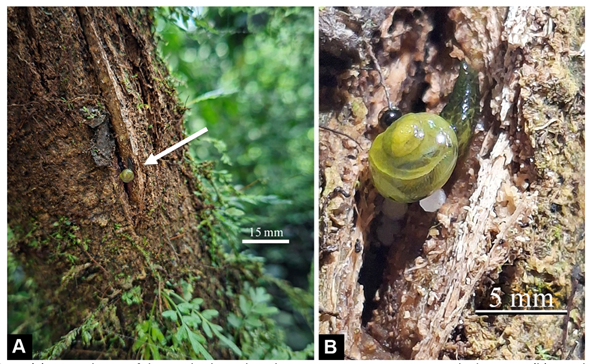
Fig. 1. (a) General view of the trunk where the Tikoconus costaricanus specimen laid its eggs. (b) Detail of the animal laying eggs in the crevice.
ACKNOWLEDGMENTS
This study was financed by the Universidad Estatal a Distancia, Costa Rica. I thank Sergio Quesada Acuña and Maribel Zúñiga Solis for assistance.
ETHICS, CONFLICT OF INTEREST, AND FUNDING STATEMENT
The author declares that she has fully complied with all pertinent ethical and legal requirements, both during the study and in the production of the manuscript; that there are no conflicts of interest of any kind; that all financial sources are fully and clearly stated in the acknowledgements section; and that she fully agrees with the final edited version of the article. A signed document has been filed in the journal archives.
REFERENCES
Barrientos, Z. (2019a). A new genus of semislugs (Stylommatophora, Euconulidae) from Costa Rica and a review of the genus Velifera (Stylommatophora, Euconulidae). Revista de Biología Tropical 67(6), 1313-1358. https://revistas.ucr.ac.cr/index.php/rbt/article/view/36105
Barrientos, Z. (2019b). Demography of Tikoconus costaricanus (Stylommatophora: Euconulidae) in tropical low montane and premontane forests, Costa Rica. Revista de Biología Tropical 67 (6), 1449-1460. https://revistas.ucr.ac.cr/index.php/rbt/article/view/36201
Barrientos, Z. (2020a). Microhabitat selection, and seasonal and daily activity of the snail Tikoconus costaricanus (Stylommatophora: Euconulidae) in tropical montane wet forest understory. Revista de Biología Tropical 68(4), 1131-1142. https://revistas.ucr.ac.cr/index.php/rbt/article/view/41620/44195
Barrientos, Z. (2020b). A new aestivation strategy for land molluscs: hanging upside down like bats. UNED Research Journal 12(1), e2802. https://doi.org/10.22458/urj.v12i1.2802
Barrientos, Z. (2021). Feeding habitat of the understory arboreal snail Tikoconus costaricanus (Stylommatophora: Euconulidae) in a tropical montane wet forest, Costa Rica. UNED Research Journal 13(1), e3311. https://doi.org/10.22458/urj.v13i1.3311