|
|


Beyond the trail: how tourist access shapes mammal activity in a highly visited national park in Costa Rica
Laura Porras-Murillo1 , Michelle Monge-Velázquez1, Leonardo D. Bacigalupe2, Luis Bernardo Vázquez3, Jaiber J. Solano-Iguaran4
 & Grace Wong1
1. Universidad Nacional (UNA), Instituto Internacional en Conservación y Manejo de Vida Silvestre (ICOMVIS), Heredia, Costa Rica; laura.porras.murillo@una.cr, mimon@una.cr, gwong@una.ac.cr
2. Universidad Austral de Chile, Instituto de Ciencias Ambientales y Evolutivas, Facultad de Ciencias, Valdivia, Chile; lbacigal@gmail.com
3. El Colegio de la Frontera Sur, Grupo de Ecología, Paisaje y Sustentabilidad. San Cristóbal de las Casas, Chiapas, México; lbvazquez@ecosur.mx
4. Instituto de Fomento Pesquero, Departamento de Salud Hidrobiológica. Puerto Montt, Chile; jaiber.solano.i@gmail.com
Received 20-VI-2026 ● Corrected 04-IX-2026 ● Accepted 30-IX-2026
DOI: https://doi.org/10.22458/urj.v18i1.6648
ABSTRACT. Introduction: Ecotourism can alter wildlife behavior without affecting species diversity, but this is a poorly known subject. Objective: To evaluate the influence of tourist access on medium- and large-bodied mammals in Manuel Antonio National Park, Costa Rica. Methods: From April 2021 to August 2022, camera traps monitored mammals along public trails during periods of restricted and unrestricted tourist access associated with COVID-19 policies and weekly closures. Results: We recorded 16 mammal species, including the first Puma concolor documented in the park. Hill numbers did not differ significantly between restricted and unrestricted access. However, under unrestricted access, Dicotyles tajacu became more nocturnal, Nasua narica increased daytime activity, and Dasyprocta punctata showed little variation. Conclusions: Tourist access affected mammal activity patterns but not community diversity. Species-specific activity was therefore a more sensitive indicator of tourism effects than diversity metrics.
Keywords: recreational pressure, anthropogenic disturbance, temporal niche, diel shifts, photographic sampling, neotropical fauna, protected-area management.
RESUMEN. “Más allá del sendero: cómo el acceso turístico afecta la actividad de los mamíferos en un parque nacional altamente visitado de Costa Rica”. Introducción: el ecoturismo puede alterar el comportamiento de la fauna silvestre sin afectar la diversidad de especies, pero este tema ha sido poco estudiado. Objetivo: evaluar la influencia del acceso turístico sobre los mamíferos medianos y grandes del Parque Nacional Manuel Antonio, Costa Rica. Métodos: de abril de 2021 a agosto de 2022, utilizamos cámaras trampa para monitorear mamíferos a lo largo de senderos públicos durante períodos de acceso turístico restringido y no restringido asociados con las políticas por COVID-19 y los cierres semanales. Resultados: registramos 16 especies de mamíferos, incluido el primer registro documentado de Puma concolor en el parque. Los números de Hill no difirieron significativamente entre los períodos de acceso restringido y no restringido. Sin embargo, durante el acceso no restringido, Dicotyles tajacu se volvió más nocturno, Nasua narica aumentó su actividad diurna y Dasyprocta punctata mostró poca variación. Conclusiones: el acceso turístico afectó los patrones de actividad de los mamíferos, pero no la diversidad de la comunidad. Por lo tanto, la actividad específica de las especies fue un indicador más sensible de los efectos del turismo que las métricas de diversidad.
Palabras clave: presión recreativa, perturbación antropogénica, nicho temporal, cambios circadianos, muestreo fotográfico, fauna neotropical, manejo de áreas protegidas.
Protected areas are globally recognized as effective strategies for conserving biodiversity under increasing anthropogenic pressures (Geldmann et al., 2019). However, protected status does not eliminate human influence, and tourism and recreation can generate ecological impacts while also contributing to conservation financing and local economic development (Buckley, 2011; Leung et al., 2018; Stronza et al., 2019). These trade-offs are particularly relevant in heavily visited protected areas, where wildlife may respond to human presence through changes in behavior, space use, and temporal activity (Higham & Shelton, 2011). In Manuel Antonio, tourism and surrounding land-use dynamics have previously been linked to changes in biodiversity and habitat conditions (Broadbent et al., 2012).
Trail systems serve as conduits for both humans and wildlife, concentrating encounters and potentially amplifying disturbances. Animals may use trails for ease of movement or foraging opportunities but may also avoid them when human activity is high, leading to altered space use and temporal partitioning of animal movement. However, despite growing concern over these dynamics, few studies have quantitatively assessed how predictable fluctuations in tourism—such as daily or weekly closures—affect mammal assemblages in high-use tropical parks. The global COVID-19 pandemic imposed an unexpected but powerful natural experiment: a sudden and sustained decrease in human mobility, including the closure or restriction of protected areas. This unprecedented shift provided a rare opportunity to evaluate how wildlife responds to variable tourist pressure in real-world conditions.
In Costa Rica, protected areas significantly contribute to the national economy, primarily through tourism (Benavides-Vindas, 2020). The Manuel Antonio National Park (MANP), the smallest in the country, receives the highest number of visitors annually (Kauffman, 2014; Sistema Nacional de Áreas de Conservación [SINAC], 2019). Since the 1980s, researchers have documented negative effects of tourism on wildlife in the park, including behavioral changes, altered home ranges, and shifts in diet, particularly in species such as Procyon lotor and Cebus imitator (Carrillo & Vaughan, 1993; Farrera, 2017; Porras-Murillo et al., 2022). In response, park authorities implemented management measures such as banning camping, closing the park one day a week, and increasing waste removal efforts to reduce tourist–wildlife interactions (Carrillo & Vaughan, 1993).
In this study, we monitored medium and large terrestrial mammals in MANP. We used camera traps along the park’s public trail system to assess how tourist access—both restricted (due to COVID-19 policies) and unrestricted—affected species richness, diversity, and activity patterns. Specifically, we asked: (i) Do daily or weekly park closures influence wildlife activity or nocturnal mammal diversity? (ii) Do diurnal and nocturnal mammals show contrasting patterns of activity under different levels of tourist access? And (iii) Are there species-specific activity shifts associated with tourist access levels? By addressing these questions, we aimed to evaluate whether behavioral indicators reveal responses to human activity that may not be apparent from community-level diversity metrics, while providing information relevant to management in highly visited tropical protected areas. Given the low number of diurnal species detected in sufficient numbers for individual analysis, species-specific analyses of diurnal mammals were treated as exploratory and are intended to identify potential patterns rather than provide conclusive evidence for the broader diurnal mammal community.
MATERIAL AND METHODS
Study area
MANP is a protected area located on the Central Pacific coast of Costa Rica, approximately 7km southeast of Quepos, Puntarenas province (9,390842, -84,145160). Established on November 15, 1972 (Boza, 1992), the park encompasses 1 983 hectares of predominantly humid tropical forest and an offshore marine area of 55 000 hectares (Broadbent et al., 2012). Its irregular topography ranges from 0 to 150m above sea level. Humidity levels fluctuate between 82% and 89%, with an average annual temperature of 26,9°C (21,8°C to 32,5°C; Instituto Meteorológico Nacional [IMN], 2022). The MANP receives an average annual rainfall of 3 820mm, with the rainiest months from June to November and December being the driest month (Kauffman, 2014).
The park primarily consists of secondary forests in various stages of succession, along with small patches of primary forest, mangrove ecosystems, beach vegetation, and marine environments (Broadbent et al., 2012). It is bordered by agricultural lands, oil palm plantations, areas undergoing forest regeneration following large-scale pasture abandonment, and nature-based tourism developments such as hotels (Littlejohn, 2018; Wong & Carrillo, 1996). The park is open to visitors from Wednesday to Monday, 7:00 to 16:00 (closed on Tuesdays). It is a critical site for tourism-derived economic benefits, as it is Costa Rica's most visited national park, with visitation exceeding 3 000 visitors per day during peak periods (SINAC, 2020). The park features a well-maintained trail system that traverses the rainforest and leads to several beaches (Porras-Murillo et al., 2022). Visitors have access to ten trails, a small convenience store, and three main beaches.
During the COVID-19 pandemic, MANP operated under strict visitor caps that were gradually relaxed. In April 2021, daily entry was limited to 1 286 visitors; by November 2021, this ceiling had increased to 1 932. These values represent official daily visitor caps rather than actual daily visitation. We did not have access to daily visitor counts for each sampling date and therefore could not quantify within-period variation in actual visitation or directly relate daily visitor numbers to wildlife detections. These phased management restrictions provided a natural contrast in potential tourist access. Because daily realized visitations were unavailable for this study, the restricted- and unrestricted- access periods were treated as categorical management periods rather than as a continuous measure of tourist pressure.
Camera trap surveys
In April 2021, we deployed 16 unbaited Bushnell Trophy Cam Trail® camera traps along all tourist trails (Fig. 1). We added five unbaited cameras in November 2021 (Fig. 1). We placed the cameras near tourist trails, between 5 and 15m from the trail edge, spaced approximately 300m apart to capture medium-sized mammals. The cameras were distributed across the ten public-access trails; however, trail-specific visitor counts were not available, and we therefore could not quantify differences in visitation intensity among trails or test whether camera placement was balanced along a spatial gradient of tourist disturbance.
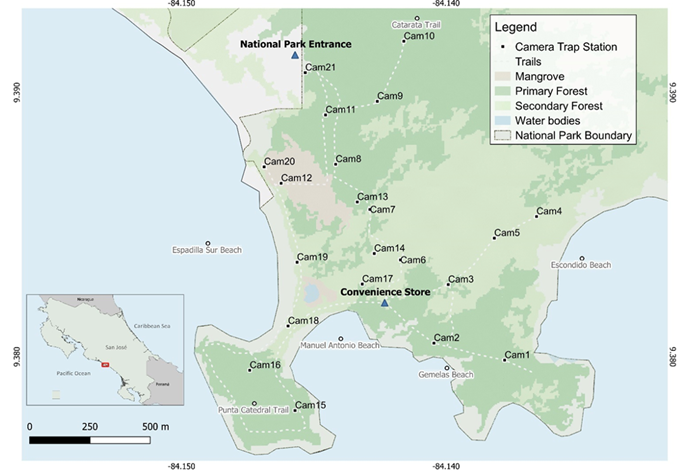
Fig. 1. Location of twenty-one camera trap stations placed across the public access trails of the Manuel Antonio National Park, Puntarenas, Costa Rica.
We mounted the cameras on trees at a height of 50cm to optimize detection of these species (Saenz-Bolaños et al., 2020). To prevent triggering by surrounding vegetation, we cleared branches and grasses in front of the cameras. Settings allowed 20-second video recordings at 30-second intervals, operating 24 hours a day. Cameras operated from April 2021 to August 2022, and sampling effort varied among cameras and between restriction periods, with camera-specific deployment durations reported (TABLE 1). This unequal effort was accounted for in the count models using camera-specific offsets based on actual camera-days. We replaced memory cards and batteries every two to three months, and videos were organized and processed using Timelapse 2 software (Greenberg et al., 2019). Mammal species were identified using using Reid’s (2009) field guide.
Statistical analyses
We conducted two main comparisons: (1) daily closure, comparing periods when the park was open (7:00–16:00) versus closed (16:01–06:59), and (2) weekly closure, comparing Tuesdays, when the park is closed to visitors, versus all other days. Because sampling spanned two distinct periods of COVID-19 tourist restrictions (restricted vs. unrestricted access), we also evaluated whether this restriction period influenced the effect of daily and weekly closure on mammal activity, as described separately below for each type of analysis. We determined independent detections using a 60-minute interval to avoid repeated recordings of the same individual (Sollmann, 2018).
TABLE 1
Camera-days for the 21 cameras traps during restricted and unrestricted tourist access. NA= Camera not deployed during the restricted-access period.
|
Camera-days |
Restricted access |
Unrestricted |
|
1 |
167 |
437 |
|
2 |
165 |
415 |
|
3 |
165 |
398 |
|
4 |
166 |
435 |
|
5 |
166 |
397 |
|
6 |
64 |
500 |
|
7 |
166 |
477 |
|
8 |
101 |
400 |
|
9 |
166 |
399 |
|
10 |
166 |
416 |
|
11 |
165 |
399 |
|
12 |
165 |
488 |
|
13 |
166 |
417 |
|
14 |
166 |
500 |
|
15 |
165 |
491 |
|
16 |
62 |
501 |
|
17 |
NA |
399 |
|
18 |
NA |
399 |
|
19 |
NA |
146 |
|
20 |
NA |
399 |
|
21 |
NA |
398 |
Diel activity classification
We classified species a priori according to their predominant diel activity pattern based on published natural-history literature (Bennie et al., 2014). We did not derive diel categories from the temporal distribution of detections in our dataset. Diurnal species were defined as those whose activity occurs mostly or exclusively during daylight whereas nocturnal species are active mostly or exclusively at night. Crepuscular species are primarily active during twilight periods. For all community-level analyses described as nocturnal, we explicitly defined the analytical subset as the species classified as predominantly nocturnal.
Nocturnal community diversity
Diversity profiles based on Hill numbers (q) were used to calculate species richness (q = 0), Shannon diversity (q = 1), and Simpson diversity (q = 2) for the nocturnal mammal community (Chao et al., 2020). We applied the interpolation/extrapolation procedure of Colwell et al. (2012) and Chao and Jost (2012), implemented in the R package iNEXT.4steps (Chao & Hu, 2024), using raw abundance counts for all treatment groups. Coverage-based rarefaction/extrapolation was used to account for unequal sampling effort between groups. We compared diversity estimates and their bootstrapped (50 runs) 95% confidence intervals between daily- and weekly-closure treatments, both for the pooled dataset and separately within each COVID-19 restriction period, to evaluate whether restriction period influenced these comparisons. Results were consistent between the pooled and period-stratified analyses (see Results). Sample completeness was quantified for each diversity measure prior to comparisons (Chao et al., 2020), and diversity estimates were compared at comparable levels of sample coverage using bootstrap-based 95% confidence intervals. Differences were interpreted from the estimated diversity and associated confidence intervals rather than from the original count totals, thereby avoiding direct comparison of samples with unequal sampling effort.
Nocturnal activity within closed hours
To evaluate whether nocturnal species show a behavioral response to weekly closure independent of their natural diel activity pattern, we restricted the dataset to nighttime hours only (daily closure period, 16:01–06:59) and compared activity between Tuesdays and non-Tuesdays within this window. We assessed this at three levels: (1) overall night time detection rate, compared between Tuesdays and non-Tuesdays using an exact Poisson rate-ratio test, which tests whether the two groups differ in their number of detections per camera-days; (2) night time community diversity (Hill numbers, q = 0, 1, 2), following the same iNEXT.4steps procedure described above; and (3) species-specific night time detection rates, modelled with negative binomial generalized linear mixed models (GLMMs, camera identity as a random intercept, COVID-19 restriction period as a fixed effect, and a camera-days offset), for the eight species with sufficient night time detections (n ≥ 10).
Diurnal species counts
We included species classified as predominantly diurnal, counting species whose published activity pattern reports a secondary crepuscular component. Because only three diurnal species were detected in sufficient numbers (see Results section), these analyses were treated as exploratory and carried out separately for each species. For each species, we fit negative binomial generalized linear mixed models (GLMMs) with a log link, with independent detection counts per camera as the response variable. Daily closure (open vs. closed) and weekly closure (Tuesday vs. non-Tuesday) were analysed in two separate sets of models; each included restriction period (restricted vs. unrestricted), the corresponding closure treatment, and their interaction as fixed factors. We treated daily and weekly closure as distinct temporal contrasts rather than levels of a single treatment because they represent different dimensions of tourist access: daily closure contrasts within-day opening hours, whereas weekly closure contrasts Tuesdays with the six visitor-access days. We therefore fitted separate model sets for the two contrasts, while including COVID-19 restriction period and its interaction with the corresponding closure treatment.
Camera identity was included as a random factor to account for repeated measurements of the same camera across treatment combinations. Models included an offset for camera-trapping effort (log camera-days), calculated separately for each camera and COVID-19 period from actual deployment dates. For the weekly-closure comparison, the offset further accounted for the unequal number of Tuesdays versus non-Tuesdays within each camera's deployment period, rather than adjusting the raw counts. The interaction term was retained only where statistically significant (likelihood-ratio test) and dropped otherwise, leaving the corresponding main-effects model as final. The negative binomial error structure was chosen over a Poisson structure based on a formal likelihood-ratio test comparing both fits for each model. In all cases the negative binomial model provided a significantly better fit (P < 0,005), consistent with overdispersion in the count data. Model diagnostics (simulated residuals; DHARMa package, Hartig, 2022) confirmed adequate fit for all models, with no evidence of residual non-uniformity, overdispersion, zero-inflation, or influential outliers (all P > 0,27). We carried out all analyses in R version 4.2.1 (R Core Team, 2022), using the MASS (Venables & Ripley, 2002) and glmmTMB (Brooks et al., 2017) packages for count models and iNEXT.4steps (Chao & Hu, 2024) for diversity estimation.
RESULTS
First documented record of Puma concolor
The first record of Puma concolor in MANP occurred on June 2nd, 2021, during the nighttime hours of the dry season, near Playa Gemelas in the south-eastern sector of the park’s public-use area. During the study period, additional records were obtained across the public-use area, including the central, southeastern, and northeastern sectors.
A Diverse Community—and a Surprising Visitor
Camera traps recorded 11 561 independent detections of 16 medium- to large-bodied mammal species over the study period (Table 2). Most species were nocturnal (n = 10), followed by diurnal species (n = 3), crepuscular species (n = 1), and species exhibiting mixed activity patterns (n = 2). The total number of detections was higher during the unrestricted period (9 303) than during the restricted period (2 258), reflecting the substantially greater total sampling effort and potentially other differences in detection and animal activity between periods.
TABLE 2
Occupancy and activity patterns of large and medium-sized mammals in areas with restricted and unrestricted tourist access in Manuel Antonio National Park. Occupancy was calculated as naive occupancy: the proportion of active camera stations at which each species was detected at least once (n = 16 stations during restricted access; n = 21 during unrestricted access).
|
Species |
Common name |
Activity pattern |
Occupancy (restricted access) |
Occupancy (unrestricted access) |
|
Cabassous centralis |
Northern naked-tailed armadillo |
Nocturnal |
0,3125 |
0 |
|
Canis latrans |
Coyote |
Nocturnal, crepuscular, diurnal |
0 |
0,048 |
|
Conepatus semistriatus |
Striped hog-nosed skunk |
Nocturnal |
0,625 |
1 |
|
Coendou mexicanus |
Mexican tree porcupine |
Nocturnal |
0 |
0,048 |
|
Cuniculus paca |
Lowland paca |
Nocturnal |
0,9375 |
1 |
|
Dasyprocta punctata |
Central American Agouti |
Diurnal, crepuscular |
1 |
1 |
|
Dasypus novemcinctus |
Nine-banded armadillo |
Nocturnal, crepuscular |
0,75 |
0,857 |
|
Dicotyles tajacu |
Collared peccary |
Diurnal |
0,5625 |
0,905 |
|
Didelphis marsupialis |
Common Opossum |
Nocturnal, crepuscular |
0,375 |
0,952 |
|
Leopardus pardalis |
Ocelot |
Nocturnal, crepuscular, diurnal |
0,375 |
0,619 |
|
Nasua narica |
White-nosed coati |
Diurnal |
0,75 |
0,952 |
|
Odocoileus virginianus |
White-tailed deer |
Crepuscular |
0,9375 |
1 |
|
Philander opossum |
Gray four-eyed opossum |
Nocturnal |
0,1875 |
0,667 |
|
Procyon lotor |
Raccoon |
Nocturnal |
0,8125 |
0,952 |
|
Puma concolor |
Mountain Lion |
Nocturnal, crepuscular |
0,125 |
0,429 |
|
Tamandua mexicana |
Northern tamandua |
Nocturnal |
0,5625 |
0,905 |
Species Diversity Remained Stable Across Tourist Levels
Diversity of the nocturnal mammal community (n = 10) measured by Hill numbers, showed no detectable differences between Tuesdays (weekly closure) and non-Tuesdays. Species richness (q = 0), Shannon diversity (q = 1), and Simpson diversity (q = 2) all showed overlapping 95% confidence intervals (richness: non-Tuesday = 10,00 [9,21–10,79] vs. Tuesday = 9,00 [7,60–10,40]; Shannon: 3,89 [3,78–4,00] vs. 4,04 [3,73–4,35]; Simpson: 2,95 [2,88–3,01] vs. 3,05 [2,83–3,28]), and sample coverage reached 100% in all cases (Fig. 2). This result was consistent whether data were pooled across the study period or analysed separately within each COVID-19 restriction period (unrestricted access: richness 9,00 [8,53–9,47] vs. 8,00 [7,41–8,59]; restricted access: richness 9,00 [8,72–9,28] vs. 8,12 [3,09–13,16]; Shannon and Simpson showed the same pattern of overlap in both periods). These results provide no evidence of a detectable effect of weekly closure on nocturnal mammal diversity. However, stable community-level diversity does not necessarily imply an absence of ecological effects, because species may alter their activity or space use without producing measurable changes in richness or diversity. Indeed, our species-level analyses detected changes in activity patterns for Dicotyles tajacu and Nasua narica, indicating that behavioral responses may occur even when community-level diversity remains stable. Confidence intervals were markedly wider for Tuesdays during the restricted-access period, reflecting the smaller number of detections available in that period.
Nightfall Brings Wildlife Back: But Not Because of Tourism
Comparisons between daytime and night-time hours revealed a clear diel activity pattern among nocturnal species: diversity (q = 1 and 2) was higher at night than during the day (Fig. S1 SUPPLEMENTARY MATERIAL), and detection rates were substantially higher at night (median: 166 detections) than during the day (median: 1,5). However, because nocturnal species are, by definition, more active at night regardless of human presence, this pattern alone cannot be attributed to tourist absence, it may simply reflect the circadian biology of the species involved.
To test more directly whether weekly closure elicits a behavioral response, we restricted comparisons to night-time hours only, contrasting activity on Tuesday nights (following a full day of closure) against non-Tuesday nights. At the community level, night-time detection rates were slightly lower on Tuesdays than on non-Tuesdays (rate ratio = 0,89, 95% CI: 0,82–0,97, P = 0,007). Night-time diversity did not differ between the two: richness, Shannon, and Simpson diversity all showed overlapping 95% confidence intervals (richness: non-Tuesday = 10,00 [9,36–10,64] vs. Tuesday = 9,00 [7,84–10,16]; Shannon: 3,97 [3,86–4,09] vs. 4,17 [3,88–4,46]; Simpson: 3,00 [2,92–3,08] vs. 3,16 [2,96–3,36]; Fig. 3). At the species level, none of the eight species with sufficient night-time detections showed a significant difference in detection rate between Tuesday and non-Tuesday nights (all P > 0,14; Table S1).
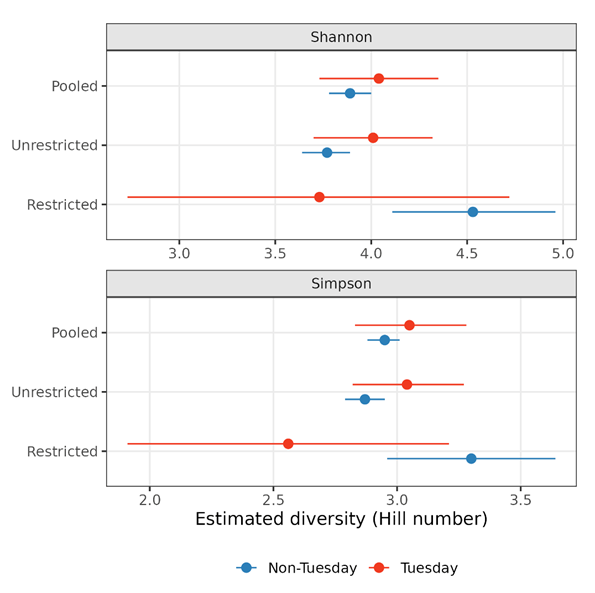
Fig. 2. Estimated Shannon (top) and Simpson (bottom) diversity of the nocturnal mammal community on Tuesdays (park closed) versus non-Tuesdays (park open), for the pooled dataset and separately within each COVID-19 restriction period (Unrestricted, Restricted). Points show asymptotic diversity estimates with 95% confidence intervals from 50 bootstrap replicates (Chao et al., 2020). Confidence intervals overlapped between Tuesdays and non-Tuesdays providing no evidence of a detectable difference in nocturnal mammal diversity.
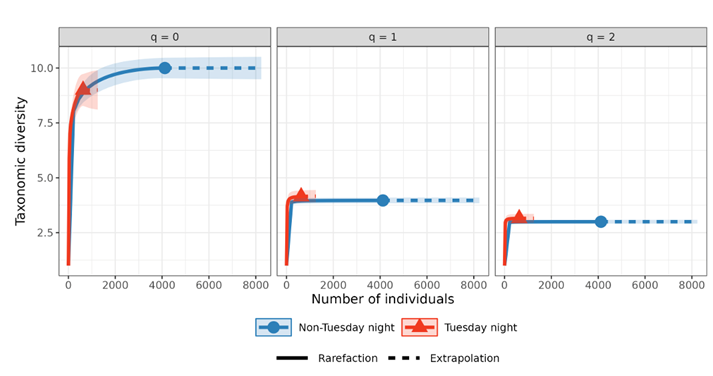
Fig. 3. Sample-size-based rarefaction (solid lines) and extrapolation curves (dashed lines) for species richness (q = 0), Shannon diversity (q = 1), and Simpson diversity (q = 2), comparing nighttime activity on Tuesdays versus non-Tuesdays. This comparison reduces the confounding influence of nocturnal species' natural diel rhythm, as both groups represent night-time hours only. Shaded areas denote 95% confidence bands from 50 bootstrap replicates. Confidence intervals overlapped between Tuesday and non-Tuesday nights across all three diversity orders, providing no evidence that weekly closure increases nocturnal mammal diversity.
Together, these results provide no evidence that weekly closure increases nocturnal mammal activity. The elevated night-time activity observed in the day-versus-night comparison most likely reflects the species' natural temporal niche rather than a behavioral response to reduced tourist presence.
Diurnal Species Respond in Divergent Ways
The three diurnal species showed markedly different responses to daily and weekly park closure, and only one species' response depended on COVID-19 restriction period. Dicotyles tajacu was the only species for which the effect of daily closure depended on restriction period (interaction: incidence rate ratio (IRR) = 2,89, 95% CI: 1,03–8,13, P = 0,044) (Fig. 4). During the unrestricted period, this species was detected far less often when the park was open than when it was closed (IRR = 0,24, 95% CI: 0,13–0,42), consistent with a shift associated with unrestricted tourist access. This avoidance was substantially weaker during the restricted-access period. Detections of D. tajacu were also lower overall during the restricted period (IRR = 0,15, 95% CI: 0,07–0,32, at closed hours), and weekly closure (Tuesday vs. non-Tuesday) had no detectable effect in either period (P = 0,403).
Nasua narica showed the opposite pattern: detections were significantly higher when the park was open than when it was closed (IRR = 2,90, 95% CI: 1,70–4,94, P < 0,001), potentially reflecting tolerance of, or even attraction to, human presence or anthropogenic resources. Unlike D. tajacu, this effect did not depend on restriction period (interaction: P = 0,698), and detections did not differ significantly between restricted and unrestricted periods (P = 0,079) or between Tuesdays and other days (P = 0,421). Finally, Dasyprocta punctata showed the weakest response of the three species. Detections were modestly but significantly higher when the park was open (IRR = 1,30, 95% CI: 1,01–1,68, P = 0,040), with no evidence that this effect depended on restriction period (interaction: P = 0,632). Weekly closure had no detectable effect (P = 0,272). Unlike the other two species, D. punctata showed a significant reduction in detections during the restricted-access period in both the daily-closure (IRR = 0,60, 95% CI: 0,46–0,80, P < 0,001) and weekly-closure models (IRR = 0,53, 95% CI: 0,42–0,67, P < 0,001).
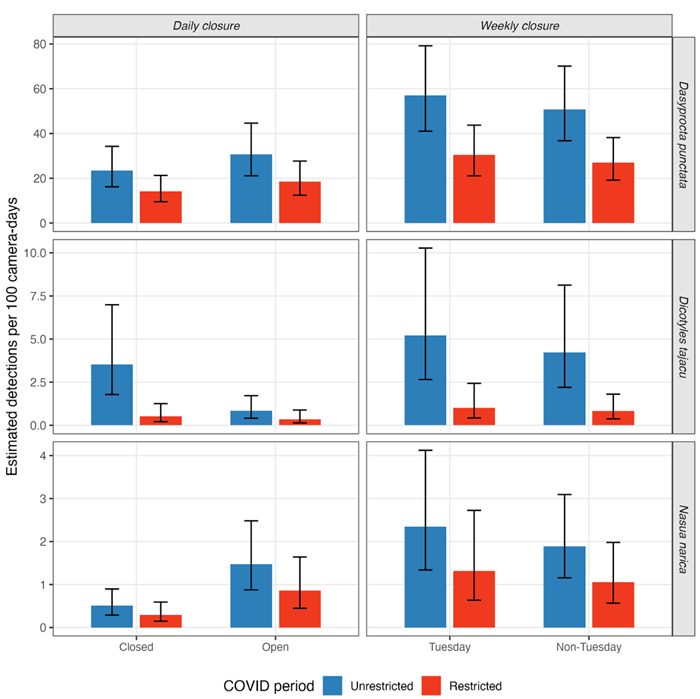
Fig. 4. Estimated detection rate (± 95% CI) of three diurnal mammal species in relation to daily closure (Closed vs. Open) and weekly closure (Tuesday vs. Non-Tuesday), by COVID-19 restriction period. Estimates come from negative binomial GLMMs (camera identity as a random intercept, offset for camera-days effort) and are standardized to 100 camera-days. Only Dicotyles tajacu showed a significant park-access × COVID-period interaction (P = 0,044); all other panels reflect main-effects models.
Across all three species, detections were consistently lower during the COVID-19 restricted-access period in the weekly-closure models (all P < 0,001 except N. narica, P = 0,053), independent of any weekly-closure effect, which was never significant for any species (all P > 0,27).
Species Detected Only Under Specific Conditions
Three species were detected in only one COVID-19 restriction period: Cabassous centralis was recorded exclusively during restricted access, while Canis latrans and Coendou mexicanus were recorded exclusively during unrestricted access. We caution against interpreting these patterns as evidence of a behavioral response to human activity. All three species had very low occupancy overall (≤ 0,05–0,31 across periods; Table 2), and the unrestricted period included substantially more sampling effort (9 303 vs. 2 258 total detections).
DISCUSSION
This study provides evidence that mammal responses to tourist access in a highly visited tropical protected area may be expressed more clearly through species-specific changes in activity than through community-level diversity metrics. We found no evidence of a detectable effect of weekly closure on nocturnal mammal diversity, and this pattern was consistent when the analysis was conducted separately within each COVID-19 restriction period. However, species-level analyses revealed contrasting changes in activity patterns among diurnal mammals, indicating that community-level stability does not necessarily imply an absence of ecological effects. These findings highlight the value of integrating behavioral indicators with community-level measures when assessing wildlife responses to human activity.
The strong diel pattern observed in nocturnal mammals should not be interpreted as evidence that weekly closure increases nocturnal activity. When comparisons were restricted to night-time hours to control for the natural diel rhythm of nocturnal species, community-level detection rates were slightly lower on Tuesdays than on non-Tuesdays, and no individual species showed a significant increase in night-time activity following the weekly closure. Thus, the observed predominance of nocturnal detections is more consistent with the natural temporal niches of these species than with a general increase in nocturnal activity caused by the weekly absence of visitors. Nevertheless, the behavioral responses observed in diurnal species are consistent with the broader concept of a human-induced “landscape of fear”, in which animals modify the timing or spatial distribution of their activities in response to perceived risks associated with human presence (Wilmers et al., 2021). Such temporal adjustments may reduce encounters with people but can also impose ecological costs if they constrain access to food, alter movement routes, reduce foraging opportunities, or interfere with reproductive activities (Beale & Monaghan, 2004; Ellenberg et al., 2006; Stankowich & Blumstein, 2005). Consequently, behavioral avoidance should not necessarily be interpreted as evidence of ecological resilience or successful adaptation. Short-term shifts in activity may instead represent sublethal responses whose consequences for energetic balance, reproduction, and fitness would require longer-term demographic or physiological studies to evaluate.
Our results highlight that responses to tourist access in MANP were species-specific rather than uniform. D. tajacu showed a shift toward greater nocturnal activity during the unrestricted-access period, consistent with a possible temporal adjustment to human activity, whereas N. narica showed the opposite pattern. The contrasting responses may reflect differences in tolerance, habitat use, resource associations, or other species-specific ecological traits, but the mechanisms cannot be distinguished from our observational design. D. punctata showed no detectable change in activity across conditions, further illustrating that species exposed to the same tourist environment may respond differently (Barcelos et al., 2022; Carrillo & Vaughan, 1993; Farrera, 2017).
This species-specific behavioral plasticity has been documented in other mammal communities exposed to tourism or human development (Higham & Shelton, 2011; Kauffman, 2014; Rodrigues-Santos, 2013). While some individuals or species adapt through learning or behavioral adjustment (Bejder et al., 2006), others may be excluded from high-use areas or forced to modify key ecological behaviors. In some cases, animals may appear habituated but still experience chronic stress or increased vulnerability to threats such as poaching or interspecific conflict (Newsome et al., 2005; Bejder et al., 2006).
It is also important to note that habituation is not inherently benign. As Rodrigues-Santos (2013) noted, animals may remain active in areas with high human presence not because of genuine tolerance, but because they lack alternative safe habitats. Thus, interpreting presence as adaptation can obscure hidden stress or degraded ecological function. These mechanisms were not directly tested in the present study.
The detection of Puma concolor represents an important addition to the documented mammal fauna of MANP. Given the species’ low detection frequency and the absence of systematic information on its movements or abundance before and during the study, the records should not be interpreted as evidence that reduced tourist access caused its occurrence in the park. Nevertheless, the detection is relevant from a conservation perspective because the presence of a large carnivore in a small, heavily visited protected area raises questions about landscape connectivity, movement between protected and surrounding habitats, and the role of highly visited parks as components of regional carnivore conservation networks. Continued camera-trap monitoring across the park and surrounding landscape could help determine whether these records represent transient movements, temporary use of the park, or more persistent occurrence.
Similarly, other species were recorded only under specific access regimes—Cabassous centralis during restricted periods and Canis latrans and Coendou mexicanus during unrestricted periods. Under these conditions, a single-period detection may arise from differences in sampling effort and detection probability. Species-specific factors likely also contributed: Coendou mexicanus is arboreal, and our camera height (50cm above ground; see Methods) may not have reliably detected it regardless of restriction period. We interpret these exclusive detections as evidence of the value of continued, longer-term monitoring to characterize rare and elusive species in the park, rather than as direct evidence of a behavioral response to tourism.
These observations emphasize the importance of long-term monitoring and systematic data collection in protected areas, aligning with calls to integrate community knowledge and ecological data into conservation planning (Geldmann et al., 2015; Porras-Murillo et al., 2022).
Our findings nevertheless support the value of retaining predictable periods of reduced human activity as a precautionary management measure, while recognizing that the present study did not demonstrate a general increase in nocturnal mammal activity following the weekly closure. Maintaining at least a weekly closure day, such as the current Tuesday policy at MANP, may provide opportunities for ecological processes and park operations to occur with reduced human disturbance, but its specific benefits for wildlife should be evaluated through longer-term monitoring and more direct measures of behavior and population performance (Instituto Costarricense de Turismo [ICT], 2023; Newsome, 2021; SINAC, 2019).
More broadly, our study highlights the need for adaptive, evidence-based management in high-use protected areas. Relying solely on standard species richness metrics may overlook behavioral shifts that signal stress or displacement. Tools like camera traps, when deployed with temporal resolution, can inform sustainable visitor limits and help managers balance conservation objectives with economic realities (Geldmann et al., 2015; Higginbottom & Cooperative Research Centre for Sustainable Tourism, 2004; IPBES, 2019; SINAC, 2013). Our findings reinforce the need to move beyond simple presence–absence evaluations and toward a more nuanced understanding of how wildlife navigates human-dominated landscapes. While diversity metrics may remain stable under moderate visitation, shifts in temporal activity, the appearance of elusive species, and contrasting species-specific responses highlight that behavioral adjustments often precede detectable changes in community composition. Integrating behavioral and ecological indicators into monitoring frameworks will be essential for identifying visitation thresholds and guiding adaptive management in highly visited protected areas.
We acknowledge several limitations that should be considered when interpreting our findings. First, all camera traps were placed within 5-15m of tourist trails, and we lacked sampling sites in areas completely free from tourist influence. Consequently, we cannot fully disentangle the effect of human presence from other spatial factors associated with trail proximity, such as edge effects or habitat structure. Second, although we explicitly accounted for unequal sampling effort using camera-days offsets in our count models and coverage-based rarefaction in our diversity analyses, the restricted-access period has substantially fewer detections (2 258) than the unrestricted period (9 303), reflecting both the shorter effective sampling period and the smaller number of active cameras. The offset standardizes the amount of sampling effort but does not explicitly model imperfect detection or other temporal changes in detectability. This imbalance reduced the precision of some estimates, particularly for Tuesdays during the restricted-access period, as reflected in the wider confidence intervals for that subset. Third, we did not have access to daily visitor counts and therefore could not model fine-scale variation in tourist pressure within each COVID-19 period; our comparisons are based on official visitor caps rather than realised visitation. Fourth, we did not record environmental covariates such as rainfall, temperature, or natural food availability, which may also influence mammal activity and could covary with sampling periods. Fifth, because the study was conducted in a single, highly visited park with unique characteristics (small size, high tourist density, and a history of wildlife habituation), our findings should not be assumed to generalize directly to other protected areas without considering their specific socio-ecological contexts.
The COVID-19 lockdown created an accidental “natural experiment” (Broadbent et al., 2012; Golden Kroner et al., 2021), revealing both the resilience and vulnerability of wildlife under changing human regimes. Our study provides valuable insights into the behavioral responses of mammals to tourist access and highlights the importance of integrating behavioral indicators into monitoring frameworks for adaptive management in high-use protected areas. If tourism continues to expand in protected areas, understanding these fine-scale dynamics will be critical to ensuring that biodiversity conservation goals are not compromised in the long term.
ACKNOWLEDGMENTS
We acknowledge funding from the Universidad Nacional, Costa Rica, under project code: SIA 0540-18. This project was conducted under research permit SINAC-ACOPAC-RES-023-2021.
ETHICS, CONFLICT OF INTEREST, AND FUNDING STATEMENT
The authors declare that they have fully complied with all relevant ethical and legal requirements, both during the study and in the preparation of the manuscript; that no conflicts of interest of any kind exist; that all sources of funding are fully and clearly acknowledged in the Acknowledgments section; and that they fully agree with the final edited version of the article. A signed document has been filed in the journal’s records.
The statement of each author’s contribution to the manuscript is as follows: L.P.M. and G.W.: study design, data collection, and data analysis. M.M.V.: data collection and data analysis. L.D.B., L.B.V. and J.S.I.: data analysis. L.P.M. and M.M.V.: preparation of the final manuscript. All coauthors: final approval of the manuscript.
REFERENCES
Barcelos, D., Vieira, E., Pinheiro, M. & Ferreira, G. (2022). A before−after assessment of the response of mammals to tourism in a Brazilian National Park. Oryx, 56(6), 854-863. https://doi.org/10.1017/S0030605321001472
Beale, C. M. & Monaghan, P. (2004). Human disturbance: people as predation-free predators? Journal of Applied Ecology, 41(2), 335-343. https://doi.org/10.1111/j.0021-8901.2004.00900.x
Bejder, L., Samuels, A., Whitehead, H., Gales, N., Mann, J., Connor, R., Heithaus, M., Watson-Capps, J., Flaherty, C. & Kruetzen, M. (2006). Decline in relative abundance of bottlenose dolphins exposed to long-term disturbance. Conservation Biology, 20(6), 1791–1798. https://doi.org/10.1111/j.1523-1739.2006.00540.x
Benavides-Vindas, S. (2020). El aporte del turismo a la economía costarricense: más de una década después. Economía y Sociedad, 25(57), 1-29. http://dx.doi.org/10.15359/eys.25-57.1
Bennie, J. J., Duffy, J. P., Inger, R. & Gaston, K. J. (2014). Biogeography of time partitioning in mammals. Proceedings of the National Academy of Sciences of the United States of America, 111(38), 13727–13732. https://doi.org/10.1073/pnas.1216063110
Boza, M. A. (1992). Parques Nacionales Costa Rica. Incafo.
Broadbent, E. N., Zambrano, A. M. A., Dirzo, R., Durham, W. H., Driscoll, L., Gallagher, P. & Randolph, S. G. (2012). The effect of land use change and ecotourism on biodiversity: a case study of Manuel Antonio, Costa Rica, from 1985 to 2008. Landscape Ecology, 27, 731-744. https://doi.org/10.1007/s10980-012-9722-7
Brooks, M. E., Kristensen, K., van Benthem, K. J., Magnusson, A., Berg, C. W., Nielsen, A., Skaug, H. J., Mächler, M. & Bolker, B. M. (2017). glmmTMB balances speed and flexibility among packages for zero-inflated generalized linear mixed modeling. The R Journal, 9(2), 378–400. https://doi.org/10.32614/RJ-2017-066
Buckley, R. (2011). Tourism and environment. Annual Review of Environment and Resources, 36, 397–416. https://doi.org/10.1146/annurev-environ-041210-132637
Carrillo, E. & Vaughan, C. (1993). Variación en el comportamiento de Procyon spp. (Carnivora: Procyonidae) por la presencia de turistas en un área silvestre de Costa Rica. Revista de Biología Tropical, 41(3B), 843–848.
Chao, A. & Hu, K. H. (2024). iNEXT. 4steps: Four-step biodiversity analysis based on Hill numbers (R package version 1.0.1). Comprehensive R Archive Network (CRAN). r-project.org
Chao, A. & Jost, L. (2012). Coverage-based rarefaction and extrapolation: standardizing samples by completeness rather than size. Ecology, 93(12), 2533-2547. https://doi.org/10.1890/11-1952.1
Chao, A., Kubota, Y., Zelený, D., Chiu, C.-H., Li, C.-F., Kusumoto, B., Yasuhara, M., Thorn, S., Wei, C.-L., Costello, M. J. & Colwell, R. K. (2020). Quantifying sample completeness and comparing diversities among assemblages. Ecological Research, 35(2), 292–314. https://doi.org/10.1111/1440-1703.12102
Colwell, R. K., Chao, A., Gotelli, N. J., Lin, S., Mao, C. X., Chazdon, R. L. & Longino, J. T. (2012). Models and estimators linking individual-based and sample-based rarefaction, extrapolation and comparison of assemblages. Journal of Plant Ecology, 5(1), 3–21. https://doi.org/10.1093/jpe/rtr044
Ellenberg, U., Mattern, T., Seddon, P. J. & Luna Jorquera, G. (2006). Physiological and reproductive consequences of human disturbance in Humboldt penguins: The need for species-specific visitor management. Biological Conservation, 133(1), 95-106. https://doi.org/10.1016/j.biocon.2006.05.019
Farrera, M. (2017). Aspectos ecológicos del mapache (Procyon lotor) y su relación con los turistas en el Parque Nacional Manuel Antonio, Costa Rica. [Master’s Thesis, Repositorio Universidad Nacional, Costa Rica]. Repositorio Universidad Nacional. https://repositorio.una.ac.cr/items/3472ccaa-8021-41b5-bbb1-8eef9f49bf22
Greenberg, S., Godin, T., & Whittington, J. (2019). Design patterns for wildlife‐related camera trap image analysis. Ecology and Evolution, 9(24), 13706–13730. https://doi.org/10.1002/ece3.5767
Geldmann, J., Coad, L., Barnes, M., Craigie, I. D., Hockings, M., Knights, K., Leverington, F., Cuadros, I. C., Zamora, C., Woodley, S. & Burgess, N. D. (2015). Changes in protected area management effectiveness over time: A global analysis. Biological Conservation, 191, 692-699. https://doi.org/10.1016/j.biocon.2015.08.029
Geldmann, J., Manica, A., Burgess, N. D., Coad, L. & Balmford, A. (2019). A global-level assessment of the effectiveness of protected areas at resisting anthropogenic pressures. Proceedings of the National Academy of Sciences, 116(46), 23209-23215. https://doi.org/10.1073/pnas.1908221116
Golden Kroner, R., Barbier, E. B., Chassot, O., Chaudhary, S., Cordova Jr., L., Cruz-Trinidad, A., Cumming, T., Howard, J., Karibuhoye Said, C., Kun, Z., Ogena, A., Palla, F., Samayoa Valiente, R., Troëng, S., Valverde, A., Wijethunga, R. & Wong, M. (2021). COVID-era policies and economic recovery plans: Are governments building back better for protected and conserved areas? PARKS, 27(Special Issue), 135–148. https://doi.org/10.2305/IUCN.CH.2021.PARKS-27-SIRGK.en
Hartig, F. (2022). DHARMa: Residual diagnostics for hierarchical (multi-level/mixed) regression models. (R package version 0.4.6). https://CRAN.R-project.org/package=DHARMa
Higginbottom, K. & Cooperative Research Centre for Sustainable Tourism. (2004). Wildlife tourism: Impacts, management and planning. Common Ground Publishing.
Higham, J. E. S. & Shelton, E. (2011). Tourism and wildlife habituation: reduced population fitness or cessation of impact? Tourism Management, 32(6), 1290– 1298. https://doi.org/10.1016/j.tourman.2010.12.006
Instituto Costarricense de Turismo. (2023). Visitas de residentes y no residentes a las áreas silvestres protegidas. https://www.ict.go.cr/es/documentos-institucionales/estad%C3%ADsticas/cifras-tur%C3%ADsticas/visita-a-las-%C3%A1reas-silvestres-protegidas-sinac/2668-visitas-areas-protegidas-1990-2024/file.html
Instituto Meteorológico Nacional (IMN). (2022). Informe de condiciones del tiempo para la estación de Damas, Quepos. https://www.imn.ac.cr/especial/estacionDamas.html
Intergovernmental Science-Policy Platform on Biodiversity and Ecosystem Services (IPBES). (2019). Global assessment report on biodiversity and ecosystem services. In E. S. Brondizio, J. Settele, S. Díaz, and H. T. Ngo (Eds). IPBES secretariat. https://doi.org/10.5281/zenodo.3831673
Kauffman, L. (2014). Interactions between tourists and white-faced monkeys (Cebus capucinus) at Manuel Antonio National Park, Quepos, Costa Rica. In A. Russon & J. Wallis (Eds.), Primate tourism: A tool for conservation? (pp. 230–244). Cambridge University Press. https://doi.org/10.1017/CBO9781139087407.017
Leung, Y.-F., Spenceley, A., Hvenegaard, G., Buckley, R. & Groves, C. (2018). Tourism and visitor management in protected areas: Guidelines for sustainability. IUCN.
Littlejohn, K. L. (2018). Personal norms and visitor compliance: A case study of wildlife tourism in Manuel Antonio National Park, Costa Rica [Master’s thesis, University of Hawai‘i at Mānoa]. https://scholarspace.manoa.hawaii.edu/server/api/core/bitstreams/a402f53c-86bb-4af1-8787-85c3d69fe893/content
Newsome, D. (2021). The collapse of tourism and its impact on wildlife tourism destinations. Journal of Tourism Futures, 7(3), 295-302. https://doi.org/10.1108/JTF-04-2020-0053
Newsome, D., Dowling, R. K. & Moore, S. A. (2005). Wildlife tourism. Channel View Publications.
Porras-Murillo, L. P., Wong, G. & Chacón, I. S. (2022). Human-wildlife interactions in a major tourist destination: Manuel Antonio National Park, Costa Rica. Biodiversitas Journal of Biological Diversity, 23(5), 2417-2425. https://doi.org/10.13057/biodiv/d230525
R Core Team. (2022). R: A language and environment for statistical computing. R Foundation for Statistical Computing. https://www.r-project.org/
Reid, F. A. (2009). A field guide to the mammals of Central America and southeast Mexico (2nd ed.). Oxford University Press.
Rodrigues-Santos, E. (2013). Impacto del turismo en el comportamiento del mono carablanca (Cebus capucinus, Linnaeus, 1758) en el Parque Nacional Manuel Antonio, Costa Rica [Undergraduate thesis, Universidad de Costa Rica]. https://repositorio.sibdi.ucr.ac.cr/items/2e9729e9-7540-4f1b-b5e6-46d06fbc73a2
Saenz-Bolaños, C., Fuller, T. K. & Carrillo, J. E. (2020). Wildlife diversity and relative abundance among a variety of adjacent protected areas in the Northern Talamanca Mountains of Costa Rica. Diversity, 12(4), 134. https://doi.org/10.3390/d12040134
Sistema Nacional de Áreas de Conservación (SINAC). (2013). Plan de manejo Parque Nacional Manuel Antonio 2014-2018. Área de Conservación Pacífico Central (ACOPAC). Costa Rica. https://sinac.go.cr/ES/planmanejo/Plan%20Manejo%20ACOPAC/PN%20Manuel%20Antonio%20(2013)/Plan%20General%20de%20Manejo%20PN%20Manuel%20Antonio%20(2013).pdf
Sistema Nacional de Áreas de Conservación (SINAC). (2019). Informe anual estadísticas SEMEC 2018: SINAC en Números. https://enbcr.go.cr/sites/default/files/informe_semec_2018.pdf
Sistema Nacional de Áreas de Conservación (SINAC). (2020). SINAC Informa, Mayo-Junio 2020. https://www.sinac.go.cr/ES/Boletines%20Prensa/Boletines%202020/Bolet%C3%ADn%20SINAC%20mayo-junio%202020.pdf
Sollmann, R. (2018). A gentle introduction to camera‐trap data analysis. African Journal of Ecology, 56, 740-749. https://doi.org/10.1111/aje.12557
Stankowich, T. & Blumstein, D. (2005). Fear in animals: a meta-analysis and review of risk assessment. Proceedings of the Royal Society B, 272(1581), 2627-34. https://doi.org/10.1098/rspb.2005.3251
Stronza, A. L., Hunt, C. A. & Fitzgerald, L. A. (2019). Ecotourism for conservation? Annual Review of Environment and Resources, 44, 229–253. https://doi.org/10.1146/annurev-environ-101718-033046
Venables, W. N. & Ripley, B. D. (2002). Modern applied statistics with S (4th ed.). Springer. https://www.stats.ox.ac.uk/pub/MASS4/
Wilmers, C. C., Nisi, A. C. & Ranc, N. (2021). COVID-19 suppression of human mobility releases mountain lions from a landscape of fear. Current Biology, 31(17), 3952-3955. https://doi.org/10.1016/j.cub.2021.06.050
Wong, G. & Carrillo, E. (1996). Squirrel monkey viewing and tourism in Costa Rica. In R. Prescott-Allen & C. Prescott-Allen (Eds.), Assessing the sustainability of uses of wild species (pp. 37–39). IUCN.
SUPPLEMENTARY MATERIAL
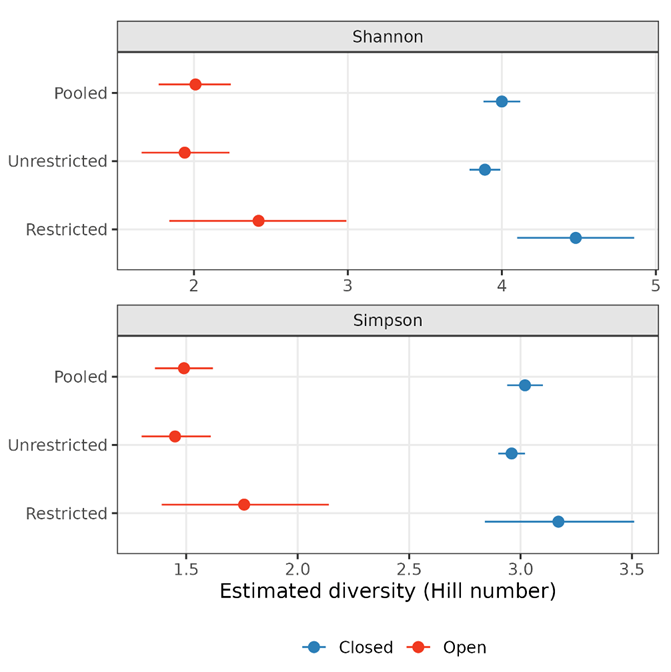
Fig.
S1. Estimated
Shannon (top) and Simpson (bottom) diversity of the nocturnal mammal community
under daily closure (Closed vs. Open), for the pooled dataset and separately
within each COVID-19 restriction period. Points show asymptotic diversity
estimates with 95% confidence intervals from 50 bootstrap replicates (Chao et
al., 2020).
TABLE S1
Species-specific effects of weekly closure on nighttime detection rates. For each of the eight nocturnal species with sufficient nighttime detections (N ≥ 10), negative binomial generalized linear mixed models were fit with detection count per camera as the response variable, weekday (Tuesday vs. non-Tuesday) and COVID-19 restriction period as fixed effects, camera identity as a random intercept, and an offset for camera-days effort. N total = total nighttime detections across all cameras and periods; coef_weekday = model coefficient for Tuesday relative to non-Tuesday (log scale; negative values indicate lower activity on Tuesday nights); p_weekday = significance of the weekday effect; p_Covid = significance of the COVID-19 restriction period effect; p_interaccion = significance of the weekday × COVID-19 period interaction (tested via likelihood-ratio test against the main-effects model). Cabassous centralis (N = 8) and Coendou mexicanus (N = 2) were excluded due to insufficient nighttime detections. No species showed a significant effect of weekday on nighttime detection rate (all P > 0,14).
|
Species |
N total |
p_weekday |
coef_weekday |
p_Covid |
p_interaccion |
|
Conepatus semistriatus |
183 |
0,91 |
-0,03 |
0,18 |
0,38 |
|
Cuniculus paca |
1 934 |
0,67 |
-0,07 |
0,15 |
0,12 |
|
Dasypus novemcinctus |
252 |
0,77 |
0,08 |
0,01 |
0,12 |
|
Didelphis marsupialis |
168 |
0,48 |
-0,22 |
< 0,001 |
0,47 |
|
Philander opossum |
164 |
0,39 |
0,18 |
< 0,001 |
NA |
|
Procyon lotor |
1 883 |
0,15 |
-0,11 |
< 0,001 |
0,23 |
|
Tamandua mexicana |
128 |
0,37 |
-0,31 |
0,9 |
0,29 |
|
Puma concolor |
22 |
0,55 |
-0,54 |
0,7 |
0,46 |