|
|


COMMUNICATION
Natalia Guillén-Benavides 1,2 , Verónica
Valverde-Cantillo 3 & Diego Fallas-Madrigal 1,3,4
, Verónica
Valverde-Cantillo 3 & Diego Fallas-Madrigal 1,3,4
1. Oceanic Alliance, Aserrí, San José, Costa Rica; nathaliaguillen16@gmail.com, diegofallasmadrigal@gmail.com
2. Universidad Nacional de Costa Rica, Escuela de Ciencias Biológicas, Heredia, Costa Rica.
3. Asociación Equipo Tora Carey para la conservación de la biodiversidad de Punta Descartes, El Jobo, Guanacaste, Costa Rica; verovalcan@gmail.com
4. Universidad de Costa Rica, Museo de Zoología / Centro de Investigación en Biodiversidad y Ecología Tropical, and Posgrado en Biología, 11501-2060, San José, Costa Rica.
Received 10-VI-2026 ● Corrected 21-VIII-2026 ● Accepted 30-IX-2026
DOI: https://doi.org/10.22458/urj.v18i1.6639
ABSTRACT. Introduction: Elasmobranchs are particularly susceptible to handling-related impacts, making careful management essential to avoid excessive physical trauma and stress. In pregnant females, capture may trigger induced parturition, which is generally considered abortion because survival rates have not been evaluated. Objective: To document and describe capture-induced parturition events in rays and their implications for the protocols used during monitoring efforts. Methods: In 2022 and 2024, we documented three cases of capture-induced parturition involving three ray species in El Jobo, Pacific of Costa Rica. We captured pregnant females using hand nets while snorkeling and transported them to shore to record morphological data before subsequently releasing them. Results: We recorded three capture-induced parturition events, in Urobatis pardalis, Urotrygon rogersi, and Gymnura crebripunctata. Pup size suggested that all females were in the final stage of gestation. Unlike most previous reports, we released all females and pups in apparently good condition, representing rarely documented cases in which both mothers and premature pups survived following stress-related parturition. Conclusion: These findings suggest that rapid release combined with minimal handling procedures may improve the likelihood of survival for premature pups at certain stages of gestational development.
Keywords: batoids, Central America, conservation, monitoring protocols, premature birth, stress response.
RESUMEN. “Parto inducido por la captura en tres especies de rayas: supervivencia materna y de las crías, e implicaciones prácticas para su manipulación”. Introducción: los elasmobranquios son particularmente susceptibles a impactos por manipulación, por lo que su manejo implica tener un gran cuidado para evitar un exceso de trauma físico y estrés. En hembras grávidas, su captura puede desencadenar partos inducidos, considerados como abortos, ya que la tasa de supervivencia no ha sido evaluada. Objetivo: documentar y describir los eventos de partos inducidos en rayas y sus implicaciones para los protocolos utilizados durante esfuerzos de monitoreo. Métodos: en 2022 y 2024, documentamos tres casos de partos inducidos por captura en tres especies de rayas en El Jobo, Pacífico de Costa Rica. Capturamos hembras preñadas con redes de mano mediante esnórquel, las cuales trasladamos a la costa para registrar datos morfológicos y ser liberadas posteriormente. Resultados: registramos tres eventos de partos inducidos por captura en Urobatis pardalis, Urotrygon rogersi y en Gymnura crebripunctata. El tamaño de las crías sugiere que todas se encontraban en la última etapa de su desarrollo gestacional. A diferencia de la mayoría de los registros previos, liberamos todas las hembras y crías en aparente buena condición, representando casos raramente documentados en los que tanto las hembras como las crías prematuras sobreviven después de un parto asociado al estrés. Conclusión: estos hallazgos sugieren que la liberación rápida junto con un procedimiento de manipulación mínima podría mejorar la probabilidad de supervivencia de crías prematuras en determinadas etapas del desarrollo gestacional.
Palabras clave: batoideos, América Central, conservación, protocolos de monitoreo, parto prematuro, respuesta al estrés.
The manipulation of elasmobranchs (sharks, rays and skates) for scientific purposes, especially when they are removed from their natural habitats, implies great care to avoid excess of physical trauma and stress (Marshall, 2004). Elasmobranchs are particularly susceptible to handling-related impacts and can display physiological stress as a response to noxious stimuli (Rose, 2002; Smith et al., 2004; Stamper, 2004). For example, one documented response of pregnant females to capture-related stress is capture-induced parturition (Adams et al., 2018). Early births can severely compromise the survival of the offspring, as they are often underdeveloped and smaller in size, making them less likely to survive (Adams et al., 2018).
Capture-induced parturition has been proposed as the appropriate term for premature birth or abortion of the offspring triggered by capture (Adams et al., 2018). However, although some near-term offspring may be born alive, capture-induced parturition events have been suggested to be treated as abortions until post-parturition mortality can be estimated, following a precautionary approach (Adams et al., 2018; Lauck et al., 1998). The frequency and impacts of capture-induced parturition and capture-induced abortion in elasmobranchs remain unclear, and despite that these events are not a novel phenomenon, they have not been thoroughly studied or quantified (Adams et al., 2018; Wosnick et al., 2018). For instance, Orrell et al. (2025) exhaustively reviewed the varied current methods, best practices and recommendations for ray and skates research, but did not integrate protocols on how to handle gravid females or pre-term parturition events. Thus, an assessment of the survival of near-term embryos birth under capture-induced parturition in elasmobranchs is needed (Adams et al., 2018). The survival rate of the offspring could be expected to be higher as the larger the size of the offspring (i.e., more complete development), however, information about birth is still lacking for several elasmobranch species to be used as a point of reference.
Recent studies estimate that one-third of sharks and ray species are at risk of extinction (Dulvy et al., 2021). In Costa Rica, where ecological knowledge of elasmobranchs remains limited (Espinoza et al., 2020), 93 species have been confirmed to occur in the country, of which nearly half were classified as Data Deficient in 2018 (Espinoza et al., 2018). In El Jobo, a small fishing town located in the northernmost peninsula of the Pacific coast of Costa Rica (11,016034, -85,725141) (Fig. 1), rays are not directly targeted by fisheries; however partial carcasses or rostra are occasionally found along Manzanillo Beach (11,007724, 2-85,732562), where fishing boats are docked. El Jobo is a region known to be influenced by upwelling events (Cortés, 2016; Fiedler, 2002) and harbors a diverse assemblage of batoids (rays and skates) with 20 species (Equipo Tora Carey, El Jobo, unpubl. data). Preliminary data also shows that in El Jobo pregnant and non-pregnant rays (e.g. Urobatis pardalis, Urotrygon asterias, U. rogersi, U. cimar, and Gymnura crebripunctata) can be found year-round (Equipo Tora Carey, El Jobo, personal communication); highlighting the need for further studies in the area. Specifically, the recurrent occurrence of neonates and young-of-the-year individuals raises the question of whether El Jobo could be serving as a residence and nursery area for different ray species.
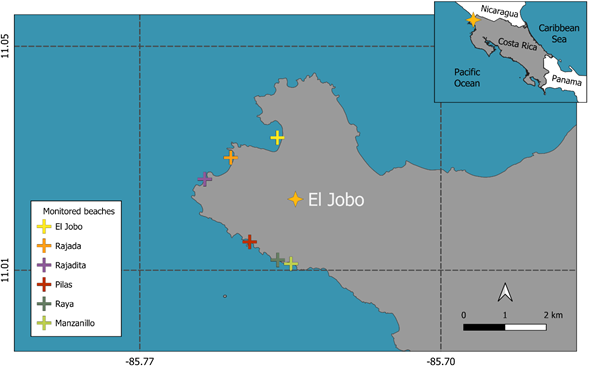
Fig. 1. Monitored beaches at El Jobo, northern Pacific of Costa Rica.
Since 2018, with the exception of 2020 due to the COVID-19 pandemic, we have conducted weekly local monitoring in El Jobo to estimate the species diversity, abundance, size and sex ratios. We follow a complete protocol, starting by capturing rays with hand nets while snorkeling (e.g. Davy et al., 2015; Orrell et al., 2025; Rosa et al., 2010). The hand nets are ~80cm long, with an opening diameter of ~40cm. After capture, we transport each ray immediately to the shore, taking roughly ~5min depending on the distance from the capture site. We then place the rays in plastic containers with fresh seawater under shaded conditions. We identify all individuals by species and sex, and collect morphometric data (disc width, disc length, total length, clasper size for males, and weight). We do not use internal or external tags. We also take complementary photos of the complete body of each individual to construct a repository of pictures of all manipulated individuals. When we observe signs of stress (e.g. rapid or low-rate breathing, or exhibiting agitated swimming), we do not take measurements in situ. We limit handling time to a maximum of ~10min per individual, and once we complete data collection, we promptly release the rays back into the water. Additionally, when we need ex situ measurements, we use the ImageJ software (Rasband, 2012) and the photographs to estimate the Disc Width (DW). We perform each ex situ measurement three times and estimate the average between measurements (TABLE 1).
From these monitoring events, we documented three capture-induced parturition events in three species of rays in Manzanillo Beach. The first parturition event occurred in the leopard round ray Urobatis pardalis Del Moral-Flores, Angulo, Lopez & Bussing 2015 on October 14th, 2022 (Fig. 2a), resulting in two pre-term pups. Following, on March 2nd, 2024, we documented two parturition events, one in a Roger’s round ray Urotrygon rogersi Jordan & Starks, 1895 (Fig. 2b, c) and other in the Mazatlán butterfly ray Gymnura crebripunctata Peters 1869 (Fig. 2d), with two and four pre-term pups respectively. All parturition events occurred on shore during the manipulation of the mothers.
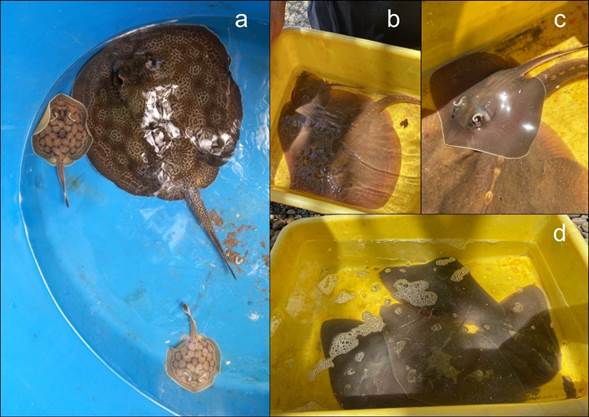
Fig. 2. Capture-induced parturition events documented for three species of rays in El Jobo, Guanacaste. (a) Urobatis pardalis; (b, c) Urotrygon rogersi; (d) Gymnura crebripunctata.
The Disc Width size for the U. pardalis mother was 22,3cm, whereas for U. rogersi was 28,5cm. Size estimation for the G. crebripunctata mother could not be obtained since no photographic evidence was taken. Unlike most reports in which offspring subsequently died (e.g. Adams et al., 2018; Garrone-Neto, 2010), following Benoît et al. (2010) and Davis (2010) we observed all pups and mothers in apparent good condition. Shortly after birth, we released all mothers and pups close to where the mothers were captured.
TABLE 1
Summary of average size DW for each pre-term pup that we measured ex situ, additional minimum size that we reported during other monitoring events, and lower size reported in literature if available.
|
Common name |
Scientific name |
Average Disc Width measured ex situ (cm) |
Minimum Disc Width recorded during other monitoring events (cm) |
Smallest Disc Width reported in the literature (cm) |
Reference |
|
Leopard round ray |
Urobatis pardalis |
6,7 |
9,5 |
NA* |
Del Moral-Flores et al. (2015) |
|
Roger’s round ray |
Urotrygon rogersi |
9,0 |
10 |
7,5 |
Mejía‐Falla et al. (2012) |
|
Mazatlan butterfly ray |
Gymnura crebripunctata |
30,0 |
17,5 |
29 |
Smith et al. (2009) |
|
Gymnura crebripunctata |
22,9 |
* NA: value corresponds to embryos
Until more evidence is available, we suggest that the sizes reported here may serve as preliminary reference values from cases in which pre-term pups were born alive following capture-induced parturition (TABLE 1), while emphasizing the importance of prompt release and minimal handling when similar events occur (Orrell et al., 2025). Our observations also support the distinction proposed by Adams et al. (2018) between capture-induced parturition and capture-induced abortion, as the latter may not adequately describe cases in which near-term pups are born alive. However, in the case of G. crebripunctata, the size of natural birth (i.e. no human interaction) could be even lower, since in previous monitoring events a smaller ray was captured (TABLE 1). In the case of U. rogersi, the lower size at birth has been reported to be 7,5 and 8,2cm for females and males, respectively (TABLE 1) (Mejía‐Falla et al., 2012). For U. pardalis the smallest DW reported has been 5cm (Del Moral-Flores et al., 2015); however, these measurements came from embryos with no mention if they were given to birth.
In the case of U. pardalis and U. rogersi pre-term pups had cartilage horn-like structures in the upper margin of the spiracles due to incomplete gestation. For the Haller’s round ray Urobatis halleri (Cooper, 1863), these horn-like structures have been described by Babel (1966) to be found in fetuses on the middle of the gestation (about 45 days). These structures become elongated and free at their posterior tip at two months, reaching their greatest proportion at full term, and are reabsorbed after parturition. In this sense, with the sizes and these horn-like structures, it is likely that the pre-term pups of U. pardalis and U. rogersi could have been almost in the final stages of their gestational development.
Considering the nature of this report, we provide observations of living near-term pups following capture-induced parturition, including information on their size and developmental condition at release. Although all pups were alive and in apparent good condition when released, further studies using individual tagging or tracking are needed to determine their survival after release, and whether developmental stage or body size influences survival following capture-induced parturition. Since most of the reports of capture-induced parturition events for shark and rays come from direct or incidental fishing (Adams et al., 2018), relatively little is known about the influence of stress in these capture-induced birth events. Future studies could combine assessments of maternal physiological stress, including hormonal responses (Guida et al., 2017), with direct evaluation of pup condition and post-release condition.
Given that capture-induced parturition events are more frequent in rays with larger size due to the high maternal investment (Guida et al., 2017), monitoring protocols should include alternative procedures to reduce stress in pregnant females that cannot be released promptly. To reduce the time females and pups are exposed to stress, photographs with size scales could be used for subsequent size estimation as done here, or to evaluate other individual aspects ex situ. For example, pictures taken during our monitoring efforts have served to document possible cases of anophthalmia (i.e. total or partial absence of eyes) or ocular affections (Argüello-Rojas et al., 2026b), other body malformations (Equipo Tora Carey, El Jobo, unpubl. data), and colour abnormalities (Argüello-Rojas et al., 2026a). Furthermore, these pictures allow us to assess the use of Photo-ID as an analog, non-invasive tagging technique (Argüello-Rojas et al., 2026a; Fallas-Madrigal et al., 2021; McIvor et al., 2024). Ultimately, advancing our understanding of capture-induced parturition in elasmobranchs will not only enhance animal welfare practices but also contribute significantly to the refinement of management strategies for this vulnerable group.
ACKNOWLEDGMENTS
We thank Randall Mora and Mathilde Giry for field work support, and Christopher G. Lowe, Luis Adrián Vega Corrales and Arturo Angulo for providing scientific support. We thank the entire team of Equipo Tora Carey for leading conservation and research work in their community. We thank Roger Blanco from Área de Conservación Guanacaste (ACG), from Sistema Nacional de Áreas de Conservación (SINAC) for providing the necessary research permits to handle wildlife.
ETHICS, CONFLICT OF INTEREST, AND FUNDING STATEMENT
The authors declare that they have fully complied with all pertinent ethical and legal requirements, both during the study and in the production of the manuscript; that there are no conflicts of interest of any kind; and that they fully agree with the final edited version of the article. A signed document has been filed in the journal archives. The statement of each author’s contribution to the manuscript is as follows: D.F-M.: Conceptualization. V.V.-C, D.F-M.: Data generation. N.G-B., D.F-M.: data analysis. N.G-B., D.F-M.: manuscript preparation. N.G-B., V.V., D.F-M.: Final writing.
REFERENCES
Adams, K. R., Fetterplace, L.C., Davis, A. R., Taylor, M. D. & Knott, N. A. (2018). Sharks, rays and abortion: the prevalence of capture-induced parturition in elasmobranchs. Biological Conservation, 217, 11–27. https://doi.org/10.1016/j.biocon.2017.10.010
Argüello-Rojas, S. Angulo, A., Valverde-Cantillo, V. & Fallas-Madrigal, D. (2026a). Pigmentation abnormality in the blotched round ray Urotrygon asterias (Myliobatiformes: Urotrygonidae): first case of partial xanthism within the family. Revista de Biología Tropical, 74(Suppl. 2) https://doi.org/10.15517/nv81th80
Argüello-Rojas, S., Fallas-Murillo, M., Méndez-Porras, E. E., Angulo-Salcedo, J. D., Valverde-Cantillo, V. & Fallas-Madrigal, D. (2026b). High incidence of anophthalmia in rays from the north Pacific of Costa Rica. [Conference presentation]. Sharks International 2026, Colombo, Sri Lanka.
Babel, J. S. (1966). Reproduction, life history, and ecology of the round stingray, Urolophus halleri Cooper (Fish Bulletin No. 137). State of California, Department of Fish and Game.
Benoît, H. P., Hurlbut, T. & Chassé, J. (2010). Assessing the factors influencing discard mortality of demersal fishes using a semi-quantitative indicator of survival potential. Fisheries Research, 106(3), 436–447. https://doi.org/10.1016/j.fishres.2010.09.018
Cortés, J. (2016). The Pacific coastal and marine ecosystems. In M. Kappelle (Ed.) Costa Rican ecosystems (97– 138). University of Chicago Press.
Davis, M. W. (2010). Fish stress and mortality can be predicted using reflex impairment. Fish and Fisheries, 11(1), 1–11. https://doi.org/10.1111/j.1467-2979.2009.00331.x
Davy, L. E., Simpfendorfer, C. A. & Heupel, M. R. (2015). Movement patterns and habitat use of juvenile mangrove whiprays (Himantura granulata). Marine and Freshwater Research, 66(6), 481–492. https://doi.org/10.1071/MF14028
Del Moral-Flores, L. F., Angulo, A., López, M. I. & Bussing, W. A. (2015). A new species of Urobatis (Myliobatiformes: Urotrygonidae) from the tropical Eastern Pacific. Revista de Biología Tropical, 63(2), 501–514. https://doi.org/10.15517/rbt.v63i2.15746
Dulvy, N. K., Pacoureau, N., Rigby, C. L., Pollom, R. A., Jabado, R. W., Ebert, D. A., Finucci, B., Pollock, C. M., Cheok, J., Derrick, D. H., Herman, K. B., Sherman, C. S., VanderWright, W. J., Lawson, J. M., Walls, R. H. L., Carlson, J. K., Charvet, P., Bineesh, K. K., Fernando, D.,… Simpfendorfer, C. A. (2021). Overfishing drives over one-third of all sharks and rays toward a global extinction crisis. Current Biology, 31(21), 4773-4787. https://doi.org/10.1016/j.cub.2021.08.062
Espinoza, M., Araya-Arce, T., Chaves-Zamora, I., Chinchilla, I. & Cambra, M. (2020). Monitoring elasmobranch assemblages in a data-poor country from the Eastern Tropical Pacific using baited remote underwater video stations. Scientific Reports, 10(1), 17175. https://doi.org/10.1038/s41598-020-74282-8
Espinoza, M., Díaz, E., Angulo, A., Hernández, S. & Clarke, T. M. (2018). Chondrichthyan diversity, conservation status, and management challenges in Costa Rica. Frontiers in Marine Science, 5, 85. https://doi.org/10.3389/fmars.2018.00085
Fallas-Madrigal, D., Castelo-Corona, A., Mejías, D., Stephens-Cárdenas, S., Astorga-Arias, J., Molina-Quirós, J. L. & Hernández, S. (2021). Diversity of white spot patterns in the eagle ray Aetobatus laticeps (Myliobatiformes: Aetobatidae) in the north Pacific coast of Costa Rica. Revista de Biología Tropical, 69(Suppl. 2), 267–276. https://doi.org/10.15517/rbt.v69iSuppl.2.48323
Fiedler, P. C. (2002). The annual cycle and biological effects of the Costa Rica Dome. Deep Sea Research Part I: Oceanographic Research Papers, 49(2), 321-338. https://doi.org/10.1016/S0967-0637(01)00057-7
Garrone-Neto, D. (2010). Considerações sobre a reprodução de duas espécies de raias (Myliobatiformes, Potamotrygonidae) na região do Alto Rio Paraná, Sudeste do Brasil. Pan-American Journal of Aquatic Sciences, 5(1), 101–111.
Guida, L., Awruch, C., Walker, T. I. & Reina, R. D. (2017). Prenatal stress from trawl capture affects mothers and neonates: a case study using the southern fiddler ray (Trygonorrhina dumerilii). Scientific Reports, 7, 1–10. https://doi.org/10.1038/srep46300
Lauck, T., Clark, C. W., Mangel, M. & Munro, G. R. (1998). Implementing the precautionary principle in fisheries management through marine reserves. Ecological Applications, 8(1), S72-S78. https://doi.org/10.1890/1051-0761(1998)8[S72:ITPPIF]2.0.CO;2
Marshall, A. (2004). Elasmobranch capture techniques and equipment. In M. Smith, D. Warmolts, D. Thoney, & R, Hueter (Eds.), The elasmobranch husbandry manual: captive care of sharks, rays and their relatives (pp. 89–103). Ohio Biological Survey.
McIvor, A. J., Williams, C. T., Rich, W. A., Knochel, A. M., Burns, N. M. & Berumen, M. L. (2024). Mark-recapture validates the use of photo-identification for the widely distributed blue-spotted ribbontail ray, Taeniura lymma. Scientific Reports, 14(1), 17432. https://doi.org/10.1038/s41598-024-68302-0
Mejía‐Falla, P. A., Navia, A. F. & Cortés, E. (2012). Reproductive variables of Urotrygon rogersi (Batoidea: Urotrygonidae): a species with a triannual reproductive cycle in the eastern tropical Pacific Ocean. Journal of Fish Biology, 80(5), 1246–1266. https://doi.org/10.1111/j.1095-8649.2012.03237.x
Orrell, D. L., Andrzejaczek, S., Armstrong, A. O., Barbosa Martins, A., Branco, I., Charvet, P., Chin, A., Elston, C., Espinoza, E., Greenway, E. S. I., McCully Phillips, S. R., Mickle, M. F., Murray, T. S., Silva, J. F., Thorburn, J. & Wosnick, N. (2025). Current methods and best practice recommendations for skate and ray (Batoidea) research: capture, handling, anaesthesia, euthanasia, and tag attachment. Reviews in Fish Biology and Fisheries, 35(1), 117–144. https://doi.org/10.1007/s11160-024-09918-3
Rasband, W. S. (2012). ImageJ: Image processing and analysis in Java. Astrophysics source code library, ascl-1206.
Rosa, R. S., Charvet-Almeida, P. & Quijada, C. C. D. (2010). Biology of the South American potamotrygonid stingrays. In Sharks and their relatives II, (pp. 257–298). CRC Press.
Rose J. D. (2002). The neurobehavioral nature of fishes and the question of awareness and pain. Reviews in Fisheries Science, 10(1), 1–38. https://doi.org/10.1080/20026491051668
Smith, M. F., Marshall, A., Correia, J. P. & Rupp, J. (2004). Elasmobranch transport techniques and equipment. Elasmobranch husbandry manual: captive care of sharks, rays, and their relatives (pp. 105–132). Ohio Biological Survey.
Smith, W. D., Bizzarro, J. J., Richards, V. P., Nielsen, J., Márquez‐Flarías, F. & Shivji, M. S. (2009). Morphometric convergence and molecular divergence: the taxonomic status and evolutionary history of Gymnura crebripunctata and Gymnura marmorata in the eastern Pacific Ocean. Journal of Fish Biology, 75(4), 761–783. https://doi.org/10.1111/j.1095-8649.2009.02300.x
Stamper, M. A. (2004). Immobilization of elasmobranchs. In M. Smith, D. Warmolts, D. Thoney, & R. Hueter (Eds.), The Elasmobranch Husbandry Manual: Captive Care of Sharks, Rays and their Relatives (pp. 281–296). Ohio Biological Survey.
Wosnick, N., Awruch, C. A., Adams, K. R., Guitierre, S. M., Bornatowski, H., Prado, A. C. & Freire, C. A. (2018). Impacts of fisheries on elasmobranch reproduction: high rates of abortion and subsequent maternal mortality in the shortnose guitarfish. Animal Conservation, 22(2), 198—206. https://doi.org/10.1111/acv.12458